In 1993, 3 Friends Met At Denny’s To Talk About Making A Chip That Would Allow Computers To Create Realistic 3D Graphics. By The Mid-1990s, The Company Was Weeks From Running Out Of Cash. Today Nvidia Is Worth Nearly $5 Trillion
Three engineers hatched a plan at a Denny's booth in East San Jose, then watched their first product come back in nearly every box shipped. What kept the company alive long enough to become the most important chip business on…

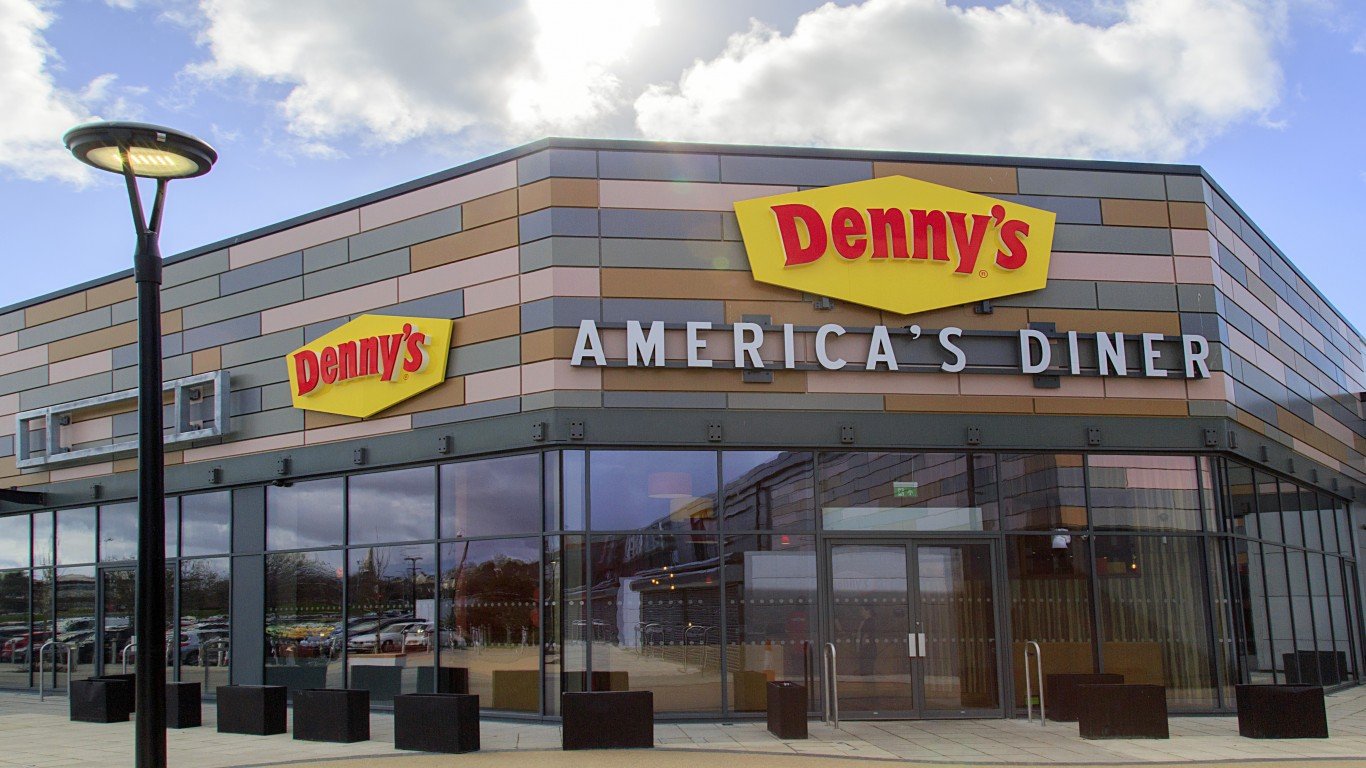
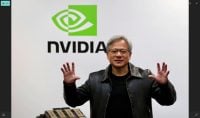
Although Wall Street now values NVIDIA (NASDAQ:NVDA | NVDA Price Prediction) at $4.94 trillion, the company started with three engineers and a diner menu. Per NVIDIA’s own blog, in 1993 three friends, Jensen Huang, Chris Malachowsky and Curtis Priem, met at Denny’s to talk about a chip that would bring realistic 3D graphics to personal computers. Speaking on Sequoia Capital’s Crucible Moments podcast, Huang placed the booth “right at the corner of Capitol and Berryessa, this place in East San Jose.” But within a few years, the startup that now anchors the technology-packed Nasdaq Composite was weeks from running out of cash.
A Birthday Start and a Chip That Came Back
On the same podcast, Huang said his first day of work was “February 17th, my birthday in 1993.” He added, “You know, I was 29, I had just turned 30.” The founders’ first product, the NV1, reached retailers and then came straight back. Huang described the damage on Sequoia’s podcast: “250,000 units went out. 250,000, well, 249,000 came back. And, practically put us out of business.” For a young chipmaker paying engineers out of venture money, a return rate like that could easily have ended the company before its second product shipped.
Thirty Days From Going Out of Business
Huang has since turned that close call into a management philosophy. Fortune reported on his Dec. 4, 2025 appearance on The Joe Rogan Experience, where he said: “You know the phrase ’30 days from going out of business,’ I’ve used for 33 years.” On the Sequoia podcast, former Sequoia partner Mark Stevens remembered Huang saying “We’re only 30 days away from going outta’ business,” and added that “on a few occasions in the mid-nineties, that was true.” The Next Web, citing Tom’s Hardware, reports that by the mid-1990s the startup had about 30 days of cash left. Huang has told versions of this story for years, including when he said NVIDIA was at the “top of the list not to make it.”
Sega’s Check Bought Six More Months
Sega, the Japanese video game company, kept the lights on. Huang remembered the rescue with his own hedge intact: “But in this particular case, it was some 5 million dollars, I think it was, that they continued to pay us. It was all the money that we had.” In a July 15, 2026 piece, The Next Web describes the money as a $5m investment in 1995 that bought NVIDIA roughly six more months. That is a short runway for any hardware company, and NVIDIA had to make it count.
RIVA 128 Saved the Company and Opened the Door to an IPO
According to The Next Web, NVIDIA put that time into the RIVA 128, which shipped in 1997 and sold one million units in four months. Huang put it simply: “Yeah, we saved the company.” NVIDIA went public in January 1999, and The Next Web reports that Sega later sold its stake for about $15m. From there, the company stacked one platform shift on another: CUDA in 2006, the 2012 AlexNet deep learning success on NVIDIA GPUs, several crypto cycles and today’s AI infrastructure expansion. Market commentator Josh Brown summed up the software advantage: “CUDA far predates AI, but CUDA is the thing that every professional in the field has standardized on.”
From a $5 Million Lifeline to a $4.94 Trillion Valuation
As of Oct. 30, 2026, NVIDIA’s market value stood at $4.94 trillion, just behind Apple (NASDAQ:AAPL) at $5.03 trillion, a gap of $88 billion. Microsoft (NASDAQ:MSFT) came next at $3.88 trillion. Apple holds a narrow lead, and the order can flip from one trading day to the next. In its most recent quarter, NVIDIA’s revenue rose to $96.22 billion, up 105.85% year over year, and Data Center contributed $89.02 billion. The company that once had about a month of cash now reports supply obligations of $279.00 billion, mostly memory for Vera Rubin.

The shares trade at about 43 times trailing earnings and 53 times free cash flow. On a split-adjusted basis, the stock rose from $1.69 on Nov. 1, 2016 to $204.97, a ten-year gain of 11999.18%, though it has slipped 10.25% over the past month. Critics have questioned NVIDIA’s investments in its own customers, and Huang addressed that on the August call: “We recognize the scale of this support, and we know some will call this circular financing. We see it differently.”

What NVIDIA’s Near-Death Years Teach Investors
Huang told Fortune that success has left the fear intact: “But the feeling doesn’t change. The sense of vulnerability, the sense of uncertainty, the sense of insecurity, it doesn’t leave you.” He also said, “I have a greater drive from not wanting to fail than the drive of wanting to succeed.” Even the market’s biggest winners were once weeks from failing. Early backers who cashed out, like Sega with its roughly $15m exit, missed most of what came after (we reverse-engineered the early traits that showed up in the biggest tech winners long before the headlines in a free Next Nvidia playbook). Over long periods, Wall Street has usually rewarded companies that survive their near-death years, but surviving once does nothing to guarantee future returns. Next, I’m watching whether NVIDIA lands near its fiscal third-quarter revenue guidance of $108.0 billion, plus or minus 2%. That figure leaves out any Data Center compute revenue from China.
Contact [email protected] for any questions or corrections.
AJ spent 10 years writing about financial markets at The Motley Fool. His coverage centers on technology stocks and the broader macroeconomic trends, from interest rates to geopolitics, that shape where markets are headed next. AJ is drawn to the stories where big-picture economics and individual companies collide.