U.S. Companies Now Pay Palantir More Than the U.S. Government for the First Time
For the first time in Palantir's history, a single earnings line flipped the company's revenue mix upside down, and it signals something much bigger about where AI spending is heading.

Palantir (NASDAQ:PLTR | PLTR Price Prediction) reported third-quarter results on November 2, 2026, and one line in the release changed how the company makes its money. U.S. commercial revenue reached $984 million, which put it ahead of U.S. government revenue of $953 million for the first time in Palantir’s history.
Here, revenue means what Palantir recognized, which can differ from cash it collected. The gap was only $31 million. A year earlier, government revenue of about $486 million led commercial by around $89 million, so the order switched within four quarters.
Total revenue rose 96% to $2.313 billion, the first quarter above $2 billion, and guidance topped estimates. Bookings, however, cooled sharply.
The stock fell 3.13% in the regular session before the report and closed at $178.34. In extended trading, it fell to $173.02, down 2.98%, as of 7:59 p.m. ET.

Why Commercial Customers Leading Matters
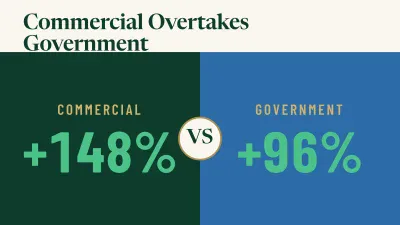
Government revenue still grew 96% from a year earlier and 18% from the prior quarter. Commercial grew faster, at 148% and 29%.
CFO Dave Glazer called it “a critical milestone in the history of our company” on the call. He said U.S. commercial revenue was $397 million a year earlier, so it rose $587 million in one year.
The shift matters because companies can raise spending faster than government budgets move through Congress. U.S. commercial customers rose 29% to 686. Net dollar retention hit 165%, which means existing customers are spending far more than they did a year ago.
A Growth Engine Built in America
Total U.S. revenue grew 119% to $1.937 billion. International commercial revenue rose just 21% to $184 million, and international government revenue grew 31% to $192 million. That leaves Palantir tied closely to U.S. corporate budgets and defense policy; if either cools, overseas sales cannot make up the difference.
Palantir forecasts fourth-quarter revenue of $2.649 billion to $2.653 billion. The average analyst estimate was $2.46 billion.
Full-year guidance rose to $8.530 billion to $8.534 billion. The company expects 2026 U.S. commercial revenue above $3.559 billion, which would be growth of at least 143%.
Bookings Slowed While Revenue Sped Up
Total contract value (TCV), the lifetime value of deals signed during the quarter, rose only 6% to $2.918 billion. U.S. commercial TCV grew 11% to $1.463 billion, after more than 153% growth in the prior quarter.
William Blair analysts said some investors could be disappointed with those bookings. Glazer said several eight-figure deals carried shorter terms than usual as customers adopted early sovereign AI tools, and he expects contracts to get longer and larger. Shorter terms lower TCV automatically, but for now his explanation remains a forecast.
Total remaining deal value, meaning unbilled value on all active contracts, reached $13.4 billion, up 55% from a year earlier but just 2% from the prior quarter. U.S. commercial remaining deal value rose 79% to $6.517 billion.
Remaining performance obligations, the narrower measure of contracted revenue Palantir has not yet recognized, were $4.9 billion, up 88% from a year earlier but flat from the prior quarter. Over the past 12 months, U.S. commercial TCV totaled $6.114 billion, up 62%.

What Palantir’s Valuation Demands From Here
Palantir is worth about $410.3 billion and trades at around 85 times forward earnings. Its 52-week range runs from $106.37 to $212.94, and that multiple only holds up if commercial growth stays very high for years.
Karp said in the release that sovereign AI is creating “the most dramatic dichotomy between haves and have nots that I have witnessed in 30 years of business.” Holding that multiple requires Palantir to stay among the haves.
The results lean positive. Fourth-quarter guidance stands well above the analyst estimate, and existing customers are spending heavily, yet the stock is up only 0.33% year to date even as revenue nearly doubled.
The fourth-quarter report will test that view. If remaining performance obligations are still stuck near $4.9 billion and U.S. commercial TCV growth is again at or below 11%, the shorter-contract explanation has failed, and the bullish case weakens considerably.
Contact [email protected] for any questions or corrections.
Omor Ibne Ehsan is a writer at 24/7 Wall St. He is a self-taught investor with a focus on growth, cyclical, and dividend equities that have strong fundamentals, value, and long-term potential. He also has an interest in high-risk, high-reward investments such as penny stocks.