Fastenal Stock Is Up 35% in 2026. Is Its Dividend Still Worth Buying?
Fastenal's shares have surged, and the yield has shrunk along with it. Retirees counting on that quarterly check should look at what the payout depends on, and at one slowdown in factory orders that deserves a close watch.

This post may contain links from our sponsors and affiliates, and Flywheel Publishing may receive compensation for actions taken through them.

Fastenal (NASDAQ:FAST | FAST Price Prediction) raised its quarterly dividend to $0.26 this summer, up from $0.24 earlier in 2026. The next payment comes November 25, 2026. The stock has gained 34.89% year to date to $52.99, so the $1.04 annualized payout now yields about 1.96%. For investors at or near retirement, that leaves one question: how safe is the cash behind each check?

Who Buys Fastenal’s Bolts, Gloves and Cutting Tools
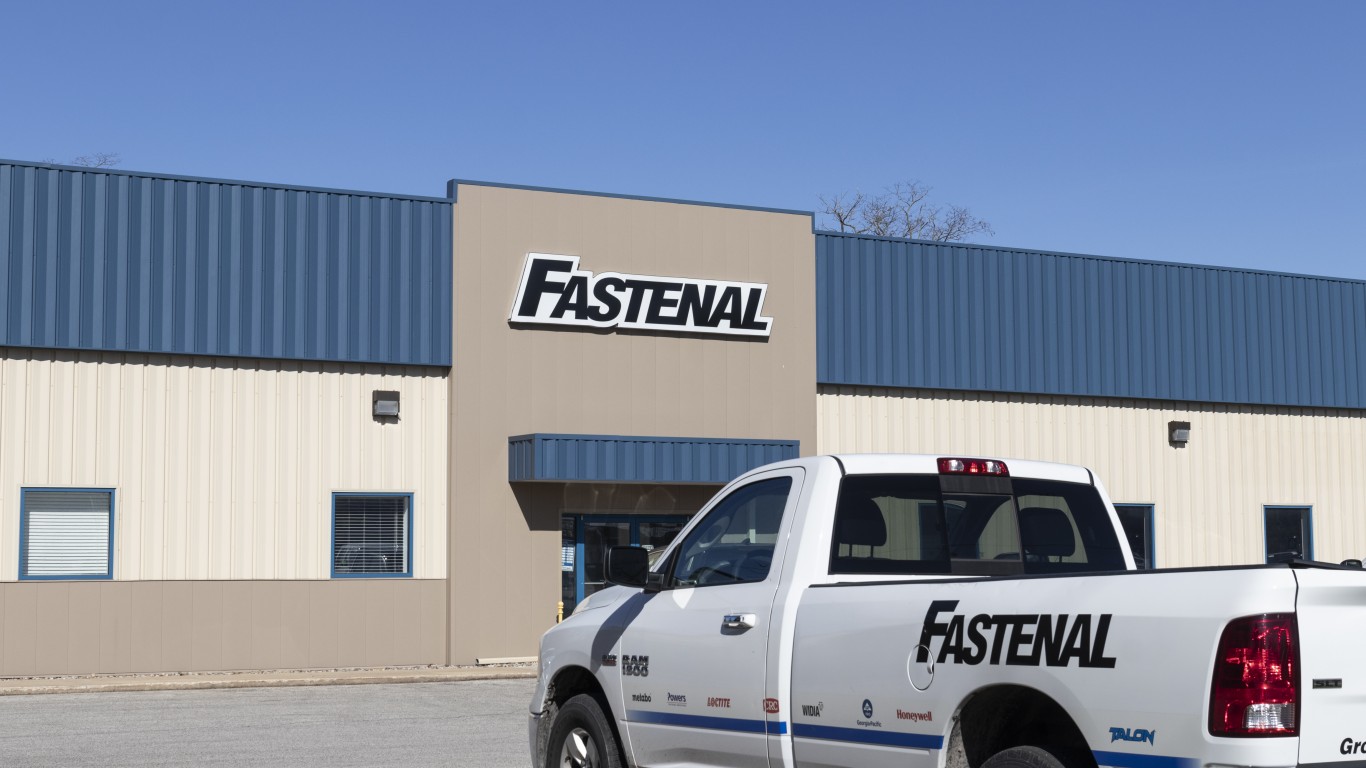
Fastenal sells fasteners, safety supplies, cutting tools, and other industrial parts to manufacturers, nonresidential builders, government agencies, and transportation fleets. Much of that product sits inside customer plants, either at Onsite locations or in FASTBin and FASTVend devices. The installed base reached 143,878 weighted devices in Q3. Contract customers now generate 76.5% of revenue, up from 73.8% a year ago. Chief Executive Jeffery Watts explained why that kind of embedded business tends to stick:
“New customer wins create embedded spend, technology deepens those relationships, and our scale allows us to grow profitably while continuing to invest.”
Cash Coverage Behind Every Quarterly Check
Q3 revenue rose 15.5% to $2.46 billion, and EPS of $0.35 beat the $0.34 consensus. Free cash flow was about $350 million, or 87% of net income. Dividends of $298.2 million used roughly 85.2% of that free cash flow, and buybacks added another $30.5 million. In 2025, dividends of $1,004.2 million equaled 79.8% of net income. Chief Financial Officer Max Tunnicliff described the formula:

“Our approach to capital is unchanged. We invest in the business where we see strong returns, return excess cash to shareholders, and keep a conservative balance sheet.”
The buffer is getting thinner. Fastenal guides 2026 capex to $310 million to $330 million, up from $230.6 million in 2025, to fund a new Atlanta hub, trucks, and IT.
How Grainger and MSC Reward Shareholders Differently
W.W. Grainger (NYSE:GWW) relies more on buybacks. It raised its dividend 10% in Q1 2026 but paid only $108 million in dividends that quarter while buying back $237 million of stock. MSC Industrial Direct (NYSE:MSM) pays more in current income: its $0.87 quarterly dividend works out to about 2.62% at its October filing price. However, MSC’s fiscal 2026 free cash flow fell to $225.2 million, and its Q4 operating income dropped 18.09%. Fastenal’s 21.5% operating margin is well above Grainger’s adjusted 16.1% and MSC’s adjusted 10.9%.
Factory Slowdown Is the Risk Retirees Must Track
Heavy manufacturing makes up about 45% of Fastenal’s sales, and that business grew about 20% last quarter. That concentration works in both directions. Daily sales growth slowed to 14.4% in September. Watts called the slowdown “more of a moderation from very strong levels, not so much a change in the strategy of customer activity behind it.” Tunnicliff also pointed to weakness elsewhere in the economy:
“A couple of notable areas of weakness that we’re sensing more in the economy are agriculture and food.”
Gross margin fell 40 basis points as larger accounts weighed on mix. Fastenal already pays out about 80% of earnings as dividends, so a factory downturn would freeze dividend growth before it threatened the payout itself.
Verdict: A Durable Payer Priced for Good Times
Fastenal’s dividend is secure. Free cash flow funds the payout, backed by embedded contracts and a 32.5% return on invested capital. The weak spot is the starting yield, which is low after this year’s rally, and future increases depend on continued factory strength (if the goal is living off dividend checks without selling shares, we laid out how to build that kind of ladder in a free guide). In the next earnings report, watch contract growth and whether September’s cooling becomes a lasting trend.
Contact [email protected] for any questions or corrections.
Chris Lange is a financial and geopolitical writer with more than a decade of experience covering a myriad of topics. He has published thousands of articles for 24/7 Wall St., with past coverage focused heavily on stocks, IPOs, healthcare, defense, global affairs, and technology.
His work has been quoted, or referenced by a number of outlets including Business Insider, USA Today, Yahoo Finance, MSN, The Motley Fool, and many other publications. A graduate of Southwestern University, he studied business with a focus on investments and has previous experience in banking and startups.
When not reading or writing the news, he is following his passion for Lacrosse, playing chess, or building solar projects with his dad.