Cramer Says Apple Investors Who Sold After Steve Jobs Missed Years Of Gains. The Stock Is Up Nearly 3,000% Since. Now He’s Asking If Nvidia Needs Jensen Huang

This post may contain links from our sponsors and affiliates, and Flywheel Publishing may receive compensation for actions taken through them.
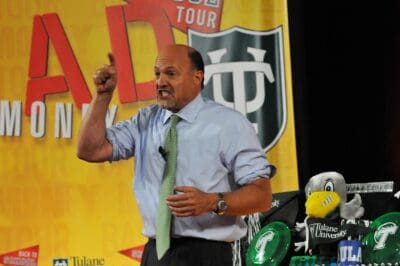
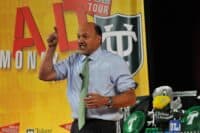
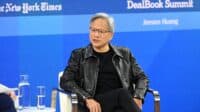
Wall Street spent most of 2026 treating NVIDIA (NASDAQ:NVDA | NVDA Price Prediction) as the purest way to own artificial intelligence, but this week the debate moved from the company’s chips to the man who founded it. CNBC’s Jim Cramer reached for a comparison that longtime tech investors remember well: Apple (NASDAQ:AAPL) after Steve Jobs died on October 5, 2011. According to TheStreet’s account of his Monday, Nov. 9 Mad Money broadcast, Cramer recalled how investors who sold Apple after Jobs’ death missed years of massive gains under Tim Cook. His reason for raising it now: Nvidia holders are being asked to price in the chance that the company will have to carry on without its founder.

What Apple Shareholders Collected After Jobs
Apple’s adjusted share price rose 2,980.67% from Oct. 5, 2011 through the Nov. 10, 2026 close. That is the nearly 3,000% in our headline. Measured from Aug. 24, 2011, Cook’s first day as CEO, the gain is 2,997.62%. Because these are adjusted prices, they may include dividends and work more like total-return figures. For comparison, the SPDR S&P 500 ETF (NYSEARCA:SPY), which tracks the benchmark S&P 500, rose 555.41% over the same window. That figure is price-only, so the two are measured differently.
Cook has since handed the company to John Ternus, who led his first earnings call as CEO for fiscal Q4 2026 on Nov. 2. Apple posted record September-quarter revenue of $114.48 billion, up 11.7% YoY. EPS of $2.10 beat the $1.9782 consensus for a 10th consecutive beat, which Ternus said was “capping off our best fiscal year ever.” The shares have rose 30.69% year to date.
Why Nvidia Holders Are Weighing a Future Without Huang
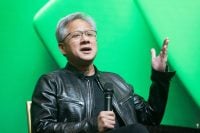
Three developments shook the stock. Huang acknowledged in a Nov. 8 message to employees that he had been cheating to his wife. Nvidia’s board said independent directors, supported by outside counsel, would investigate whether Huang was targeted by a foreign intelligence operation. The board said it had no reason to believe national security or Nvidia’s confidential information had been compromised.
It also expressed confidence in Huang’s leadership and said he would cooperate. Per TheStreet, a Nov. 9 shareholder lawsuit accused Nvidia and Huang of holding back information. Those claims are unproven.
Bloomberg wrote that the bull case depends on Huang surviving the probe, and Business Insider reported a rare Wall Street downgrade tied to the pressure on him this week. Nvidia’s August earnings call never touched succession: Huang fielded questions on strategy and supply while CFO Colette Kress handled the financials, and no named successor or formal succession plan came up. We have already examined whether Kress would take over if Huang leaves.

How Cramer’s View Shifted Over Three Days
Cramer started from a long-standing rule. On Mad Money on Sept. 25, he said: “Own it, don’t trade it. And they’re Apple and Nvidia. A pair of revolutionary companies with outstanding management.”
On Monday, he relaxed that rule. “Given the facts of the story, which seem to get worse with each update, we are going to have to consider owning shares in a Jensen-less Nvidia,” he said, adding, “If that is the case, you can no longer be bound by our ‘own it, don’t trade it’ mantra.” He also stressed that “Right now, Jensen is still working. He’s still CEO. And he still has the support of NVIDIA’s board of directors.” He continued: “We are not anxious to dump it. I still think NVIDIA is a buy, though we must be prepared for a change.”
On Tuesday night his tone hardened. He urged the company to “Name an interim CEO, perhaps Ian Buck, to show that there is more to this company than one person. That’s what’s killing it.” On CNBC’s Squawk on the Street Wednesday morning, he took a middle position: “I think that in the end Jensen Huang will be there. I think that there are issues with Jensen Huang that have to do with the actual stature with our country that makes it so I know this is going to sound jingoistic, but do we need the guy?”
Nvidia Stock Swings While the Business Keeps Growing
Nvidia fell 4.27% on Nov. 9 to close at $178.67, wiping out nearly $190 billion in market value, per Reuters as cited by TheStreet. As of 12:05 PM ET on Nov. 11, shares traded at $176.13, up 4.29% on the day and down 5.34% for the year. Fiscal Q2 revenue rose 105.8% YoY to $96.22 billion, and Q3 guidance calls for $108.0 billion, plus or minus 2%. Nvidia’s P/E of 34 sits below Apple’s 38, even though Nvidia’s 55.60% net margin is far wider than Apple’s 27.60%.

Where the Apple Parallel Breaks Down
Apple’s gains came under a planned succession: Cook was already CEO when Jobs died, and investors had watched him run the company’s operations. Nvidia is facing an open board review with no successor named. How one company performed under one new CEO cannot forecast another company’s results, and Apple’s run was built on a consumer franchise decades in the making. I’m watching Nvidia’s management bench as closely as its Vera Rubin ramp.
Nov. 17 Earnings Report Is the Next Checkpoint
Nvidia’s next earnings report is expected after the close on Nov. 17, though the company has not confirmed the date. The report will show whether Nvidia delivered the guided $108.0 billion quarter and whether management addresses leadership directly. The Apple comparison shows that a great franchise can keep compounding after its founder leaves. Whether Nvidia faces that test at all depends on what its board finds.
Contact [email protected] for any questions or corrections.
AJ spent 10 years writing about financial markets at The Motley Fool. His coverage centers on technology stocks and the broader macroeconomic trends, from interest rates to geopolitics, that shape where markets are headed next. AJ is drawn to the stories where big-picture economics and individual companies collide.