How Retirees Can Turn $175,000 Into Passive Income With These 4 Dividend Stocks

This post may contain links from our sponsors and affiliates, and Flywheel Publishing may receive compensation for actions taken through them.

Retirees spend decades building a nest egg, and then they have to turn it into a paycheck that comes whether markets rise or fall. Social Security covers part of the gap. Many families fill the rest by selling shares, which means selling at whatever price the market offers that month.
Dividend stocks offer another path. A $175,000 portfolio split evenly across four high-yield stocks from four different sectors would return more than $7,400 in annual income at current forward yields. A $43,750 stake in each one would produce the following. Dividends can be cut, and this income is not guaranteed, so each profile includes a dividend-safety check and one key risk.
AbbVie: A Dividend Aristocrat With a Fresh Raise
- Stock #4: AbbVie (NYSE:ABBV | ABBV Price Prediction)
- Yield (forward): 2.47%
- Shares for $43,750: 148.22
- Annual Passive Income: ~$1,079.04
AbbVie sells immunology, neuroscience, oncology and aesthetics drugs. Skyrizi revenue grew 22.7% in Q3 and Rinvoq revenue grew 23.9%, which more than offset Humira’s fall. The stock has gained 32.98% year to date, so the yield is the lowest of the four even after the board raised the quarterly dividend from $1.73 to $1.82. The new rate is payable February 16, 2027.
The $7.28 annualized dividend equals about 52% of full-year adjusted EPS guidance of $13.95 to $13.99. Risk: Humira sales fell 31.2%, and acquisition charges drove Q3 GAAP EPS down to $2.37.
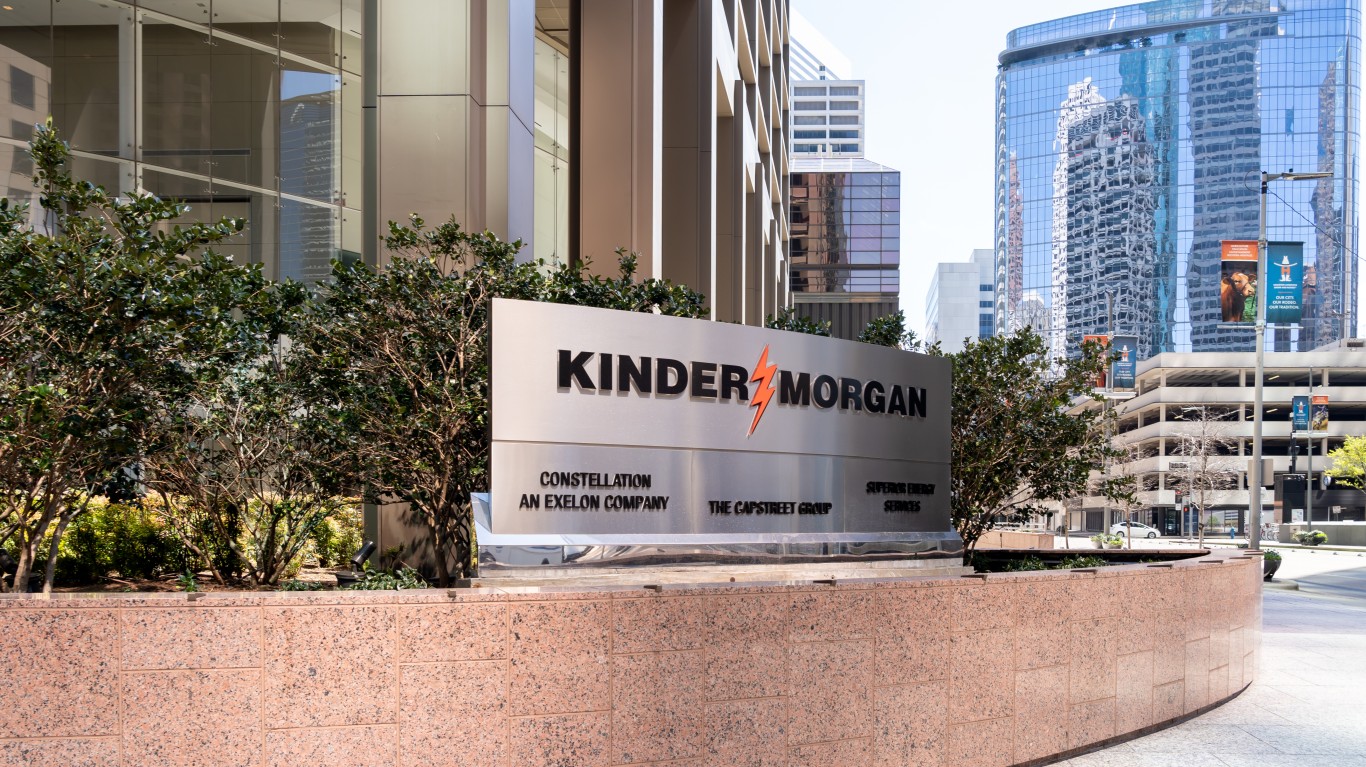
Kinder Morgan: Fee-Based Pipeline Cash Flow
- Stock #3: Kinder Morgan (NYSE:KMI)
- Yield (forward): 3.73%
- Shares for $43,750: 1,369.76
- Annual Passive Income: ~$1,630.01
Kinder Morgan operates about 78,000 miles of pipelines under mostly fee-based, long-term contracts. Pipelines need little reinvestment once they are built, so the company pays out a large share of its cash flow. It is a C-corp, so IRA holders face no UBTI issue.
In Q2, operating cash flow came in at $1.96 billion[1] and free cash flow at $978 million. Net debt to adjusted EBITDA was at 3.6x[1], and Moody’s (NYSE:MCO) upgraded the company to Baa1[2]. Management’s Q2 outlook, now dated, had adjusted EPS tracking more than 12%[1] above its $1.36 budget, which covers the $1.19 dividend. Risk: The dividend history includes a cut. The quarterly payout fell from $0.51 in late 2015 to $0.125 in 2016.
T. Rowe Price: A Retirement-Focused Asset Manager
- Stock #2: T. Rowe Price (NASDAQ:TROW)
- Yield (forward): 4.77%
- Shares for $43,750: 401.63
- Annual Passive Income: ~$2,088.50
T. Rowe Price manages $1.86 trillion in client assets. Asset managers need little capital spending, so most of their fee income can go to shareholders. The yield is elevated because the stock has fallen 37.11% over five years while the quarterly dividend rose from $0.90 in 2020 to $1.30.
The $5.20 forward dividend equals about 53% of trailing EPS of $9.88. The company also has $3.774 billion[3] in cash. Risk: Clients pulled a net $28.3 billion[3] in Q3, and the fee rate slipped to 37.8 bps from 39.1 bps.
Verizon: Ultra-High-Yield Income Backed by Subscriber Growth
- Stock #1: Verizon Communications (NYSE:VZ)
- Yield (forward): 6.10%
- Shares for $43,750: 943.50
- Annual Passive Income: ~$2,670.10
Verizon serves about 147 million wireless retail connections. Revenue grew only 1.4%[4] in Q3, and that slow-growth profile helps explain the ultra-high yield. Operations are improving, though. The company added 406,000[4] postpaid phone subscribers in the quarter, and free cash flow rose 13.9% to $7.801 billion.
The $2.83 annualized dividend equals about 56% of adjusted EPS guidance of $5.04 to $5.06[4]. The quarterly payout rose to $0.7075 from $0.69 in 2026. Risk: Total debt amounts to $166.2 billion, and interest expense rose 17.2%.
Four Paychecks, One Income Stream
| Name | Yield | Annual Dividend Income |
|---|---|---|
| AbbVie | 2.47% | $1,079.04 |
| Kinder Morgan | 3.73% | $1,630.01 |
| T. Rowe Price | 4.77% | $2,088.50 |
| Verizon | 6.10% | $2,670.10 |
| Total | 4.27% | $7,467.64 |
Combined, these four holdings produce $7,467.64 of annual income on a $175,000 investment, a blended yield of 4.27%. Verizon contributes $2,670.10, T. Rowe Price adds $2,088.50, Kinder Morgan provides $1,630.01, and AbbVie chips in $1,079.04.
All four pay quarterly, so a retiree with this mix gets payments spread across the calendar. Since the holdings span energy, healthcare, financials and telecom, a dividend cut at one company would affect only part of the income. Investors who keep an eye on payout coverage each quarter can see trouble coming before a cut shows up in their brokerage account.
Contact [email protected] for any questions or corrections.
Lee Jackson has covered Wall Street analysts' equity and debt research and equity strategy daily for 24/7 Wall St. since 2012. His broad, diverse career, including a stint as creative services director at an NBC affiliate in Austin, Texas, gives him unique insight into the financial industry.
Lee Jackson's journey in the financial industry spans more than 30 years, including nearly two decades as an institutional equity salesperson at Bear Stearns, Lehman Brothers, and Morgan Stanley. His career spanned pivotal sell-side Wall Street events, from the dot-com rise and bubble to the Long-Term Capital Management debacle, 9/11, and the Great Recession of 2008. This reflects his resilience and adaptability amid market volatility.
Lee Jackson’s practical financial industry experience, gained through a career at some of the biggest banks and brokerage firms, is complemented by a lifetime of writing across various platforms. This unique combination allows him to shed light on the intricacies of Wall Street in a way only someone with deep insider experience and knowledge can. Moreover, his extensive network across Wall Street continues to provide direct access for him and 24/7 Wall St., a privilege few firms enjoy.
Since 2012, Jackson’s work for 24/7 Wall St. has been featured in Barron’s, Yahoo Finance, MarketWatch, Business Insider, TradingView, Real Money, The Street, Seeking Alpha, Benzinga, and other media outlets. He attended the prestigious Cranbrook Schools in Bloomfield Hills, Michigan, and has a degree in broadcasting from the Specs Howard School of Media Arts.