CoreWeave Shed 50% Of Its Value Over 3 Months: One Noted Analyst Predicts Prices Triple, Several Others Close Behind

This post may contain links from our sponsors and affiliates, and Flywheel Publishing may receive compensation for actions taken through them.
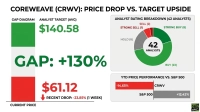
CoreWeave (NASDAQ:CRWV) currently trades at $53.13. The average analyst price target is $115.47, which implies upside of about 117%.
CoreWeave leases NVIDIA GPU capacity to AI labs, hyperscalers and enterprises. Its customers include OpenAI, Meta and Anthropic. The market treats it as the purest public proxy for AI infrastructure spending, so the stock tends to lead the whole trade in both directions.
This gap matters because CoreWeave keeps beating estimates while the stock keeps falling. Sooner or later, either the price or the targets will have to move.
Debt Costs Turned a Breakout Quarter Into a 50% Slide
Financing costs did the most damage. Q3 interest expense reached $846 million, compared with $310 million in Q3 2025[1], and management guided Q4 interest expense to $1.05-$1.15B[2]. The net loss grew to $709 million from $110 million[1]. Over three months the stock fell 49.88%, from $106 to $53.13.
Other concerns added to the pressure. A securities fraud class action alleged concealed data center construction delays[3]. The CEO’s large stock sales drew scrutiny, and Barron’s reported he is now pausing them. A new ATM program allows the sale of up to 35M Class A shares[2], which raises dilution risk alongside capex guidance of $37-$39B.
The whole sector weakened, and CoreWeave led the decline. CNBC described it as “at the heart of the latest sell off”. Over the same month the S&P 500 fell only 1.98%.
Rosenblatt’s $160 Call Leads a Bullish Street
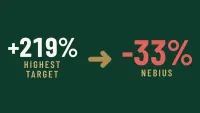
Rosenblatt Securities analyst John McPeake holds the Street-high target of $160.00 with a Buy rating. That target is about 3.01 times the current price. Citigroup is at $149.00, Bank of America at $140.00 and Piper Sandler at $124.00, although most desks reset targets after Q3.
Pricing power supports the optimistic thesis. CoreWeave raised prices approximately 25% in July, followed by another 10% increase[1], and new four- and five-year contracts are pricing at $20 million to $25 million per megawatt. Management cited 10 times as much qualified demand as available capacity through the end of 2027[1].
Optimists are watching a few near-term catalysts. They include roughly $9 billion of customer prepayments and deposits over the next three months[1], a revenue backlog of about $133 billion and an exit-2026 run rate of $20-$21B[2]. The longer timeline points to adjusted net-income positive in the first half of 2028[1].
Of 42 analysts, 32 rate the stock Buy or Strong Buy, seven rate it Hold, two Sell and one Strong Sell. Consensus still expects losses. The 2027 EPS consensus is -4.1344, and individual estimates range from -8.7500 to -0.0687.
Neoclouds Sank Together, but Upside Is Uneven
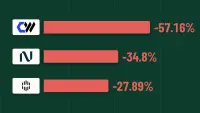
The peer group sold off together. Nebius Group (NASDAQ:NBIS | NBIS Price Prediction) fell 37.7% in one month to $115.88. Its average target of $234.50 implies roughly 102% upside, slightly below CoreWeave’s. Ratings break down as two Strong Buy, 13 Buy, six Hold and one Sell. Nebius now expects 2026 revenue at the low end of the $3.0–3.4 billion range.
Applied Digital (NASDAQ:APLD) fell 21.43% over the month to $15.97. Its $59.94 target implies about 275% upside, carried by two Strong Buy, 12 Buy and two Hold ratings. That target may lag the stock’s decline. CoreWeave is one of its principal hyperscaler customers.
Applied Digital has the largest implied upside in the group, but its leases depend partly on CoreWeave’s health. That leaves CoreWeave’s setup in the middle of the group and tied directly to its own financing.
A 117% Gap While the S&P 500 Climbs
At $53.13, CoreWeave trades with about 117% upside to the $115.47 consensus of 42 analysts. Shares are down 25.81% year to date, while the S&P 500 is up 10.62%.
The stock also rose 14.5% over the past week after the earnings report, then dropped 6.13% in the latest session. Its 52-week range runs from $40.58 to $138.25. Price targets are estimates, and this stock has blown through plenty of them in both directions.
Upside Looks Real, but Financing Decides the Outcome
The optimistic thesis improves if prepayments arrive on schedule, pricing holds and interest expense peaks while backlog turns into cash. In that case, the targets in the $120s to $160 range look reachable. The downside risk grows if construction delays return, ATM dilution speeds up or AI compute pricing moderates before 2028 profits arrives. With debt-to-equity at 8.94, the company has very little room for error.
I lean cautiously bullish. Operating results are improving faster than the share price suggests. Still, I’d keep an eye on the stock through the Q4 interest bill before treating the consensus target as a floor.
Contact [email protected] for any questions or corrections.
Alex Sirois is a financial writer with experience spanning both retail and institutional investing. He has written for InvestorPlace and held roles at BNY Mellon and Bernstein, giving him a perspective that bridges Main Street portfolios and Wall Street analysis.
Alex holds an MBA from George Washington University and has built his career across multiple industries, including e-commerce, education, and translation — a breadth of experience that informs how he breaks down complex financial topics for everyday investors. His writing is conversational, actionable, and grounded in long-term, buy-and-hold investing principles.
At 247 Wall St., Alex focuses on delivering analysis that is both accessible and useful, with a clear emphasis on helping readers make more informed decisions with their money.