3 High-Yield Dividend Stocks Down Nearly 30% or More in 5 Years

This post may contain links from our sponsors and affiliates, and Flywheel Publishing may receive compensation for actions taken through them.

Three household names with long dividend histories are starting December well below where they traded five years ago. Conagra Brands (NYSE:CAG | CAG Price Prediction) is down 38.49% over five years, Campbell’s (NASDAQ:CPB) is down 29.71%, and Pfizer (NYSE:PFE) is down 27.47%. All three still pay. The two food companies cut their dividends in 2026 to pay down debt, and Pfizer kept its payout unchanged. For income investors willing to own unpopular stocks, the first thing to check is whether each payout is safe (we laid out the seven warning signs that a big yield is about to be cut in a free report here). The yield comes second.
Conagra Brands: A Halved Dividend With Debt Reduction Coming First
Price and yield. Conagra trades at $14.81. That is down 7.57% over the past year and well below its 52-week high of $19.37. Some stock screens still show a trailing yield of 8.32%, but that number includes payments made before the cut. The new annual rate is $0.70, which works out to a forward yield of about 4.73%.
Dividend safety. In July, management cut the quarterly dividend from $0.35 to $0.175, a 50% reduction. The stated goal was to speed up debt reduction and spend more on brands and the supply chain. The company paid $0.35 per quarter from July 2023 until the cut, and its quarterly payment record goes back to 1999.
The new payout is well covered. Against fiscal 2027 adjusted EPS guidance of $1.40 to $1.50[1], the dividend uses roughly 47% to 50% of earnings. Fiscal 2026 free cash flow was $978.7 million[2], compared with an annual dividend cost of about $334 million at the new rate. Cash flow does swing from quarter to quarter: free cash flow in the first quarter was negative $127.9 million[1]. The balance sheet is the weak spot. Leverage was 3.99 times[3] at the end of the first quarter, compared with a long-term target of three times. The CEO said the company is “maniacally focused on getting there as soon as possible.”[3] Its debt is “pretty much 100% fixed”.
Bull case. Results are improving even as sales still fall. First-quarter adjusted EPS of $0.41[1] beat the $0.2815 consensus. Foodservice sales rose 3.2%,[1] and International rose 2.7%. Earnings from the Ardent Mills flour joint venture rose 71.8% to $50 million. The stock trades at about 10 times forward earnings, and management is cutting a product list that includes “over 400 single-serve meal SKUs”[3]. Most of the benefit from that cleanup is expected in fiscal 2028.
Risk. Inflation could pressure margins before price increases take hold. The CFO said costs are running toward the high end of a 5% to 6%[3] inflation range, and transportation inflation has roughly doubled from plan. Management expects second-quarter organic sales to fall 2%[3]. Analysts are cautious: the average price target of $13.74 is below the current price, and 10 of the analysts covering the stock rate it a hold.
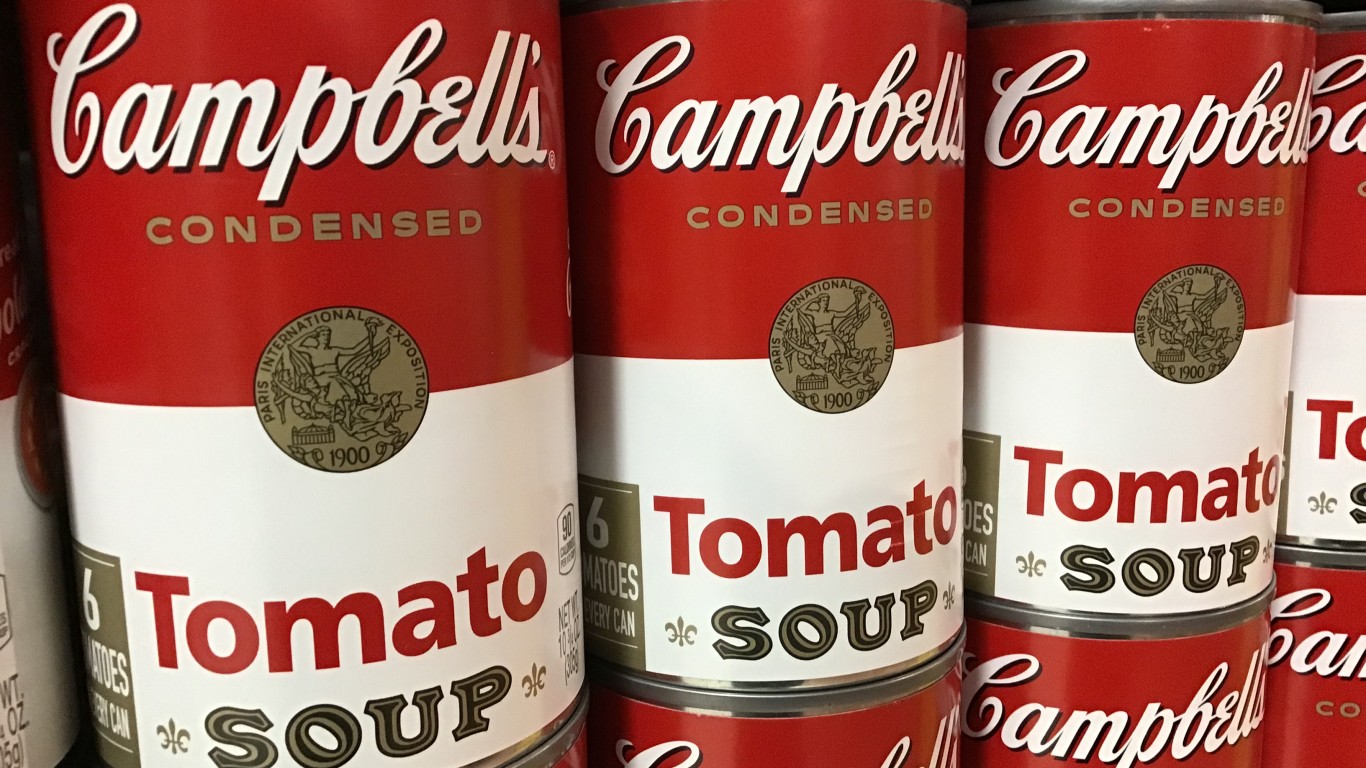
Campbell’s: The Rebound Has Started, but the Dividend Was Cut 36%
Price and yield. The bounce has already begun. Campbell’s is up 18.67% over the past month to $23.58. It is still down 18.4% over the past year and well below its 52-week high of $30.11. Screens show a trailing yield of 6.85%, but that also reflects the old rate. At the new annual rate of $1.00, the forward yield is about 4.24%.
Dividend safety. In September, Campbell’s cut its quarterly dividend 36%[4], from $0.39 to $0.25. The quarterly payment had been $0.37 from 2021 through 2024, and the company’s records go back to 1999. The CEO called the cut “a difficult decision, but it is unfortunately a necessary decision.”[5]
Against fiscal 2027 adjusted EPS guidance of $1.65 to $1.80[4], the new dividend uses about 56% to 61% of earnings. Fiscal 2026 operating cash flow was $1.039 billion[4], compared with an annual dividend cost of about $299 million. Campbell’s has not disclosed a capital-spending figure that would allow a clean free cash flow comparison. Debt costs are rising. Interest expense is expected to be about $25 million[5] higher this year, and a $500 million bond matures in March.
Bull case. The core brands are holding up. Meals & Beverages posted 3%[4] organic growth in the fourth quarter, helped by Rao’s, broth, and cooking sauces. A new $500 million[5] cost-savings program runs through fiscal 2030. The company has raised prices 4% to 5%[5] on about 60% of its products. At about 13 times forward earnings, the stock does not need a big turnaround to earn a higher valuation.
Risk. The snacks business is the problem. Snacks organic sales fell 6%,[4] and segment operating earnings fell 34% in the fourth quarter. The CFO warned that the first quarter for snacks would be “very, very challenging.”[5] After the recent rally, the stock sits above the average analyst target of $20.79.
Pfizer: Highest Yield of the Three, With No Cut and a Raised Outlook
Price and yield. Pfizer is up 21.86% this year to $28.43, but it is still down 27.47% from five years ago. Rather than a recent dip, the stock has been beaten down over the long run. Pfizer pays $0.43 per quarter, or $1.72 a year, for a high yield of 5.94%.
Dividend safety. Measured against earnings, the dividend is well covered. It uses about 56% to 58% of the newly raised 2026 adjusted EPS guidance of $2.95 to $3.05[6]. Measured against free cash flow, it is not fully covered. Pfizer’s free cash flow yield of 5.51% is below its dividend yield. Over nine months, operating cash flow was $8.8 billion[7], and Pfizer paid out $7.3 billion in dividends. Its balance sheet is in reasonable shape. Leverage is 2.6 times, below the 2.7-times target; interest coverage is 6.52; and the company has no buybacks planned for 2026.
The track record is solid. Pfizer raised its quarterly payout every year from $0.18 in 2010 to $0.43 in 2025, then held it flat through 2026. It last cut the dividend in 2009, from $0.32 to $0.16. The CFO said the company’s priorities include maintaining or growing its dividend over time.[7]
Bull case. Pfizer has beaten earnings estimates for seven straight quarters. Third-quarter adjusted EPS was $0.87[6], against the $0.73 estimate. Revenue outside its COVID products grew 7%[6] operationally, and newly launched and acquired drugs grew 32%. Padcev sales rose 55%[6]. The stock trades at about 10 times forward earnings, and the obesity drug program offers another possible source of growth.
Risk. Several major drugs are losing patent protection, which lets cheaper generic and biosimilar competitors in. Management flagged pressure on Ibrance and Xtandi in the U.S. and on Eliquis internationally. It also said leverage could stay near current levels or rise slightly from 2027 through 2029. U.S. drug-pricing rules, including the Inflation Reduction Act (IRA) and most-favored-nation pricing, add to the uncertainty.
Pfizer Has the Strongest Income Case of the Three
Pfizer has the strongest income case. It has the highest yield of the three, has not cut its dividend, and pays out less than 60% of guided earnings. Free cash flow coverage is tight, but cost savings and growth from new drugs give it room to improve. Conagra and Campbell’s are recovery stories whose income has already been cut. Conagra’s lower payout is better covered, while Campbell’s has already bounced sharply. Keep an eye on Pfizer’s 2027 outlook, which management says will reflect the hit from expiring patents, new drug launches, pricing pressure, and cost savings.
Contact [email protected] for any questions or corrections.
Chris Lange is a financial and geopolitical writer with more than a decade of experience covering a myriad of topics. He has published thousands of articles for 24/7 Wall St., with past coverage focused heavily on stocks, IPOs, healthcare, defense, global affairs, and technology.
His work has been quoted, or referenced by a number of outlets including Business Insider, USA Today, Yahoo Finance, MSN, The Motley Fool, and many other publications. A graduate of Southwestern University, he studied business with a focus on investments and has previous experience in banking and startups.
When not reading or writing the news, he is following his passion for Lacrosse, playing chess, or building solar projects with his dad.