Gridlock in Washington: 4 Rock-Solid Dividend Stocks to Buy Before the Market Reacts

This post may contain links from our sponsors and affiliates, and Flywheel Publishing may receive compensation for actions taken through them.
Voters gave Democrats control of both the House and the Senate while the White House remains under Republican control. Divided government usually means legislative gridlock, and gridlock rewards companies whose cash flows depend on customers, state regulators and pricing power instead of the next big bill out of Washington. The four steady dividend payers below cover insurance, water, drinks and rails, and each has kept raising its payout through every kind of political mix. One of them has now raised its dividend for 44 consecutive years.
Aflac: A Long Raise Streak With the Next Increase Already Announced
Aflac (NYSE: AFL | AFL Price Prediction) yields about 1.95% on its annualized dividend of $2.44 at a share price of $125.27. The board has also announced a 4.9% increase[1] for the first quarterly payment of next year, so the next raise is already set.
Dividend safety: The payout uses about 36% of trailing EPS of $6.85, which leaves plenty of room. Last quarter Aflac returned $1.1 billion to shareholders, made up of $804 million in buybacks and $305 million in dividends. Because buybacks are more than double the dividend bill, management could slow repurchases well before the dividend came under pressure. Shareholders’ equity stood at $30.3 billion[2] in the second-quarter filing. Over the last three years the quarterly payout rose from $0.50 to $0.58 to $0.61.
Washington angle: A Democratic Congress will probably aim its health care oversight at major medical insurance companies, drug pricing and marketplace subsidies, while Aflac sells supplemental cancer, dental, life and disability coverage through employers, which is largely outside those debates. A split government also makes a broad health law reform less likely, and a large part of the business is in Japan, which further limits exposure to U.S. policy.
Bull case: Aflac ranks as the No. 1 U.S. provider of supplemental health insurance per LIMRA. U.S. pretax adjusted earnings rose 31.5% last quarter, and buybacks have cut the share count by 6.1% year over year. That means each remaining share gets a larger piece of the dividend pool.
Risk: Currency. A weaker yen (158.49 vs 147.68) cut adjusted EPS by $0.03, and portfolio repositioning produced $1.1 billion in net investment losses that weighed on GAAP results.
American Water Works: Dividend Growth Matched to Earnings Growth
American Water Works (NYSE: AWK) yields about 2.38%, based on an annualized dividend of $3.58 and a share price of $150.13. It is the largest regulated water and wastewater utility in the United States and serves about 14 million people across 14 states.
Dividend safety: The trailing dividend matches about 61% of trailing EPS of $5.78, which is a comfortable level for a regulated utility. Management targets 7-9%[3] annual dividend growth, the same range as its EPS growth target, so the payout should rise only as fast as earnings do. The quarterly dividend has grown from $0.20 in 2008 to $0.895 now. Like most utilities, American Water funds its heavy capital spending with debt and equity. Debt-to-capital was 58%[4] at the end of last quarter. The CFO said the company is “already in alignment with our targets for debt-to-capital and dividend payout.”[4]
Washington angle: State commissions set water rates, so gridlock in Congress rarely affects revenue. The federal policies that matter most are rules on lead and copper service lines and PFAS, which push more spending into the rate base. A Democratic Congress is more likely to defend those standards and back water infrastructure funding than to weaken them.
Bull case: Next year’s standalone EPS guidance of $6.53-$6.63[3] implies about 8% growth at the center. The decade-long capital plan tops $48 billion[3]. Regulators have authorized $284 million of additional annualized revenue so far this year, and the pending Essential Utilities merger is targeted to close by the end of Q1 next year.
Risk: Interest rates and dilution. Higher borrowing costs raise interest expense, and the financing plan still includes $1.5 billion[4] of new equity later in the five-year window.
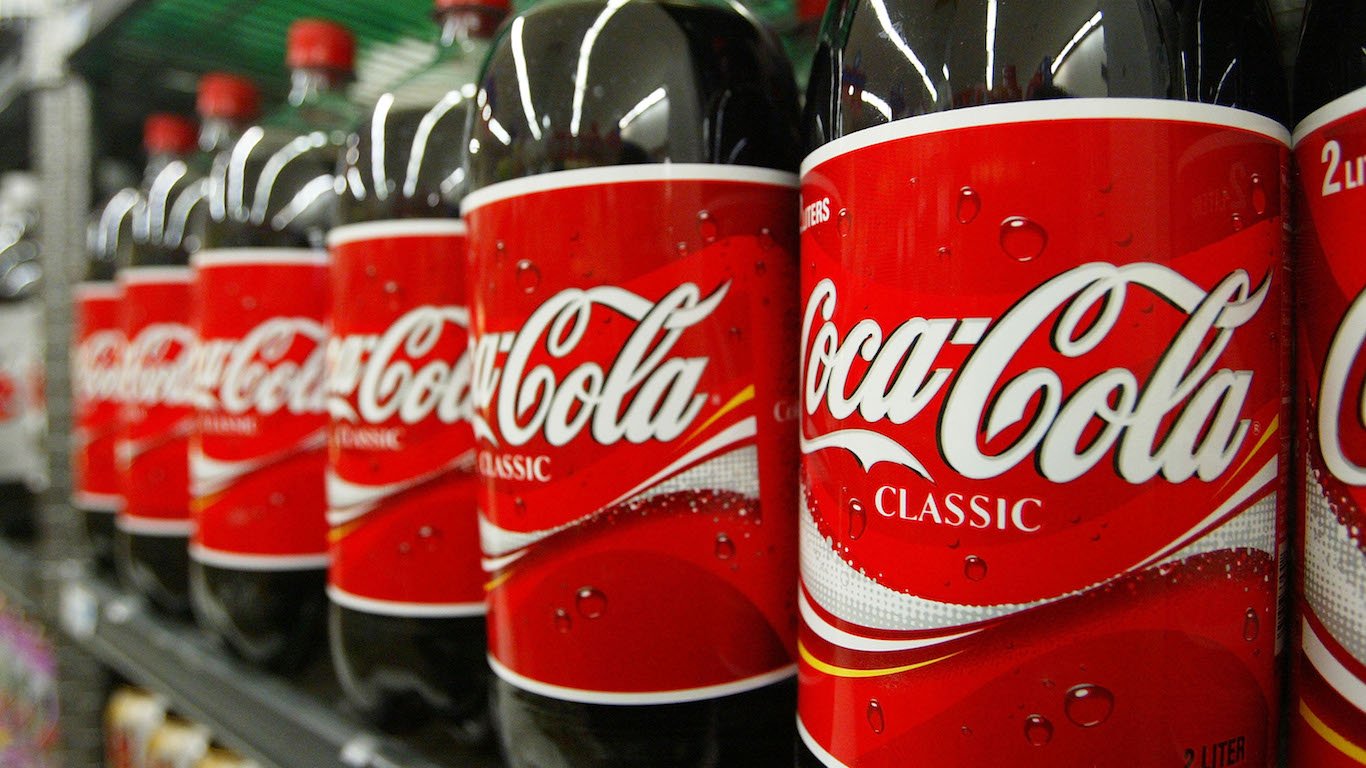
Coca-Cola: Global Pricing Power Behind a Rising Payout
Coca-Cola (NYSE: KO) yields 2.08%. The quarterly dividend is $0.53, up from $0.51 the prior year and $0.485 the year before. The record shows quarterly payments going back decades.
Dividend safety: The dividend takes about 62% of trailing EPS of $3.39. Management raised its free cash flow guidance to at least $13.0 billion[5], up from $12.4 billion. Net debt leverage of 1.3 times EBITDA[6] is below the company’s own two to 2.5 times target range, and interest coverage stands at 8.32x. The CFO left no doubt about priorities: “As always, we’re here to return capital to our shareowners. Again, at the moment, that’s primarily through our dividend.”[6]
Washington angle: A split government lowers the odds that major corporate tax changes pass in either direction. Congressional committees may hold hearings. But turning hearings on sugary drinks or food ingredients into federal law requires agreement between Congress and the White House. Coca-Cola sells in more than 200 countries and territories, so no single capital controls its results.
Bull case: Global unit case volume rose 5%[5], Coca-Cola Zero Sugar grew 16%, and comparable operating margin expanded to 32.9%. Guidance calls for comparable EPS growth of at least 11%[5] this year. Investors pay for that consistency with a P/E of about 32.
Risk: The IRS case. Management is “anticipating a decision in the coming months in the IRS case”[6], and an unfavorable ruling could require a large tax payment. The strong balance sheet is the company’s buffer against that outcome.
Union Pacific: Two Decades of Raises Backed by Record Rail Efficiency
Union Pacific (NYSE: UNP) yields about 1.89%, based on an annualized dividend of $5.68 and a share price of $300.90. The railroad lifted its quarterly dividend to $1.42[7] from $1.38[8], a 3%[9] raise that management called its 20th consecutive year providing shareholders with an annual dividend raise.
Dividend safety: The trailing dividend uses about 43% of trailing EPS of $12.82. Cash from operations rose 18% to $8.3 billion[9], free cash flow reached $2.4 billion, and adjusted debt-to-EBITDA was 2.4x. Buybacks fell to $26 million[7] from $2.68 billion a year earlier while the merger is pending. That keeps cash available for the dividend, and management’s outlook confirms consistent annual dividend increases[7].
Washington angle: The pending Norfolk Southern acquisition needs Surface Transportation Board approval. A Democratic Congress could use hearings to press on rail safety, labor protections and consolidation. Union Pacific has already reached an agreement covering locomotive engineers at both railroads and has met with the Department of Justice, according to its CEO. Any infrastructure spending deal would also likely need bipartisan support, and rail’s freight efficiency fits both parties’ priorities.
Bull case: Revenue rose 15.3%[7] and net income increased 16.1% last quarter, with an operating ratio of 58.8%[9] and a ninth consecutive quarter of record workforce productivity. Pricing ahead of inflation supports continued dividend growth.
Risk: The merger could add substantial debt and possibly lead to a credit rating downgrade, which would reduce the balance sheet cushion behind the dividend.
Four Sectors, One Common Trait: Dividends That Keep Rising
Aflac, American Water, Coca-Cola and Union Pacific earn their income from employers, state rate cases, global consumers and freight shippers, and none of those revenue streams depends on Congress passing a new law. Each company covers its dividend with earnings, and each has a track record of raising the payout year after year. In a gridlocked Washington, that kind of predictable dividend growth is what these four stocks offer income investors.
Contact [email protected] for any questions or corrections.
Lee Jackson has covered Wall Street analysts' equity and debt research and equity strategy daily for 24/7 Wall St. since 2012. His broad, diverse career, including a stint as creative services director at an NBC affiliate in Austin, Texas, gives him unique insight into the financial industry.
Lee Jackson's journey in the financial industry spans more than 30 years, including nearly two decades as an institutional equity salesperson at Bear Stearns, Lehman Brothers, and Morgan Stanley. His career spanned pivotal sell-side Wall Street events, from the dot-com rise and bubble to the Long-Term Capital Management debacle, 9/11, and the Great Recession of 2008. This reflects his resilience and adaptability amid market volatility.
Lee Jackson’s practical financial industry experience, gained through a career at some of the biggest banks and brokerage firms, is complemented by a lifetime of writing across various platforms. This unique combination allows him to shed light on the intricacies of Wall Street in a way only someone with deep insider experience and knowledge can. Moreover, his extensive network across Wall Street continues to provide direct access for him and 24/7 Wall St., a privilege few firms enjoy.
Since 2012, Jackson’s work for 24/7 Wall St. has been featured in Barron’s, Yahoo Finance, MarketWatch, Business Insider, TradingView, Real Money, The Street, Seeking Alpha, Benzinga, and other media outlets. He attended the prestigious Cranbrook Schools in Bloomfield Hills, Michigan, and has a degree in broadcasting from the Specs Howard School of Media Arts.