Want Reliable Retirement Income? Invest in These 3 Dow Jones Passive Income Dividend Stocks

This post may contain links from our sponsors and affiliates, and Flywheel Publishing may receive compensation for actions taken through them.
Retirement income holds up best when it comes from companies that have already kept paying through recessions, rate shocks, and bear markets. Coca-Cola (NYSE: KO | KO Price Prediction), Johnson & Johnson (NYSE: JNJ), and JPMorgan Chase (NYSE: JPM) are long-tenured members of the Dow Jones Industrial Average. Each comes from a different part of the economy (consumer staples, health care, and financials), and each pays its dividend from a large, diversified cash engine. J&J has the strongest record of the three: its latest raise marked its 64th consecutive year of dividend increases[1]. Below, we check each payout for coverage, free cash flow, balance sheet strength, and track record.
Coca-Cola: Six Decades of Raises Backed by Swelling Free Cash Flow
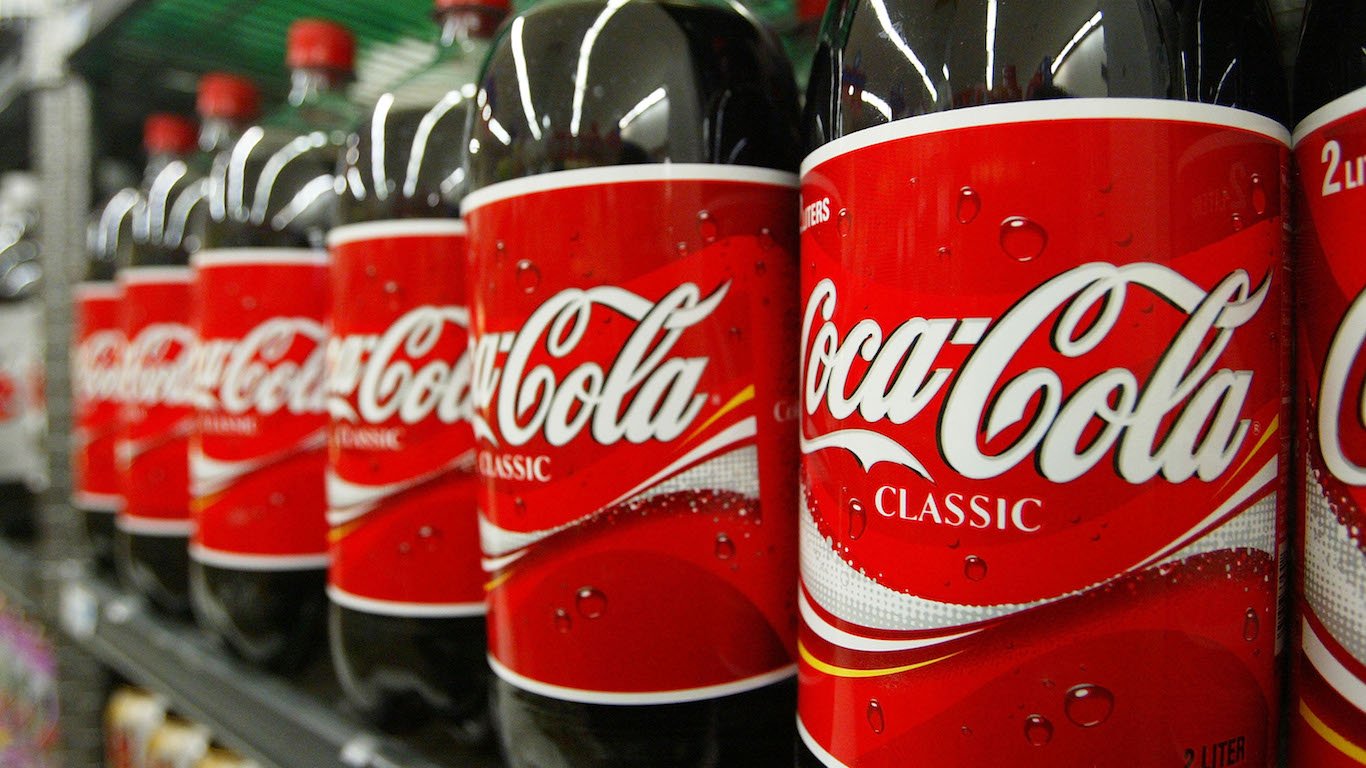
Coca-Cola has held its current Dow seat since 1987, and its dividend yield is 2.08%. The quarterly payout is $0.53 per share, up from $0.51 last year. That works out to an annualized forward dividend of $2.12 per share.
Dividend safety: With its full-year 2025 results, Coca-Cola reported 63 consecutive years of dividend increases[2]. That puts it well inside Dividend King territory (50 or more straight years of raises). The company paid $8.8 billion[2] in dividends during 2025. Management has since raised its free cash flow outlook for this year to at least $13.0 billion[3], up from roughly $12.4 billion. Last year’s dividend bill equals about 68% of that new free cash flow floor. That leaves room for buybacks, which reached $900 million[3] year to date through early October. Its finances are solid: interest coverage is 8.32x, net debt to EBITDA is 2.49, cash and equivalents reached $13.454 billion, and total liabilities fell 5.99% year over year.
Bull case: Coca-Cola sells concentrate to a global network of franchise bottlers. That model produces a 28.71% operating margin and a 45.97% return on equity. Recent results were strong. Third-quarter adjusted EPS of $0.91[3] beat the $0.88 estimate, and revenue rose 7.4% to $13.38 billion. Global unit case volume grew 5%[3], led by India, China, Mexico and Brazil, and Coca-Cola Zero Sugar grew 16%. Comparable operating margin expanded to 32.9%[3] from 31.9%, and management now expects comparable EPS growth of at least 11% for the full year. Chief Executive Henrique Braun said in the earnings release, “Our results this quarter demonstrate our system’s sustained momentum, giving us confidence in our updated full-year guidance.”[2] For retirees, that means a payout funded by a business that is still growing.
Risk: The stock is expensive. Shares have climbed 42.97% year to date to $98.04, which lifts the P/E to 32. Barron’s has warned that Coca-Cola stock could lose its fizz because of its valuation. New buyers start with a lower yield, and any slowdown in growth could pull on the share price even while the dividend keeps rising.
Johnson & Johnson: A 64-Year Dividend Streak With Room to Run
Johnson & Johnson has been a Dow component since 1997. Its quarterly dividend of $1.34 annualizes to $5.36, a yield of about 1.97% at the recent price of $272.69.
Dividend safety: The board’s latest increase raised the quarterly payout 3.1%[1] from $1.30 to $1.34. That marked the 64th consecutive year[1] of increases and supports J&J’s Dividend King status. Coverage is comfortable. The trailing 12-month dividend of $5.28 equals about 49% of full-year 2025 EPS of $10.79[4], so roughly half of earnings stays in the business. Full-year 2025 free cash flow was $19.7 billion[4]. J&J has also historically carried an AAA-rated balance sheet, a credit standing that is rare among U.S. corporations.
Bull case: J&J runs two large businesses, Innovative Medicine and MedTech, so its growth comes from many products at once. Second-quarter adjusted EPS of $2.90[5] beat the $2.85 estimate, and revenue rose 6.6% to $25.31 billion. Oncology grew 17.3%[5]. The cancer drug DARZALEX brought in $4.21 billion[5], and immunology treatment TREMFYA rose 72.5% to $2.05 billion. Chairman and CEO Joaquin Duato said J&J “delivered strong second-quarter results, demonstrating the power of our innovation, the depth of our portfolio and the momentum in our pipeline.”[4] Shareholders have also seen the stock rise 33.89% year to date on top of their dividend checks.
Risk: J&J’s former blockbuster STELARA is losing sales quickly to biosimilar competition. Its revenue fell 55.2%[4] to $740 million in the second quarter. Management estimates that biosimilar erosion takes about 760 basis points[4] off Innovative Medicine growth, so newer drugs need to keep filling that gap.
JPMorgan Chase: Fresh Dividend Hike Backed by Fortress Capital
JPMorgan Chase has been in the Dow since 1991. Its board recently raised the quarterly dividend to $1.65 from $1.50, which lifts the annualized forward payout to $6.60. At the recent price of $324.07, that is a yield of about 2.04%. Shares slipped 5.63% over the past week after customers reported outages at Chase and other big banks, which pushed the yield higher for new buyers.
Dividend safety: JPMorgan’s track record comes with an asterisk. The bank cut its quarterly dividend to $0.05 during the financial crisis, so it lacks Aristocrat status. After restoring the payout to $0.25 in 2011, it has raised the dividend repeatedly, including steps to $1.40 and then $1.50 in 2025. On current earnings, its coverage is the strongest of the three: the new quarterly dividend equals about 27% of second-quarter adjusted EPS of $6.14[6]. Capital is deep, with a CET1 ratio of 14.3%, $291 billion[7] of CET1 capital and $1.5 trillion in cash and marketable securities. In the first quarter, JPMorgan returned $4.1 billion[7] through dividends and $8.1 billion through buybacks, and a new $50 billion[6] repurchase authorization is now in place.
Bull case: JPMorgan makes money across consumer banking, cards, investment banking, trading, payments and wealth management, and that diversity stabilizes the cash flow behind the dividend. Second-quarter adjusted EPS rose 13%[6] year over year, with a return on tangible common equity of 23%. Commercial and Investment Bank revenue climbed 27%[6] to $24.85 billion, net interest income rose 10%, and assets under management reached $5.14 trillion. Chase is also set to become the new issuer of Apple Card, adding another source of card revenue. CEO Jamie Dimon noted that “revenue in each line of business hit a new record.”[8]
Risk: Bank dividends depend on the credit cycle. Dimon warned that “several risks are shifting below the surface like tectonic plates, including geopolitical tensions and wars, sticky inflation, large global fiscal deficits and elevated asset prices.”[8] The credit card net charge-off rate is already 3.33%, and the total allowance for credit losses has grown to $31.4 billion[6]. Investors should watch those figures.
Three Dow Veterans, Three Ways to Fund a Retirement Paycheck
Coca-Cola and J&J offer six decades of continuous raises, paid for by global brands and a diversified health care portfolio that both throw off billions in free cash flow. JPMorgan adds the group’s lowest payout ratio and fortress-level capital, and its board just lifted the dividend again. Together, they spread an income portfolio across staples, health care, and financials, with each payout supported by cash generation, a solid balance sheet, and a long Dow membership.
Contact [email protected] for any questions or corrections.
Lee Jackson has covered Wall Street analysts' equity and debt research and equity strategy daily for 24/7 Wall St. since 2012. His broad, diverse career, including a stint as creative services director at an NBC affiliate in Austin, Texas, gives him unique insight into the financial industry.
Lee Jackson's journey in the financial industry spans more than 30 years, including nearly two decades as an institutional equity salesperson at Bear Stearns, Lehman Brothers, and Morgan Stanley. His career spanned pivotal sell-side Wall Street events, from the dot-com rise and bubble to the Long-Term Capital Management debacle, 9/11, and the Great Recession of 2008. This reflects his resilience and adaptability amid market volatility.
Lee Jackson’s practical financial industry experience, gained through a career at some of the biggest banks and brokerage firms, is complemented by a lifetime of writing across various platforms. This unique combination allows him to shed light on the intricacies of Wall Street in a way only someone with deep insider experience and knowledge can. Moreover, his extensive network across Wall Street continues to provide direct access for him and 24/7 Wall St., a privilege few firms enjoy.
Since 2012, Jackson’s work for 24/7 Wall St. has been featured in Barron’s, Yahoo Finance, MarketWatch, Business Insider, TradingView, Real Money, The Street, Seeking Alpha, Benzinga, and other media outlets. He attended the prestigious Cranbrook Schools in Bloomfield Hills, Michigan, and has a degree in broadcasting from the Specs Howard School of Media Arts.