The Dividend Investing Strategy That Made Geraldine Weiss a Wall Street Legend

This post may contain links from our sponsors and affiliates, and Flywheel Publishing may receive compensation for actions taken through them.

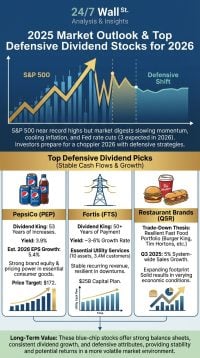
Three of America’s most reliable dividend payers now sit at very different points on Geraldine Weiss’s valuation map. PepsiCo (NASDAQ:PEP | PEP Price Prediction) yields ~3.95% after a flat year. Coca-Cola (NYSE:KO) and Johnson & Johnson (NYSE:JNJ) have rallied hard enough to push their yields down. Weiss built her career on reading gaps like this one.
How “G. Weiss” Built a Dividend Legacy
Brokerage firms turned Weiss away when she tried to become an analyst. In 1966 she co-founded Investment Quality Trends and became the first woman to start an investment advisory service. She signed the newsletter “G. Weiss” to hide her gender and revealed herself on Wall Street Week in 1977. Her 1988 book, Dividends Don’t Lie, made dividend yield a mainstream valuation tool, and Wall Street came to know her as the “Grande Dame of Dividends.”
Why a Rising Yield Can Signal a Bargain
Yield is the annual dividend divided by the share price. When the dividend stays the same, a falling price raises the yield and a rising price lowers it. Weiss saw that blue chips tend to trade within yield bands that repeat over time. A yield near the top of a company’s own historical range showed to undervaluation. A yield near the bottom showed to overvaluation.
She compared each stock with its own history. For example, a stock that has historically yielded 2.5% and now yields 4% deserves a closer look, as long as the dividend is sustainable. AAII still runs a Weiss Blue Chip Dividend Yield screen built on this method.
Quality Filters Come Before Yield
Weiss screened for quality before yield, because a yield can spike just before a dividend cut. Her filters required at least 25 years of uninterrupted dividends, dividend increases 5 times in the last 12 years, earnings growth in at least 7 of the last 12 years and an S&P quality ranking of A or better. These three companies all meet her long-history test as Dividend Kings.
Using Weiss’s Lens to 3 Dividend Kings
| Company | Price | Dividend Yield | Forward Annual Dividend | YTD Price Change |
|---|---|---|---|---|
| Johnson & Johnson | $277.38 | 1.85% | $5.36 | 36.19% |
| Coca-Cola | $97.93 | 2.07% | $2.12 | 42.81% |
| PepsiCo | $141.93 | 3.95% | $5.92 | 1.9% |
Johnson & Johnson: The company raised its quarterly dividend 3.1% to $1.34[1], which marked 64 consecutive years of increases. It also lifted full-year adjusted EPS guidance to $11.60-$11.75[2] and agreed to buy Ollin Biosciences. The business looks strong, but a large share-price gain has reduced the yield. In Weiss’s framework, that signals a less attractive valuation.
Coca-Cola: The quarterly dividend rose from 51 cents to 53 cents, while the stock rallied faster. Management raised free cash flow guidance to at least $13 billion[3]. The business passes Weiss’s quality test, but by her yield measure the stock looks expensive.
PepsiCo: Of the three, PepsiCo comes closest to the Weiss example. Its quarterly payout rose from $1.4225 to $1.48, while shares gained just 2.09% over five years. The stock trades at 18x trailing earnings. Earnings consistency is the weak point. Management cut core EPS growth guidance to 2.5%–3.5%[4] from 5%–7%, and North American snack operating profit fell 12%. Barron’s also cut the stock to Sell.
What Retirees Need to Track Before the Next Dividend Raise
Retirees benefit most from this approach. Buying at a historically high yield gets more income for every dollar invested, and regular dividend growth helps that income keep pace with inflation. The main risk is a dividend cut, which wipes out both the income and the valuation case (we rated ten Dividend Kings by valuation at today’s prices in a free report here).
PepsiCo is the test case for 2027. It plans $7.9B[4] in dividends, so its structural cost cuts have to bring earnings growth back in line with payout growth. If they do, the yield fits Weiss’s undervaluation pattern. If earnings keep falling short, the high yield signals risk instead of value.
Coca-Cola expects about 8% revenue headwind from divestitures in 2027. Johnson & Johnson still has its planned Orthopaedics separation to complete. Weiss’s rule still holds: quality comes first, and the yield signals when the price is right.
Contact [email protected] for any questions or corrections.
Joel South covers large-cap stocks, dividend investing, and major market trends, with a focus on earnings analysis, valuation, and turning complex data into actionable insights for investors.
He brings more than 15 years of experience as an investor and financial journalist, including 12 years at The Motley Fool, where he served as an investment analyst, Bureau Chief, and later led the Fool.com investing news desk. He has also co-hosted an investing podcast and appeared across TV and radio discussing market trends.