2027 Industrial Divide: Caterpillar Monetizes AI Power While Deere Chases an Ag Bottom

This post may contain links from our sponsors and affiliates, and Flywheel Publishing may receive compensation for actions taken through them.
Caterpillar (NYSE:CAT | CAT Price Prediction) and Deere (NYSE:DE) both just reported third-quarter results, and the two reports set up very different 2027 stories. Caterpillar posted its highest sales quarter ever on October 29[1] because data centers kept ordering turbines and engines. Deere’s August 20[2] report showed construction gear doing most of the work while large farm machinery holds off for a recovery.
Data Centers Fill Caterpillar’s Order Book While Big Farm Machines Stall at Deere
Caterpillar’s revenue rose 17.3%[1] to $20.68 billion. Adjusted EPS of $7.20[1] exceeded the $7.04 consensus. Backlog reached a record $78 billion[3], up 96% in a year. That gives a cyclical manufacturer years of visibility, which is rare. Power generation sales to users jumped 75%[3] on data center demand, and turbine orders already reach into 2030.
Deere’s EPS of $5.10[2] exceeded the $4.70 consensus, but Production & Precision Ag sales fell 6%. Construction & Forestry carried the quarter. Sales rose 18%[2] and the margin expanded to 12.1% from 7.7%, which shows its price increases are holding. On the call, Deanna Kovar, Deere’s agriculture president, said she expects “a measured recovery rather than a sharp rebound in 2027.”[4]
| Business Driver | Caterpillar | Deere |
|---|---|---|
| Growth Engine | Data center power generation | Construction & Forestry |
| Soft Spot | Asia Pacific, down 2%[1] | Large ag, down 6%[2] |
| Visibility | $78 billion[3] backlog | Four to five months[4] of C&F orders |
Caterpillar Races to Add Capacity While Deere Protects Its Dealers
Caterpillar is setting up a second line for its 3600 series engines in Winston-Salem. The goal is nearly three times[3] its 2024 large-engine capacity by 2030. That growth has a cost. Tariffs should total about $2.2 billion[3] this year, which keeps margins near the bottom of the company’s target range.
Deere built slightly fewer machines than dealers sold, and inventories of late-model high-horsepower tractors fell nearly 40%[4]. That makes space for new sales. See & Spray is now on about one-third[4] of North American sprayers on order. I think farmers adding more of this technology is Deere’s most credible path to recovery.
Margins and Farm Orders Will Decide 2027
Caterpillar’s January outlook will be worth watching. Dealers are expected to cut inventory by about $1.6 billion[3] in the fourth quarter, which will weigh on sales volume. Large data center projects can also make orders uneven or get delayed by permitting. At Deere, early orders for planters and sprayers ran mid-single-digits[4] above last year’s program. Check whether that strength holds in its next report.
Why I Lean Toward Caterpillar for 2027
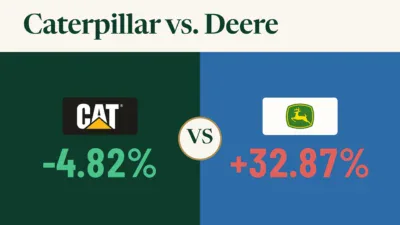
Investors have already rewarded Deere. Its shares are up 32.87% this year. Caterpillar is down 4.82% after a 21.12% drop over the past month. Caterpillar trades near 17x to 18x earnings, compared with roughly 27x to 29x for Deere. Deere’s higher price assumes a farm rebound that its own executives call measured.
I prefer Caterpillar’s position: a record backlog, power demand limited only by factory capacity, and a cheaper stock (we highlighted seven suppliers riding the same AI power expansion, from turbines to cooling, in a free report). Deere suits patient investors who trust precision farming tools to lift margins. My view would change if Caterpillar’s margins stay stuck at the bottom of its range or data center orders start dropping off.
Contact [email protected] for any questions or corrections.
Alex Sirois is a financial writer with experience spanning both retail and institutional investing. He has written for InvestorPlace and held roles at BNY Mellon and Bernstein, giving him a perspective that bridges Main Street portfolios and Wall Street analysis.
Alex holds an MBA from George Washington University and has built his career across multiple industries, including e-commerce, education, and translation — a breadth of experience that informs how he breaks down complex financial topics for everyday investors. His writing is conversational, actionable, and grounded in long-term, buy-and-hold investing principles.
At 247 Wall St., Alex focuses on delivering analysis that is both accessible and useful, with a clear emphasis on helping readers make more informed decisions with their money.