Prediction: Eli Lilly’s $92 Billion Revenue Outlook Could Be Just the Beginning

This post may contain links from our sponsors and affiliates, and Flywheel Publishing may receive compensation for actions taken through them.
Eli Lilly (NYSE:LLY | LLY Price Prediction) sells into what CEO David Ricks calls “the largest new category expansion in the history of the pharmaceutical industry, and Lilly is leading that.”[1] The results support that claim.
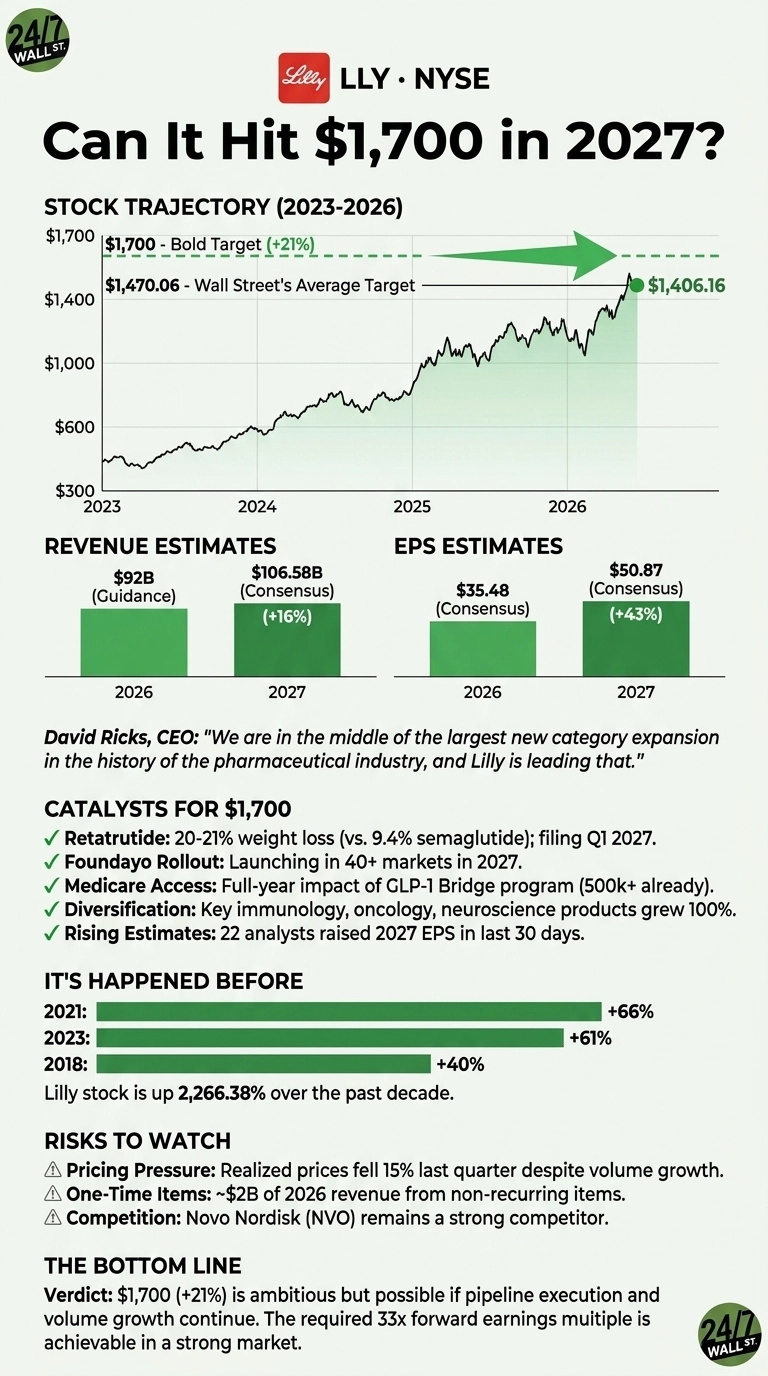
Shares are up 31.64% so far this year, after gains of 40% in 2025 and 33% in 2024. Mounjaro and Zepbound brought in more than $16 billion[1] in third-quarter sales, and Lilly raised its 2026 revenue outlook to $91 to $92 billion[2]. Below, I lay out what Lilly needs to do to reach $1,700 per share in 2027.

Wall Street’s Target Lags, but 2027 Estimates Keep Rising
The average analyst price target is $1,470.06, only about 4.5% above today’s $1,406.16. The underlying forecasts look much stronger than that.

For 2027, analysts expect revenue of $106.58 billion and EPS of $50.8704. That would be about 43% above the 2026 consensus of $35.4809. Ninety days ago, the 2027 EPS estimate was $47.2340. In the past 30 days, 22 analysts raised it and only one cut it.
Lilly has also exceeded EPS estimates for five consecutive quarters. That suggests actual results could again come in ahead of forecasts. In the third quarter, Lilly earned $7.48[2] per share against expectations of $6.67, even after absorbing $4.57[1] per share in acquired IPR&D charges.
Here’s What It Takes for Eli Lilly to Reach $1,700
At today’s price, Lilly trades at 28x estimated 2027 earnings. At $1,700, that multiple would rise to 33x. That is a premium, but a defensible one if earnings grow more than 40% in a year. Volume is driving the growth.
Tirzepatide volume rose 53%[2] worldwide last quarter, even as prices fell 15%. The chief financial officer, Lucas Montarce, said on the call, “We are still scratching the surface on the number of patients that we can reach.”[1]

What Could Push Eli Lilly to $1,700?
- Retatrutide: In a head-to-head trial, it produced 20% to 21%[1] weight loss, compared with 9.4% for semaglutide. Lilly plans to file for approval in obesity in Q1 2027.
- Foundayo’s rollout: About 4 in 10[1] U.S. patients starting an oral obesity drug choose Foundayo. Lilly expects to be ready to launch it in more than 40 markets[1] in 2027.
- Medicare access: More than half a million[1] people have filled a prescription for a Lilly medicine through the Medicare GLP-1 Bridge program. The full-year effect of that program arrives in 2027.
- Diversification: Sales of Lilly’s key immunology, oncology and neuroscience products grew 100%.
- January guidance: Lilly plans to give formal 2027 guidance on its fourth-quarter call.
Lower net prices remain a drag, and roughly $2 billion[1] of 2026 revenue came from one-time items that management does not expect to repeat. Novo Nordisk (NYSE:NVO) is still competing for patients.
Lilly’s History Says $1,700 Is Within Reach
Getting to $1,700 calls for a gain of about 21%, which is modest by Lilly’s standards.
Based on dividend-adjusted prices, shares rose more than that in seven of the eight years from 2018 through 2025. They gained 66% in 2021, 61% in 2023 and 40% in 2018. Over the past decade, the stock is up 2,266.38%.
Is $1,700 Realistic? Here’s My Take
Reaching $1,700 means Lilly would need to gain about 21% in 2027. Analysts are already raising earnings estimates, Lilly keeps beating them, and retatrutide and Foundayo could add new sources of growth.
If the market holds up, the 33x multiple needed at $1,700 is achievable. Returns at this level shouldn’t be expected every year, but this is how Eli Lilly could deliver outsized gains in 2027.
Contact [email protected] for any questions or corrections.
Vandita Jadeja is a financial publisher with over a decade of experience writing about financial topics, including investment, savings, retirement, insurance and banking. Vandita is a Chartered Accountant who loves to debunk financial concepts for readers.
Her work has appeared on sites that include The Motley Fool, InvestorPlace, and Benzinga. She covers investing and focuses on stock picks and price prediction for 24/7 Wall St.
When not looking for the next stock investment opportunity, she can be found traveling, reading, chasing sunsets and enjoying her iced latte.