Barron’s Jack Hough Says the AI Boom Has a Playbook: the Dot-Com Bubble

This post may contain links from our sponsors and affiliates, and Flywheel Publishing may receive compensation for actions taken through them.
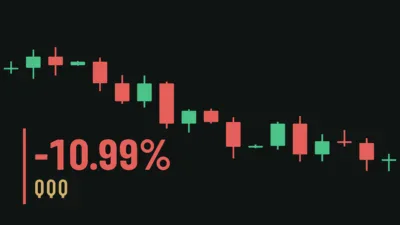
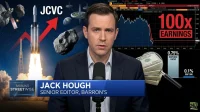
The AI trade is under heavy pressure. The Invesco QQQ Trust (NASDAQ:QQQ) fell 10.99% through November 25, and Bespoke Investment Group said that day that the Nasdaq 100 was in a “-20% bear market.” Jack Hough, host of Barron’s Streetwise, took a listener’s question about what happens if the AI expansion fails. His answer: history already offers a guide.
Hough’s Dot-Com Playbook for an AI Bust
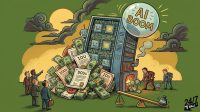
In the November 26 episode, Hough said, “We kind of have a playbook for that with the dot-com buildout of the 1990s,” which he described as “a rip-roaring stock market bubble in hindsight, and it popped in 2000, and returns were painful for a little while, but the market came back. And the stuff we were building back then proved plenty useful.” The problem was timing. In his words, “the payoff didn’t happen with quite the timing that investors were expecting.”
He expects the data center builders and their suppliers to “struggle mightily in the near term” if returns let down. In a big miss, he said, they “could take years to recover,” while money shifts toward companies that use AI. He offered two possible outcomes: “Will it be a graceful deceleration, or will it be like running into a sliding glass patio door carrying a birthday cake? I’m hoping for gentle, but I can’t rule out messy.”
Where the 1990s Comparison Fits Today
The financing pattern looks familiar. In the early days of a gold rush, Hough said, spenders “will issue bonds, they’ll sell shares, they’ll provide financing to each other.” Once evidence shows that returns are slowing, the same companies “get more sensitive to interest rates in a hurry.” Rates are already part of the conversation. A Goldman Sachs (NYSE:GS | GS Price Prediction) strategist warned on November 25 that investors are questioning AI investment returns and rising borrowing costs.
Concentration is the major difference. Index funds now put substantial money into the AI theme itself. NVIDIA (NASDAQ:NVDA) is QQQ’s largest holding at 7.6%[1] of net assets. Micron Technology (NASDAQ:MU) makes up another 5.6%[1], according to the fund’s SEC filings. Hough added that tech is “about 40%” of the S&P 500, and the 10 largest stocks are 37% of it.
Older Investors Hold More of the Risk Than in 2000
Federal Reserve distributional data show that households aged 55 and older held 78.4%[2] of household stocks and mutual funds in 2026 Q2. In 2000 Q1[2], the figure was 61.2%. Through the dot-com bust, equity holdings of households aged 70 and older fell 53% between 2000 Q1 and 2002 Q3[2].
For a retiree, the market’s later recovery helps only if the shares are still in the account. Selling to cover living costs during a slump turns a paper loss into a permanent one.
Hough’s Practical Steps for Retirees: Bonds and Balance
Hough suggested against leaving the market. “I would stay invested and stay diversified,” he said. The purpose of bonds, he explained, is “to give you some money that’s secure and some income coming in so that you can ride out a prolonged downturn in the stock market so that you don’t have to sell shares at low prices and lock in losses.”
For investors concerned that AI dominates their holdings, he suggested an equal-weight S&P 500 fund as a “satellite position” next to a core holding weighted by market cap. Tech is less than 15% of the equal-weight index, and its top 10 stocks make up less than 3%. Fees run higher. Hough’s example was about 0.2% for an equal-weight fund versus 0.05% for a standard one. He also said that diversifying away from big tech “hasn’t really paid off” so far.
Signals That Will Show Which Ending Arrives
Two things to watch: whether AI spenders begin to wonder about their returns and financing costs, and the Federal Reserve’s December 9 decision. Even after the selloff, QQQ is up 135.82% from its October 13, 2022 level. Much of that gain remains at risk.
For investors at or near retirement, the key questions are how much of their index money sits in AI-linked stocks and whether their cash and bonds cover several years of withdrawals, which reduces the risk of being forced to sell stocks after a big drop. Hough’s playbook says the market eventually recovered after 2000. For retirees, safe money is what makes it possible to stay invested until it does.
Contact [email protected] for any questions or corrections.
Chris Lange is a financial and geopolitical writer with more than a decade of experience covering a myriad of topics. He has published thousands of articles for 24/7 Wall St., with past coverage focused heavily on stocks, IPOs, healthcare, defense, global affairs, and technology.
His work has been quoted, or referenced by a number of outlets including Business Insider, USA Today, Yahoo Finance, MSN, The Motley Fool, and many other publications. A graduate of Southwestern University, he studied business with a focus on investments and has previous experience in banking and startups.
When not reading or writing the news, he is following his passion for Lacrosse, playing chess, or building solar projects with his dad.