Microsoft Reports With Zero Sell Ratings and a Year of Flat Returns, We See 22% Upside
Microsoft's revenue surged nearly 18% last year while its stock sat almost perfectly flat, and that disconnect between earnings momentum and share price tells a story most investors are missing ahead of this quarter's report.

Microsoft (NASDAQ:MSFT | MSFT Price Prediction) goes into its fiscal first-quarter 2027 report with a ratings split that almost no mega-cap can match: 14 Strong Buy, 39 Buy, 2 Hold and zero Sell ratings.
Our 24/7 Wall St. price target for Microsoft is $643.14 over the next 12 months. That means 22.62% upside, and our model rates the stock a buy with high confidence.
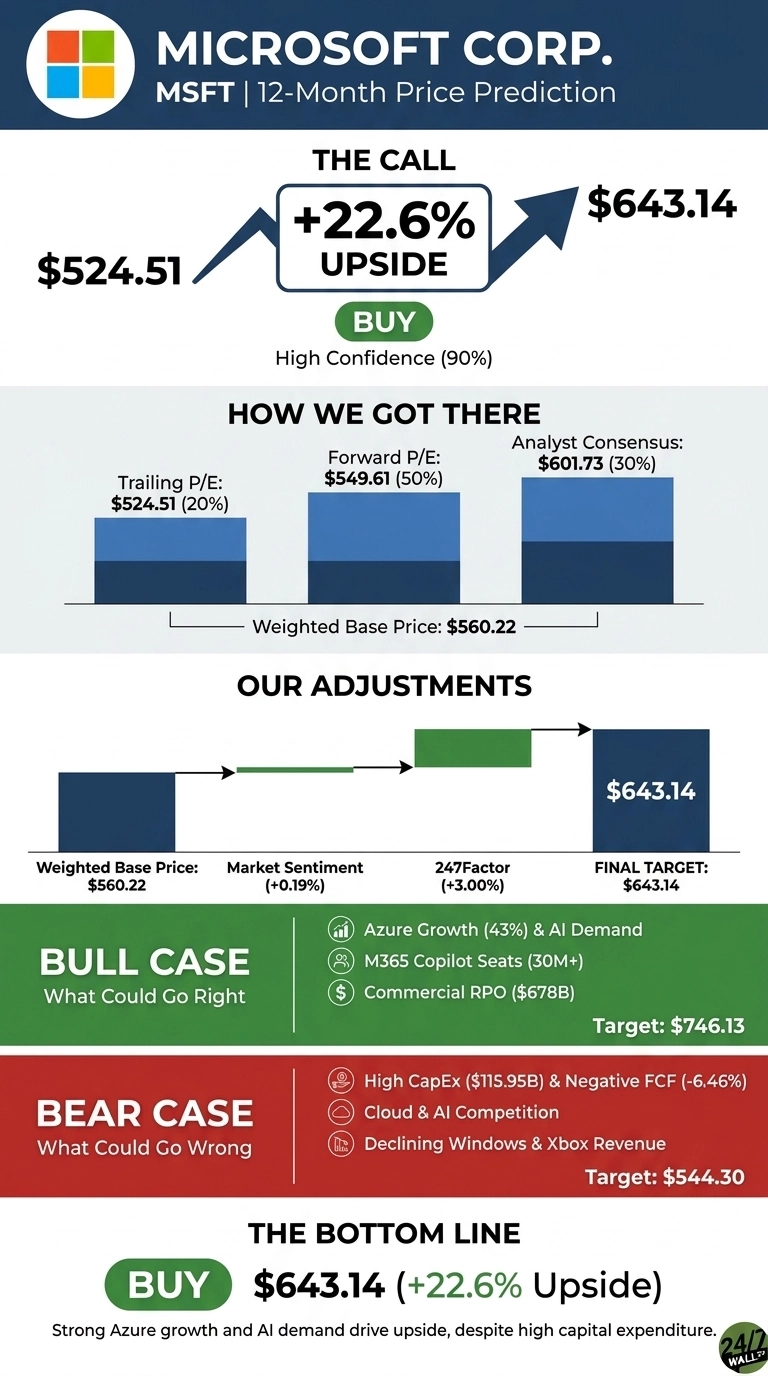
24/7 Wall St. Price Target Summary
| Metric | Value |
|---|---|
| Current Price | $524.51 |
| Price Target from 24/7 Wall St. | $643.14 |
| Upside/Downside | 22.62% |
| Recommendation | BUY |
| Confidence Level | 90% |

Over the past year the stock returned only 2.66%, while fiscal 2026 revenue grew 17.79% to $331.84 billion. Results kept climbing and the share price did not follow. That gap is where I see the opportunity.
A Flat Year Hides a Sharp Rebound Since February
Shares traded at $530.02 Monday morning. They are up 0.18% for the week, 5.88% for the month and 10.29% year to date. That leaves Microsoft 3.8% below its $551.15 52-week high and 52% above its $348.54 low.
The fiscal fourth quarter drove the recovery. Revenue of $90.01 billion beat the $87.63 billion consensus, and EPS of $4.74 exceeded the $4.24 estimate. That made six straight double beats.
Azure grew 43%, and commercial RPO reached $678 billion. For the current quarter, management guided to revenue of $89.85 billion to $90.95 billion and Azure growth of about 45% in constant currency. Preview coverage this week centers on whether that valuation still holds up ahead of earnings.

Why Bulls See $746 Ahead
In our bull case, the stock reaches $746.13. Demand still exceeds supply. As the CFO put it, “Customer demand continues to exceed available capacity.”
Microsoft 365 Copilot passed 30 million paid seats, and net seat adds more than doubled sequentially. Microsoft is also adding usage-based billing on top of per-seat pricing. The consensus target of $601.73 stands well above today’s price.

Spending Is the Risk Worth Watching
Our bear case is $544.30. Fiscal 2026 CapEx reached $115.95 billion, and free cash flow fell 6.46%. Management expects fiscal 2027 CapEx of about $175 billion (that spending has to be powered, cooled, and networked by somebody, and we covered seven of those suppliers in a free AI infrastructure report).
Windows OEM and Devices revenue is expected to decline in the low 20s this quarter. Bulls would counter that operating cash flow rose 34.35%, about two-thirds of CapEx goes to short-lived chips that can be scaled back, and management expects free cash flow to stay positive in fiscal 2027.
Microsoft Holds the Margin Edge Over Alphabet and Amazon
Alphabet (NASDAQ:GOOGL) is the closest AI hyperscaler comparison. The cloud business posted 82% growth, though its P/E of 14 is flattered by a $99.03 billion equity gain. Its quarterly free cash flow came in at -$5.855 billion, and buybacks are suspended.
Amazon (NASDAQ:AMZN) runs AWS, which grew 37%. Amazon trades at a P/E of 34 with trailing free cash flow of -$7.6 billion. MSFT generates positive free cash flow and posts far higher margins, so a 24/7 Wall St. price target of about 33x trailing earnings looks reasonable to me.
| Company | Trailing P/E | Operating Margin | Cloud Growth |
|---|---|---|---|
| Microsoft | 29 | 46.78% | 43% |
| Alphabet | 14 | 32.06% | 82% |
| Amazon | 34 | 11.16% | 37% |
Microsoft Price Prediction 2026-2030
Microsoft earns a buy rating from our model, with a 24/7 Wall St. price target of $643.14 and 90% confidence. The deciding factor is the RPO backlog.
My view gets stronger if Azure delivers about 45% growth and Copilot billing keeps accelerating. I would turn more cautious if CapEx keeps rising while Azure growth slows. For now, flat returns against growing earnings tip the scale toward upside.
Looking further out, this is where our model projects Microsoft could trade if current growth holds. Each figure is the model’s 12-month-forward value from October of that year.
| Year | Price Target from 24/7 Wall St. |
|---|---|
| 2026 | $643.14 |
| 2027 | $749.17 |
| 2028 | $826.89 |
| 2029 | $896.23 |
| 2030 | $966.04 |
Our projections depend on Microsoft keeping up its AI infrastructure strategy. Results could land well above or below them depending on how quickly CapEx turns into revenue and how the OpenAI partnership develops.
Contact [email protected] for any questions or corrections.
Vandita Jadeja is a financial publisher with over a decade of experience writing about financial topics, including investment, savings, retirement, insurance and banking. Vandita is a Chartered Accountant who loves to debunk financial concepts for readers.
Her work has appeared on sites that include The Motley Fool, InvestorPlace, and Benzinga. She covers investing and focuses on stock picks and price prediction for 24/7 Wall St.
When not looking for the next stock investment opportunity, she can be found traveling, reading, chasing sunsets and enjoying her iced latte.