Think QQQ Is Concentrated? This Nasdaq ETF Bets Even Harder on Big Tech (And It’s Winning)
QQQ already tilts heavily toward Big Tech, but a newer Nasdaq ETF cuts the lineup down to just 30 names and bets almost everything on a handful of AI giants. Whether that concentration is a feature or a trap depends…

This post may contain links from our sponsors and affiliates, and Flywheel Publishing may receive compensation for actions taken through them.

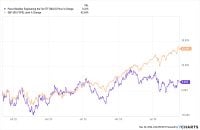
If QQQ already feels like a tech-heavy bet, iShares Nasdaq Top 30 Stocks ETF (NASDAQ:QTOP) takes the same idea and strips it down further. QTOP holds only the 30 largest names on Nasdaq, weighted by market cap, resulting in a portfolio dominated by a handful of AI-era giants and almost nothing behind them. Over the past year, QTOP returned 30%, ahead of Invesco QQQ Trust (NASDAQ:QQQ) at 27%, and it charges just 0.20% to own.
The Fund And What It Actually Does
QTOP launched in October 2024 and manages roughly $266 million, still tiny next to QQQ’s hundreds of billions. The mechanics are simple. Take the Nasdaq-100, keep only the 30 largest names, weight by market cap, and let the top handful do the heavy work. Because those top names are the same mega-cap technology franchises already dominating QQQ, QTOP is best understood as a leverage-free way to lean harder into the megacap AI trade without borrowing or using options.
The return engine is capital appreciation from a concentrated basket. Dividends are almost incidental, since NVIDIA (NASDAQ:NVDA | NVDA Price Prediction) yields near 0.47% and Apple (NASDAQ:AAPL) yields around 0.3%. You buy this for gains, or you are in the wrong fund.
Does The Concentration Actually Pay
Over the trailing year, QTOP beat QQQ by roughly three points. Year to date, the spread is similar, 16% for QTOP versus 15% for QQQ. The gap looks modest, but it is consistent, and it comes almost entirely from cutting the smaller 70 names of the Nasdaq-100 whose average returns dragged the broader index down.
The names doing the driving are exactly the ones you would guess. Alphabet (NASDAQ:GOOGL) is up 94% over the past year on the back of Google Cloud growth and a cloud backlog above $460 billion. Apple is up 59%. Nvidia added another 21% to Q1 FY27 data center revenue at $75 billion, with Jensen Huang calling the AI factory buildout “the largest infrastructure expansion in human history.” Zacks currently has QTOP at its highest research rating.
The Fragility Underneath The Firepower
Microsoft (NASDAQ:MSFT) went down 20% over the same year QTOP delivered a 30% gain. In a top-heavy 30-stock portfolio, such a decline in a single anchor holding usually kneecaps the fund. QTOP survived because Alphabet and Apple did the offsetting work. Next time the offset might not show up.
That is the core tradeoff. Nvidia alone can run past 10% of the fund, technology sits near 60% of assets, and the top handful of names all ride the same AI capex narrative. Polymarket bettors currently see Nvidia clustered tightly around $195 to $200 for week’s end with a sharp probability cliff above $210, meaning even the crowd sees limited near-term upside from the fund’s largest position.
Three risks to weigh. First, correlation. NVDA, MSFT, GOOGL, and AAPL do not diversify against each other during a drawdown. Second, valuation. Nvidia trades at a forward P/E of 23x and Apple at 34x, so multiple compression alone can take a bite. Third, size. QTOP’s small AUM means less trading depth than QQQ if flows reverse in a hurry.
Who This Fund Actually Fits
QTOP works as a satellite, a 5% to 10% sleeve for investors who already own a diversified base and want to deliberately overweight mega-cap tech. They understand they are trading breadth for firepower. Anyone using QTOP as their main equity holding is running a portfolio that is essentially four stocks in a trench coat, and would be better served by QQQ or a total-market fund. The fee is fair, the strategy is candid about what it is, and the trailing-year outperformance versus QQQ is real. Just do not confuse a concentrated tech bet for diversification.
Contact [email protected] for any questions or corrections.
Omor Ibne Ehsan is a writer at 24/7 Wall St. He is a self-taught investor with a focus on growth, cyclical, and dividend equities that have strong fundamentals, value, and long-term potential. He also has an interest in high-risk, high-reward investments such as penny stocks.