SCHG Owns More Apple Than Tesla, Meta and Palantir Combined. Is That Why Growth Investors Are Falling Behind?
SCHG markets itself as a diversified large-cap growth fund, but a closer look at its holdings reveals a much narrower bet, and that structural quirk may explain why growth investors keep watching SPY and QQQ pull ahead.

This post may contain links from our sponsors and affiliates, and Flywheel Publishing may receive compensation for actions taken through them.
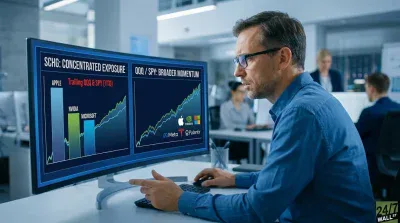
The Schwab U.S. Large-Cap Growth ETF (NYSEARCA:SCHG) devotes 9.83% of the fund to Apple (NASDAQ:AAPL | AAPL Price Prediction), a position larger than its holdings in Tesla (NASDAQ:TSLA) at 3.91%, Meta Platforms (NASDAQ:META) at 3.45%, and Palantir (NASDAQ:PLTR) at 1.25% combined.
SCHG holds nearly two hundred stocks, but that label understates what an investor actually owns.
The Apple weighting is only the start. NVIDIA (NASDAQ:NVDA) sits on top at 11.01%, Apple next at 9.83%, and Microsoft (NASDAQ:MSFT) at 7.17%. Three companies control close to a third of the portfolio. Anyone who bought SCHG for diversified exposure across a large growth basket got something narrower: a three-stock bet wearing broader packaging.
Gap Growth Investors Did Not Sign Up For
Through the September 3 close, SCHG returned 10.12% year-to-date on a price basis. The SPDR S&P 500 ETF Trust (NYSEARCA:SPY) returned 13.38%, and the Invesco QQQ Trust (NASDAQ:QQQ) returned 16.83%. A fund built for growth trailed a broad-market benchmark by roughly 3 points and lost to the Nasdaq-100 by nearly 7 points. The concentration numbers only partly explain that gap.
That said, there’s more to the underperformance.
Blaming Apple alone would be lazy analysis. Apple rose 21.06% year to date, aided by a $109.4 billion June quarter that CEO Tim Cook called “our strongest June quarter ever, with double-digit revenue growth across iPhone, Mac and Services”. NVIDIA rose 22.64% after data center revenue grew 117% year over year. Those two positions helped SCHG.
The drag came from what SCHG under-owns and from what its index rules push toward the top. The Dow Jones U.S. Large-Cap Growth index anchors weights to size and pure-growth factor scores, which promotes established mega-caps even when their year is quiet. Microsoft returned only 6.15% year-to-date, with a 7% weight. Tesla is down 16.31%. Palantir, the year’s marquee AI story, is capped at 1.25% despite 92.83% revenue growth last quarter, because Schwab’s methodology throttles the most expensive names.
QQQ pulled ahead because it captures the same semiconductor and hardware complex that SCHG holds, plus non-growth-classified names like Costco and T-Mobile that the Nasdaq-100 already includes. SPY beat SCHG because its benchmark rewards whichever mega-caps are working, growth-tagged or not.
How SCHG Stacks Up Against VUG
The closest peer is the Vanguard Growth ETF (NYSEARCA: VUG), which returned 9.56% year-to-date. VUG holds a heavier NVIDIA position at 13.3% and an Apple position at 12.3%, and it does not hold Palantir in its top ranks. That the two large-cap growth funds finished within roughly half a point of each other suggests SCHG’s design is not broken. The growth category itself sat behind the market, and any factor-scored large-cap growth vehicle landed in the same neighborhood.
SCHG trades near $36, and some buyers treat that low nominal price as an advantage because a $10,000 deposit buys more shares than an equivalent stake in SPY near $773 or QQQ near $718. It is not an advantage. Returns compound on dollars invested, not share counts, and a lower share price is an accident of how many times a fund has split.
What SCHG Actually Delivers
SCHG’s shortfall this year is mostly a timing problem tied to which mega-caps led. If Apple, NVIDIA, and Microsoft continue leading, the same concentration that pinched in early 2026 reasserts itself in the fund’s favor.
The design problem only shows up if leadership rotates durably toward names SCHG cannot weight heavily, whether Palantir-style AI upstarts or non-growth-tagged cash cows in SPY. Investors who want a purer bet on today’s leaders should look at QQQ. Investors comfortable with a factor-scored, mega-cap-tilted growth basket are getting exactly what SCHG’s rules require.
Contact [email protected] for any questions or corrections.
Omor Ibne Ehsan is a writer at 24/7 Wall St. He is a self-taught investor with a focus on growth, cyclical, and dividend equities that have strong fundamentals, value, and long-term potential. He also has an interest in high-risk, high-reward investments such as penny stocks.