Here Are 5 ETFs Retirees Use to Get Paid Without Leaning on the Magnificent Seven
Most broad index funds quietly hand enormous weight to the same seven companies, which means retirees collecting dividends may be more exposed to big tech than they realize. These five ETFs take a different approach, and the tradeoffs are sharper…

This post may contain links from our sponsors and affiliates, and Flywheel Publishing may receive compensation for actions taken through them.

Many broad index funds now lean heavily on a small group of giant technology-oriented companies: Apple, Microsoft, NVIDIA, Amazon, Alphabet, Meta Platforms and Tesla. The “Magnificent Seven” is an informal market nickname for that group. Some retirees want income that doesn’t depend on how those seven stocks perform. Five ETFs work toward that goal in different ways: SPDR Portfolio S&P 500 High Dividend ETF (NYSEARCA:SPYD), Vanguard International High Dividend Yield ETF (NASDAQ:VYMI), Invesco High Yield Equity Dividend Achievers ETF (NASDAQ:PEY), Pacer US Cash Cows 100 ETF (CBOE:COWZ) and Invesco S&P 500 Equal Weight ETF (NYSEARCA:RSP). The first three focus on dividends. The last two pay small amounts and earn their place for other reasons.
SPYD: High-Dividend Large US Companies
SPYD tracks the S&P 500 High Dividend Index, which holds the top 80 high dividend-yielding companies within the S&P 500. Its most recent disclosed holdings, as of June 30, 2026, listed 82 positions. The Magnificent Seven made up a combined 0% of the fund. The largest stock position was Iron Mountain, at about 1.6% of assets, so no single company drives results.
The fund’s fact sheet shows the sector tilt: real estate at 21.59%, financials at 17%, consumer staples at 16.14%, and utilities at 13.48%. Information technology is just 1.13% of the fund. SPYD lists a dividend yield of 4.72% and an expense ratio of 0.07%. It pays quarterly, and the payment amount varies: the latest payment was $0.517794 per share, down from $0.542849 the quarter before.
VYMI: High-Dividend Companies Outside the US
VYMI tracks the FTSE All-World ex US High Dividend Yield Index, which covers non-US companies with high dividend yields. All seven Magnificent Seven companies are based in the US, so the fund’s rules leave them out by design. You also get income from economies that run on different cycles than the US market.
The Vanguard fact sheet lists an expense ratio of 0.07%, a dividend yield of 4.21% and about $13.054 billion in assets. VYMI pays quarterly, but the checks swing widely: $0.817 per share in September versus $1.2569 in June. Its adjusted price gained 25.14% over the past year. Currency moves can push those returns either way.
PEY: Higher Yields From Proven Dividend Raisers
PEY tracks the Nasdaq US Dividend Achievers 50 Index. It picks the 50 issuers with the highest modified dividend yield from a broader group of companies with at least 10 consecutive years of dividend increases. As of July 31, 2026, it held 52 positions, and the Magnificent Seven made up 0% of the fund. Its largest stock holdings were Robert Half and Insperity, each near 3.9%.
PEY pays monthly, which makes budgeting easier. Its latest payment of $0.09881 per share lands on October 23. Distributions over the past 12 months came to about $1.05 per share, and the shares recently traded near $23.59. The prospectus lists an expense ratio of 0.68%, the highest of these five funds.
COWZ: Companies Screened on Free Cash Flow
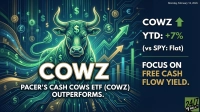
Free cash flow is the cash a business has left after paying its operating costs and investing in equipment and facilities. COWZ ranks large US companies by free cash flow yield, which compares that cash to the company’s share price, and holds the top 100. As of July 31, 2026, it held 102 positions, with a combined Magnificent Seven weight of 0%. The fund reconstitutes periodically, so its holdings can change, and that figure reflects only a single point in time. Additionally, it still owns tech companies like Adobe and Salesforce.
COWZ lists a yield of 1.7%, so it plays a small role in your income. Its value lies in the cash-flow screen. It charges 0.49% a year, and its quarterly payouts vary sharply.
RSP: Every S&P 500 Stock at Equal Weight
RSP owns every company in the S&P 500, the Magnificent Seven included. What changes is the weighting. As of July 31, Microsoft made up about 0.23% of the fund and NVIDIA about 0.19%, similar to most of its 508 positions. The fund holds those giants without depending on them.
RSP charges 0.20%. Its payout is small: about $3.18 per share over the past 12 months, with shares recently near $215.95.
What You Give Up by Leaning Less on Big Tech
Owning less of these seven companies cuts both ways. If they fall, your portfolio depends less on them. If they keep leading, you capture less of that upside. Dividend-focused funds also tend to lean toward real estate, utilities, and other rate-sensitive sectors. None of these distributions is fixed or guaranteed, and every fund above has cut a payment from one period to the next.
For retirees who want income that doesn’t depend on a handful of tech giants, the roles are clear. SPYD, VYMI, and PEY provide the income. COWZ and RSP broaden what you own without adding much yield.
Contact [email protected] for any questions or corrections.
Ryne Mauck is an investment writer covering exchange-traded funds, retirement planning, and portfolio strategy. Through his work at 24/7 Wall St. and other investment platforms, including Seeking Alpha, he aims to provide clear, research-driven insights that help investors make more informed decisions while maintaining a long-term approach to investing.
Ryne holds a B.Sc. in Finance and an M.A. in Political Science. He is a formerly registered Municipal Advisor Representative and has passed the Series 50, Series 63, and Series 65 exams. His articles are not intended to be, nor should they be interpreted as, financial advice.