Investors Have Poured a Record $2.24 Trillion Into ETFs This Year. Three Firms Collected Nearly Half of It
A record $2.24 trillion has flooded into ETFs worldwide this year, yet despite thousands of funds competing for that money, nearly half of it ended up in the hands of just three companies running essentially the same idea.

This post may contain links from our sponsors and affiliates, and Flywheel Publishing may receive compensation for actions taken through them.
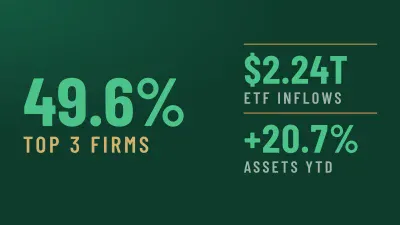
Investors have poured a record $2.24 trillion into exchange-traded funds worldwide so far this year, according to industry research firm ETFGI, which tracked the total through September 2026. Most of that money landed in a familiar place.
Nearly half of it went to just three firms. ETFGI reports that iShares, Vanguard, and State Street SPDR gathered $1.11 trillion in net new assets year to date, or 49.6% of all global ETF inflows in 2026. Net inflows are simply the money investors put into funds minus what they took out.
Those three companies run the best-known S&P 500 funds on the market: iShares Core S&P 500 ETF (NYSEARCA:IVV), Vanguard S&P 500 ETF (NYSEARCA:VOO), plus the State Street SPDR S&P 500 ETF Trust (NYSEARCA:SPY). New funds are starting at a record pace worldwide, yet investors keep sending the most money to the biggest, cheapest, and simplest options.
Assets Slipped in September While the Money Kept Flowing In
ETFs gathered $276.06 billion in net inflows during September alone, according to ETFGI. ETFGI says that marked the 88th consecutive month of net inflows into ETFs globally.
Total assets moved the other way. ETFGI says global ETF assets stood at $23.91 trillion at the end of September, slightly below the record $24.03 trillion reached at the end of August. In plain terms, assets dipped in September even as new money kept coming in, and ETFGI points to weaker equity markets that month as the backdrop.
That gap makes sense once you know what assets under management means: the total market value of everything held in the funds, which grows with new deposits and market gains, and can shrink when prices fall, even if investors keep buying.
Over the full year, global ETF assets have increased 20.7% year to date, ETFGI says, up from $19.81 trillion at the end of 2025.
Three Firms Now Control More Than Half of All ETF Money
iShares, Vanguard, and State Street SPDR managed $13.93 trillion at the end of September. ETFGI puts that at 58.3% of global ETF assets.
ETFGI’s August report shows how each firm got there. iShares, the largest ETF provider globally, held $6.55 trillion at the end of August and had gathered $410.51 billion in net inflows year to date through August.
Vanguard, the second largest provider, held $5.18 trillion at the end of August, and led all providers with a record $440.69 billion in year-to-date net inflows through August. State Street SPDR ranked third with $2.35 trillion in assets and $132.39 billion in year-to-date inflows through August, according to ETFGI.
The leading S&P 500 funds drew a large share of that money. SPY gathered $10.70 billion in September, the most of any ETF in the world that month. VOO pulled in $27.18 billion in August alone. IVV rounds out the trio as iShares’ leading S&P 500 fund.
Active ETFs Are Pulling In Money Far Faster Than Last Year
The jump reached nearly every corner of the market. Equity ETFs drew $976.17 billion year to date through September, compared with $677.01 billion through September 2025.
Fixed income ETFs, which hold bonds, took in $437.78 billion through September, ahead of the $314.16 billion gathered over the same period of 2025.
Active ETFs stood out. These are funds where managers choose the investments instead of copying an index. ETFGI reports active ETFs took in $733.95 billion year to date through September, well above the $446.75 billion gathered through September 2025.
Investors Keep Choosing Low-Cost Core Funds
In 2026, investors have more ETF choices than ever, and active strategies are winning real money, but investors still send the most money to a few of the giant index funds.
For investors near retirement, that pattern offers useful context. A single S&P 500 fund from one of the big three holds 500 of the largest U.S. companies in one position. Flow data shows those big core funds remain the most popular choice, even amid a record wave of new launches.
Contact [email protected] for any questions or corrections.
Ryne Mauck is an investment writer covering exchange-traded funds, retirement planning, and portfolio strategy. Through his work at 24/7 Wall St. and other investment platforms, including Seeking Alpha, he aims to provide clear, research-driven insights that help investors make more informed decisions while maintaining a long-term approach to investing.
Ryne holds a B.Sc. in Finance and an M.A. in Political Science. He is a formerly registered Municipal Advisor Representative and has passed the Series 50, Series 63, and Series 65 exams. His articles are not intended to be, nor should they be interpreted as, financial advice.