Jensen Huang Is Out. Here’s How Much Nvidia’s Selloff Cost a $10,000 QQQ Position

This post may contain links from our sponsors and affiliates, and Flywheel Publishing may receive compensation for actions taken through them.
Nvidia (NASDAQ:NVDA | NVDA Price Prediction) shares were down 5.01% at $165.03 as of 10:29 AM ET on Thursday, after Jensen Huang resigned as chief executive. Axios reported that the stock fell as much as 13% after the news and then recovered some of that loss. Investors who hold Nvidia through the Invesco QQQ Trust (NASDAQ:QQQ) took a much smaller hit, because of how little of the fund Nvidia makes up.

Inside Nvidia’s Leadership Shake-Up
Per Axios, Nvidia’s board named longtime CFO Colette Kress interim CEO and started a search for a permanent replacement. Axios reported that Nvidia did not give a reason for the resignation. The departure follows press reports about Huang’s personal relationships. Axios noted that The New York Times reported Wednesday that Huang had a relationship with a senior Nvidia executive who reports to him.
Axios also reported that on Nov. 8, Nvidia’s board announced an independent investigation after reports that Huang may have been targeted by a foreign intelligence effort. The New York Times reported that U.S. officials believed a businesswoman with close ties to Huang was gathering intelligence for Beijing.
In a note to staff quoted by Axios, Kress wrote: “I believe deeply in this company and in its future.” According to the same report, the board expects operations, customer commitments and the product roadmap to continue without interruption.
Huang leaves a business that was still growing quickly. For the fiscal second quarter, reported Aug. 26, 2026, Nvidia posted revenue of $96.22 billion, up 105.8% YoY. Non-GAAP EPS came in at $2.22, beating the $2.09 consensus. Third-quarter guidance called for revenue of $108.0 billion, plus or minus 2%. When Nvidia next reports, leadership questions will now sit beside the data center story (Morningstar).

What a $10,000 QQQ Position Lost Today and This Month
As of 10:29 AM ET, QQQ was down 0.58%. On a $10,000 position, that comes to about $58. Over the past month, QQQ has dropped 8%, or about $800 on the same investment.
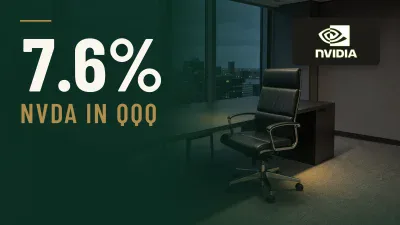
The fund’s most recent holdings filing, dated June 30, 2026, places Nvidia at about 7.6% of net assets. On that date, roughly $760 of a $10,000 position was in Nvidia. Applying today’s Nvidia decline to that weight, Nvidia accounts for about $38 of today’s loss. Over the past month, the calculation points to about $206. These are rough estimates. Nvidia’s actual weight has changed since June.
A direct investment shows the difference. Over the same windows, $10,000 in Nvidia shares lost about $501 today and about $2,708 over the month, as the stock fell 27.08%.
Why One Stock Can Only Move an Index Fund So Far
A holding’s weight sets a limit on how much it can move the fund. When a stock is about 7.6% of the portfolio, even a 27% drop takes only a small cut off the total. QQQ tracks the Nasdaq-100, which uses a “modified market capitalization-weighted” method. Under its rules, no single component may exceed 24% of the index.
Narrower funds offer less of that cushion. As of June 30, 2026, Nvidia made up 14.65% of the Technology Select Sector SPDR Fund (NYSEARCA:XLK) and 17.55% of the VanEck Semiconductor ETF (NASDAQ:SMH). With that much weight in one stock, a selloff like this month’s hurts those funds more than it hurts QQQ.
Concentration and Overlap Risk in Retirement Accounts
QQQ reported net assets of about $490.1 billion as of June 30, and its Nvidia investment was worth about $37.2 billion. Axios put it this way: because of Nvidia’s size, the move has “massive implications for every American with a retirement account.” As a few mega-caps take up more of these funds, a leadership crisis at one company hits portfolios that were built to spread risk around.
Overlap can be easy to miss. Someone who holds QQQ, XLK, and SMH has Nvidia three times, and an S&P 500 index fund in the same account would likely add a fourth position. Each fund looks diversified by itself. Combined, the Nvidia exposure can end up well above what any single fund shows.
Next up are the CEO search and Nvidia’s next earnings report. Analysts are already considering the leadership change. According to a summary posted on X, Goldman Sachs kept a Buy rating with a $220 price target but expects a search for the “right multiple.” For QQQ holders, the losses so far have been small compared with what direct shareholders took in.

Contact [email protected] for any questions or corrections.
Ryne Mauck is an investment writer covering exchange-traded funds, retirement planning, and portfolio strategy. Through his work at 24/7 Wall St. and other investment platforms, including Seeking Alpha, he aims to provide clear, research-driven insights that help investors make more informed decisions while maintaining a long-term approach to investing.
Ryne holds a B.Sc. in Finance and an M.A. in Political Science. He is a formerly registered Municipal Advisor Representative and has passed the Series 50, Series 63, and Series 65 exams. His articles are not intended to be, nor should they be interpreted as, financial advice.