Who Benefits Most from Taking Social Security at 62? Dave Ramsey Breaks It Down
Dave Ramsey is not always right. Financial situations come in every shape imaginable, and there is rarely a single solution that works for everyone. Opinions and viewpoints are unavoidable, and it is perfectly reasonable to disagree with any pundit on…

This post may contain links from our sponsors and affiliates, and Flywheel Publishing may receive compensation for actions taken through them.

Dave Ramsey is not always right. Financial situations come in every shape imaginable, and there is rarely a single solution that works for everyone. Opinions and viewpoints are unavoidable, and it is perfectly reasonable to disagree with any pundit on any particular topic. That said, there is one Ramsey position that is worth taking seriously: collecting Social Security at 62, the earliest age you can file.
Delayed gratification is usually a sound financial strategy, and waiting past 62 does raise your monthly benefit. But the real-world value of that money is not constant across every stage of life. The enjoyment and utility you get from a benefit check can be substantially greater in your early 60s, even when the dollar figure is smaller. A modest payment collected now may deliver more practical value than a larger one arriving a decade later.
Taking Social Security sooner rather than later: why it can make more sense than delaying
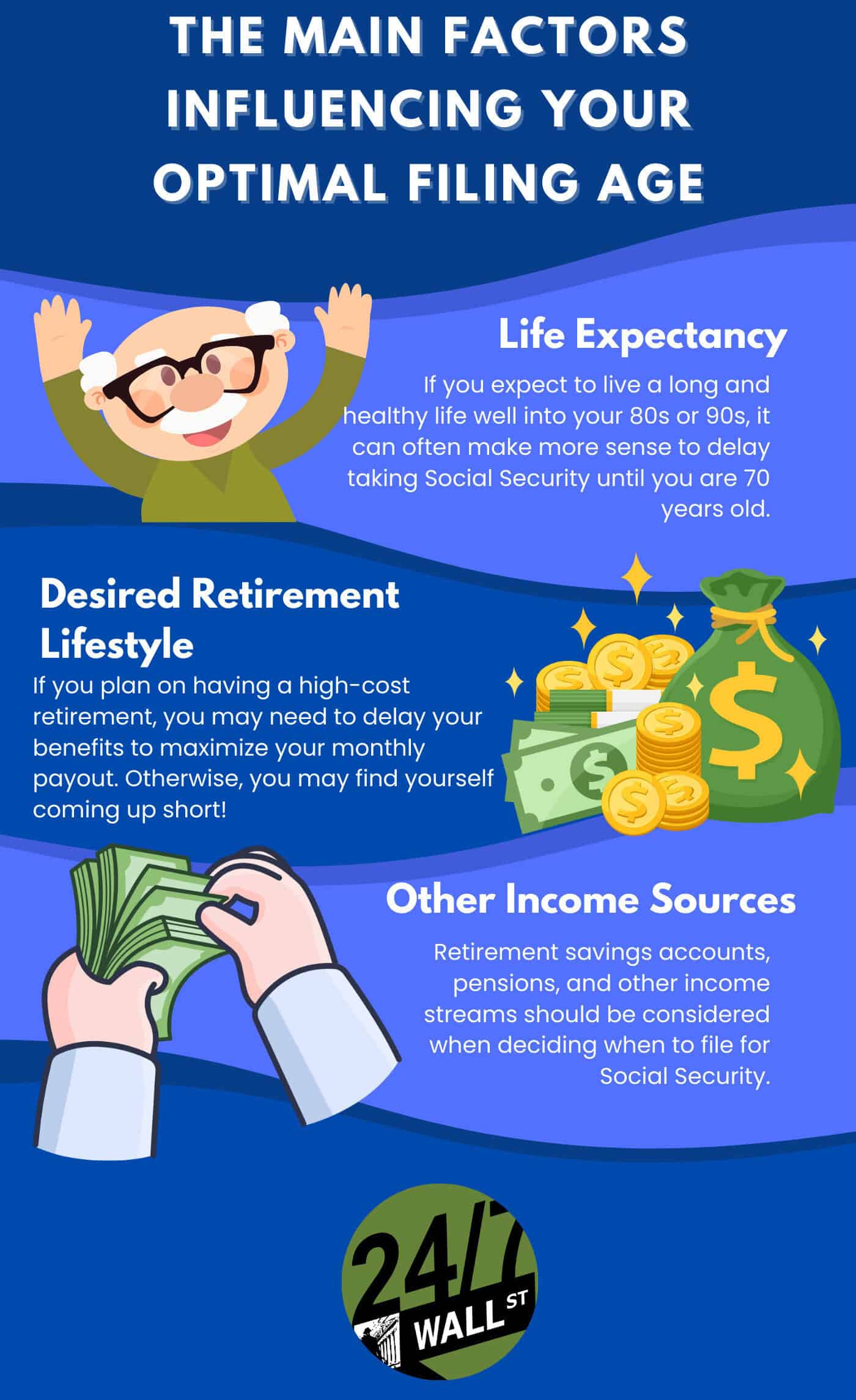
Good health is one of the strongest arguments for collecting earlier. Unexpected health issues become more common with age, and the capacity to travel, stay active, and genuinely enjoy life tends to peak in the early 60s for many people. Accepting a smaller benefit now, rather than holding out for a larger one, can simply make better use of the years when you are most physically capable.
The time value of money can also tilt in your favor at 62, though this choice remains deeply personal. The correct answer depends on health, finances, family dynamics, and individual goals. Many people who reach 62 today will live well into their late 80s or beyond, a reality worth weighing carefully. For those with good health and a long family history of longevity, delaying claims remains a rational option.
The decision also does not have to be locked in all at once. You can choose to file or wait, then revisit that plan year by year as your circumstances, health, or financial needs evolve.
With that context in place, here is why Ramsey believes taking Social Security at 62 is a smart move, along with a closer look at the trade-offs his advice carries.
Take the money and invest it
| Claiming Age | Monthly Benefit (as % of FRA Benefit) | Pros | Cons |
|---|---|---|---|
| 62 | 70% | – Receive benefits early – Can use income if retiring early |
– Reduced monthly benefit for life – May not maximize lifetime benefits if you live long |
| FRA (66-67 depending on birth year) | 100% | – Full monthly benefit – No reduction for early claiming |
– No early access to funds – Lower than benefits at age 70 |
| 70 | 124% | – Maximized monthly benefit – Ideal for those with longer life expectancy |
– Delay in receiving benefits – May not be optimal for those with shorter life expectancy |
Even without an urgent need for cash today, collecting at 62 and investing those checks could produce a greater long-run return than waiting. Ramsey has argued that even someone who expects to live to 100 can come out ahead by taking the money early and putting it to work in the market. Beyond the potential return, early collection builds a cash cushion that creates genuine flexibility when unexpected costs arise. Ramsey specifically cites that flexibility as a central reason to begin payments sooner rather than later.
Putting early Social Security checks into blue-chip stocks or a broad index fund has clear appeal, particularly for those who can add capital during sharp market downturns. The recovery that followed the March 2020 crash illustrates the kind of opportunity that extra liquidity can unlock. For those who prefer simplicity, Ramsey argues that even a low-cost mutual fund can outperform the guaranteed, but inflation-indexed, increases that come from delaying claims to 70.
This strategy carries real constraints. Anyone who files early and keeps working runs into the Social Security earnings test. For 2026, the SSA withholds $1 in benefits for every $2 earned above $24,480 annually for beneficiaries who remain under Full Retirement Age for the entire year. In the calendar year you reach Full Retirement Age, a softer rule applies: $1 is withheld per $3 earned above $65,160, counting only earnings before your FRA month. One important nuance is that withheld amounts are generally credited back through a benefit recomputation at Full Retirement Age, so the earnings test functions more as a deferral than a permanent penalty. Beyond the earnings test, early filers face up to a three-year gap in healthcare coverage before Medicare eligibility begins at 65. The 2026 standard Part B premium is $202.90 per month, with an annual deductible of $283, costs that belong in any pre-Medicare budget calculation.
Congress may yet change the earnings test rules. Senator Rick Scott introduced the Senior Citizens’ Freedom to Work Act (S. 4184) in the Senate on March 24, 2026, with Representative Greg Murphy following with the House companion (H.R. 8344) on April 16, 2026. The legislation would repeal the earnings test entirely for pre-Full Retirement Age beneficiaries. As of late summer 2026, both bills remain in committee, but their introduction reflects a growing bipartisan frustration with a rule many retirement experts consider outdated.
Sequence of returns risk adds another layer to consider. A severe market downturn early in retirement can permanently damage a portfolio, even while the retiree remains locked into a permanently reduced baseline benefit. Filing at 62 also caps potential survivor benefits for a remaining spouse, a household-level consequence that individual investment calculations often miss. By contrast, delaying claims past Full Retirement Age earns a guaranteed, inflation-indexed increase of roughly 8% per year up to age 70, a risk-free benchmark that active market strategies rarely beat with consistency.
The long-term funding picture adds urgency to every claiming decision. The Social Security Trustees’ 2026 annual report, released June 9, 2026, projects that the Old-Age and Survivors Insurance (OASI) trust fund will deplete its reserves in the fourth quarter of 2032, one quarter earlier than the prior year’s estimate. At that point, ongoing payroll tax revenue would cover only about 78% of scheduled benefits unless Congress intervenes, a roughly 22% automatic cut for all recipients. The same report puts the program’s 75-year actuarial deficit at 4.42% of taxable payroll, up from 3.82% in the 2025 report, representing the largest shortfall in nearly half a century according to the Committee for a Responsible Federal Budget. The Trustees attributed part of the deterioration to lower projected immigration levels and to income-tax provisions in the One Big Beautiful Bill Act that reduced revenues flowing back to the trust funds.
The numbers translate directly to household budgets. The average monthly Social Security retirement benefit reached $2,087.52 as of August 2026, according to the SSA’s Monthly Statistical Snapshot. A 22% reduction upon trust fund depletion would cut that average check by roughly $460 per month, a loss that illustrates just how much is at stake if Congress fails to act before 2032. Looking ahead, forecasters currently place the 2027 cost-of-living adjustment in a range of 3.4% to 3.6%, with the Senior Citizens League’s most recent estimate at 3.5% and AARP projecting 3.6%. The official figure will be announced by SSA in mid-October. If a 3.5% adjustment takes effect, the average retired-worker benefit would climb by roughly $73 per month, which would mark the largest annual increase since 2023.
On balance, Ramsey’s position is clear: take Social Security early, invest the proceeds, and treat the program as one component of a broader retirement plan rather than its entire foundation. For those who value flexibility and investment opportunity, and who can accept the market risk that comes with putting those early checks to work, claiming at 62 is a case worth examining carefully.
The bottom line
There is no universal right answer in personal finance. Do not act on Ramsey’s advice without doing your own research and consulting a financial advisor who can evaluate your specific situation, concerns, and goals.
If you want more capital to invest through your 60s and place a premium on financial flexibility, Ramsey’s argument for taking Social Security at 62 is among the more compelling positions he has staked out. Just make sure the complete picture is part of your thinking before you file: healthcare costs in the gap before Medicare, the earnings test and its potential legislative repeal, spousal and survivor benefit implications, and the program’s long-term funding trajectory.
Editor’s note: The average monthly Social Security retirement benefit figure has been updated to $2,087.52 per the SSA’s August 2026 Monthly Statistical Snapshot, and the 2027 COLA projection has been revised to reflect a current forecaster range of 3.4% to 3.6%, with the Senior Citizens League’s latest estimate at 3.5%, down from the 3.6% estimate cited in the prior version of this article. The earnings test section was expanded to include the higher $65,160 FRA-year threshold and to note that withheld amounts are generally credited back at Full Retirement Age.
Contact [email protected] for any questions or corrections.