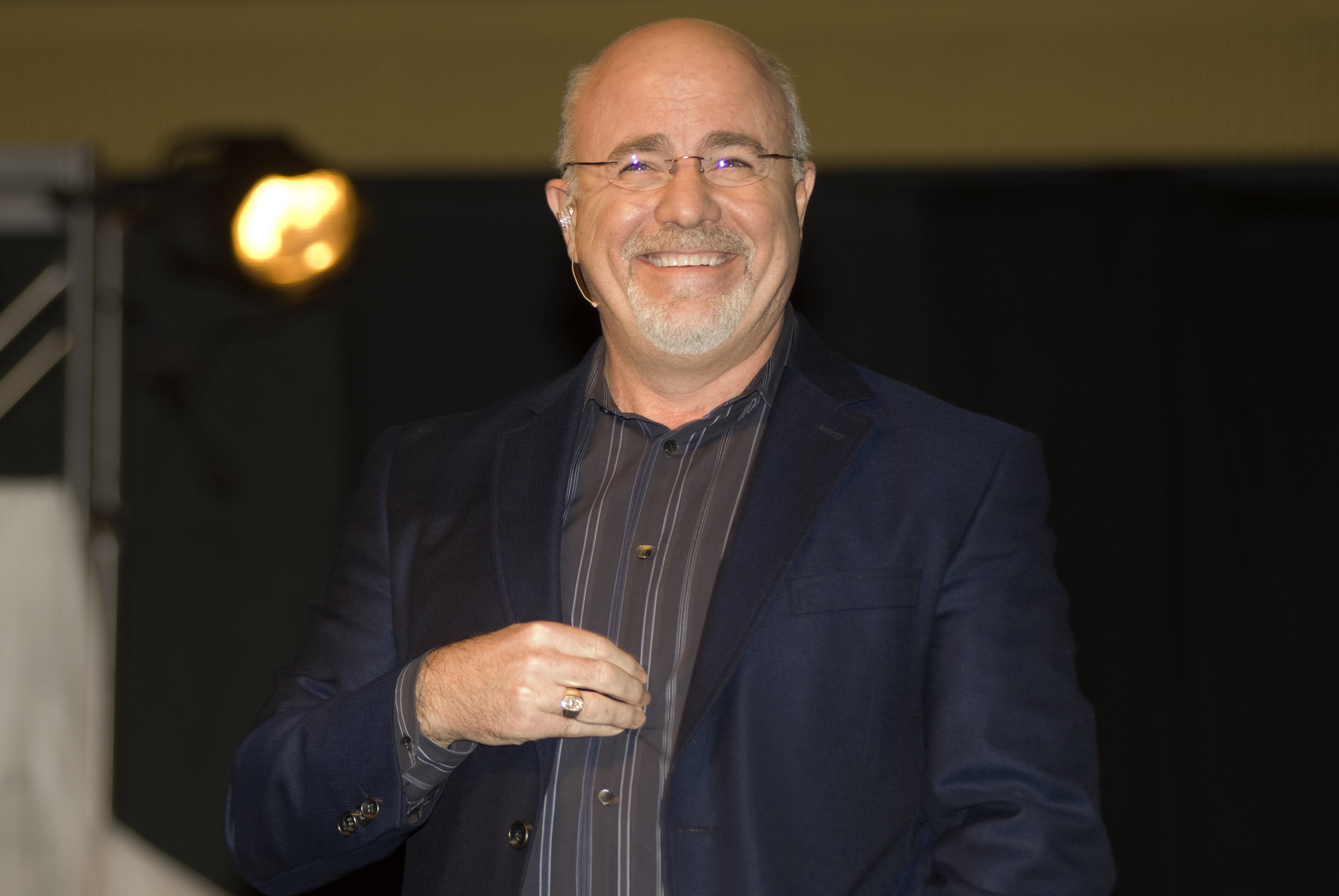
Dave Ramsey’s Social Security Advice is the Opposite of Everything He Stands For
Dave Ramsey has created a name for himself in the world of personal finance as being extremely conservative when it comes to savings and debt. Ramsey feels that consumers should, on a whole, protect themselves with savings and avoid debt…

This post may contain links from our sponsors and affiliates, and Flywheel Publishing may receive compensation for actions taken through them.
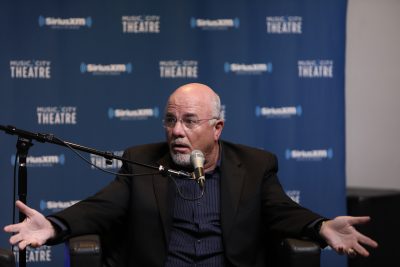
Dave Ramsey has built his reputation in personal finance on a single core principle: protect yourself with savings and stay out of debt. He has applied that philosophy to nearly every corner of daily spending, from car purchases to vacations to housing, and he has even gone so far as to suggest that Americans buy a home with cash rather than take on a mortgage.
That makes his position on Social Security all the more striking. When it comes to claiming benefits, Ramsey breaks sharply from his own playbook, and the reasoning behind that break deserves a close look.
Why Ramsey’s Social Security advice defies his usual logic
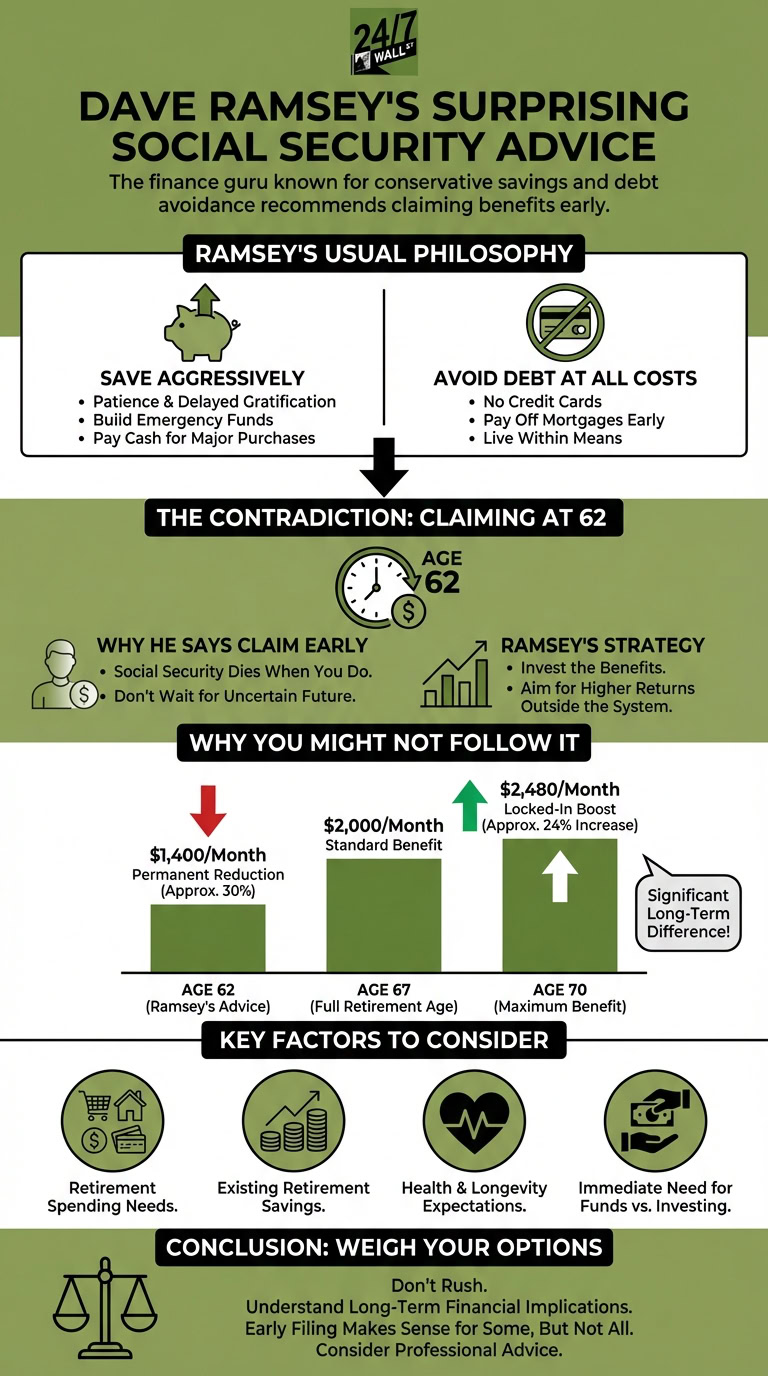
Ramsey’s financial guidance rests on patience and delayed gratification. Save first, spend later. Avoid debt-financed convenience in every category: automobiles, clothing, travel. That philosophy is what makes his Social Security advice so surprising. He tells Americans to claim at the earliest possible age: 62.
For anyone born in 1960 or later, full retirement age (FRA) is 67. Waiting until FRA means collecting 100% of the benefit earned through a lifetime of payroll taxes. Delaying past FRA adds roughly 8% per year, so holding out until 70 pushes the monthly check to 124% of the FRA amount. Filing at 62, by contrast, locks in a permanent 30% reduction. A person with an FRA of 67 who claims at 62 walks away with just 70% of their full benefit, for life.
Yet Ramsey recommends filing at 62 anyway, and he offers two distinct arguments. The first is straightforward: benefits stop when you die, so collecting earlier means more total payments if your lifespan is average or shorter. The second goes further. Ramsey does not suggest grabbing the check and spending it. His recommendation is to start payments at 62 and immediately channel the money into a diversified mutual fund, on the theory that investment returns can outpace the guaranteed 8% annual increase available by waiting. As he has stated on the Ramsey Solutions blog, “You can do a much better job investing that money than the government ever could.”
You may not want to follow Ramsey’s advice
Some of Ramsey’s thinking reflects genuine concern about Social Security’s financial durability, and those concerns are harder to dismiss than ever. The 2026 Social Security Trustees Report, released June 9, 2026, projects that the Old-Age and Survivors Insurance (OASI) trust fund will be able to pay 100% of scheduled benefits only through the fourth quarter of 2032, one quarter earlier than the prior year’s report projected. Part of that acceleration stems from the “One Big Beautiful Bill Act,” which lowered tax liability for Social Security beneficiaries and thereby reduced trust fund revenue. Demographic headwinds played an even larger role: the Trustees sharply revised down their fertility and immigration assumptions, cutting projected payroll tax revenue for decades to come. Unless Congress acts, OASI fund depletion would trigger an automatic 22% benefit cut for everyone receiving checks at that time. On a combined basis, the OASI and Disability Insurance trust funds are projected to run dry in 2034, unchanged from last year’s estimate, which would trigger a 17% cut. The program’s long-run picture has also darkened considerably: the 75-year actuarial shortfall now stands at approximately $30.3 trillion, up from $26.1 trillion in last year’s report.
That is a real risk worth factoring into any claiming decision. Even so, filing at 62 locks in a smaller check before any future cuts are even applied. The Senior Citizens League’s 2026 Loss of Buying Power study found that Social Security benefits have already lost 13.7% of their purchasing power since 2016, because annual cost-of-living adjustments have consistently trailed real-world retiree expenses in categories like healthcare, housing, and utilities. The 2026 COLA was 2.8%, raising the average retired worker’s monthly check to $2,071. Starting with a permanently reduced base only compounds that erosion over time.
The numbers tell the story plainly. Imagine you are eligible for a $2,000 monthly benefit at your FRA of 67. Claiming at 62 pays $1,400 a month (70% of the full amount), waiting to FRA pays $2,000, and delaying to 70 pays $2,480 a month (124%). Those gaps compound over decades. According to AARP, the break-even point at which cumulative lifetime benefits from claiming at FRA surpass those from claiming at 62 arrives at around age 78 and 8 months. Anyone who lives into their 80s comes out ahead by waiting. The Social Security Administration’s own life expectancy data puts the average 65-year-old more than 20 years from that birthday. Notably, the SSA discontinued its own online break-even calculator after finding it frequently steered users toward early claiming.
There is also a practical obstacle embedded in Ramsey’s invest-the-checks plan. In 2026, any beneficiary under FRA who is still working and earns more than $24,480 will have Social Security withhold $1 in benefits for every $2 earned above that threshold. That earnings test creates a direct conflict for anyone who has not fully stopped working by 62. To execute the strategy as Ramsey describes it, a retiree generally needs to be completely out of the workforce and financially positioned to cover all living expenses while routing every check into the market. That is a high bar. According to Fidelity’s Q1 2026 data, the average 401(k) balance for workers aged 60 to 64 is $257,400, but the median is close to $89,000, meaning most workers approaching retirement have far less than the average implies. The share of new beneficiaries claiming at 62 fell to about 26% in 2024, the lowest level in at least 40 years. That said, 2025 saw a surge of roughly 11% in early claims as some Americans rushed to file amid fears about the program’s future and staffing cuts at the SSA.
Your Social Security claiming decision ultimately comes down to several personal factors:
- What your retirement spending needs look like
- How much money you have saved for your senior years
- How healthy you are, and how you expect that to affect your longevity
If Social Security is your primary source of living expenses in retirement, investing those checks is simply not realistic. Ramsey’s strategy of claiming early and channeling the money into equities depends on several conditions that are far from guaranteed. Market performance is the most obvious variable: returns are volatile, especially over shorter timeframes, and a retiree who claims at 62 and immediately encounters a prolonged downturn may find this approach underperforms a straightforward decision to delay. The 8% annual increase from waiting is a guaranteed, government-backed return on a stream of payments that lasts a lifetime. Historical stock returns averaging 7% to 10% annually represent a long-run figure, not a promise for any specific retirement window.
Ramsey’s debt-avoidance and savings philosophy serves people well across most areas of personal finance. On Social Security specifically, his advice may fit a narrow set of circumstances: a retiree who is fully debt-free, has substantial savings well beyond a typical 401(k) balance, is genuinely committed to investing every check rather than spending it, and has reasons to expect a shorter-than-average lifespan. For everyone else, running the break-even math against your own health history and income needs is the smarter first step before accepting a permanently reduced benefit.
Editor’s note: This update corrects the average retired-worker Social Security benefit to $2,071 per month, reflecting the SSA’s official 2026 COLA fact sheet, and updates the average 401(k) balance for workers aged 60 to 64 to $257,400 based on Fidelity’s Q1 2026 data. It also adds context that demographic shifts, including revised fertility and immigration assumptions, were the largest drivers of Social Security’s worsened financial outlook, with the “One Big Beautiful Bill Act” a secondary factor.
Contact [email protected] for any questions or corrections.
Maurie Backman has more than a decade of experience writing about financial topics, including retirement, investing, Social Security, and real estate. Her work has appeared on sites that include The Motley Fool, USA Today, U.S. News & World Report, The Washington Post, and Kiplinger.
Prior to becoming a full-time financial writer, Maurie worked in the financial industry trading distressed debt. She then changed course and spent a few years designing electronic toys. After a stint in content marketing and UX, she shifted back into writing and has since covered everything from the housing market to estate planning to Medicare.
When she's not busy writing, Maurie can be found hiking, walking her dogs, driving her kids to their various sports practices and games, and curling up with a good book. She cooks on occasion and bakes way too often.