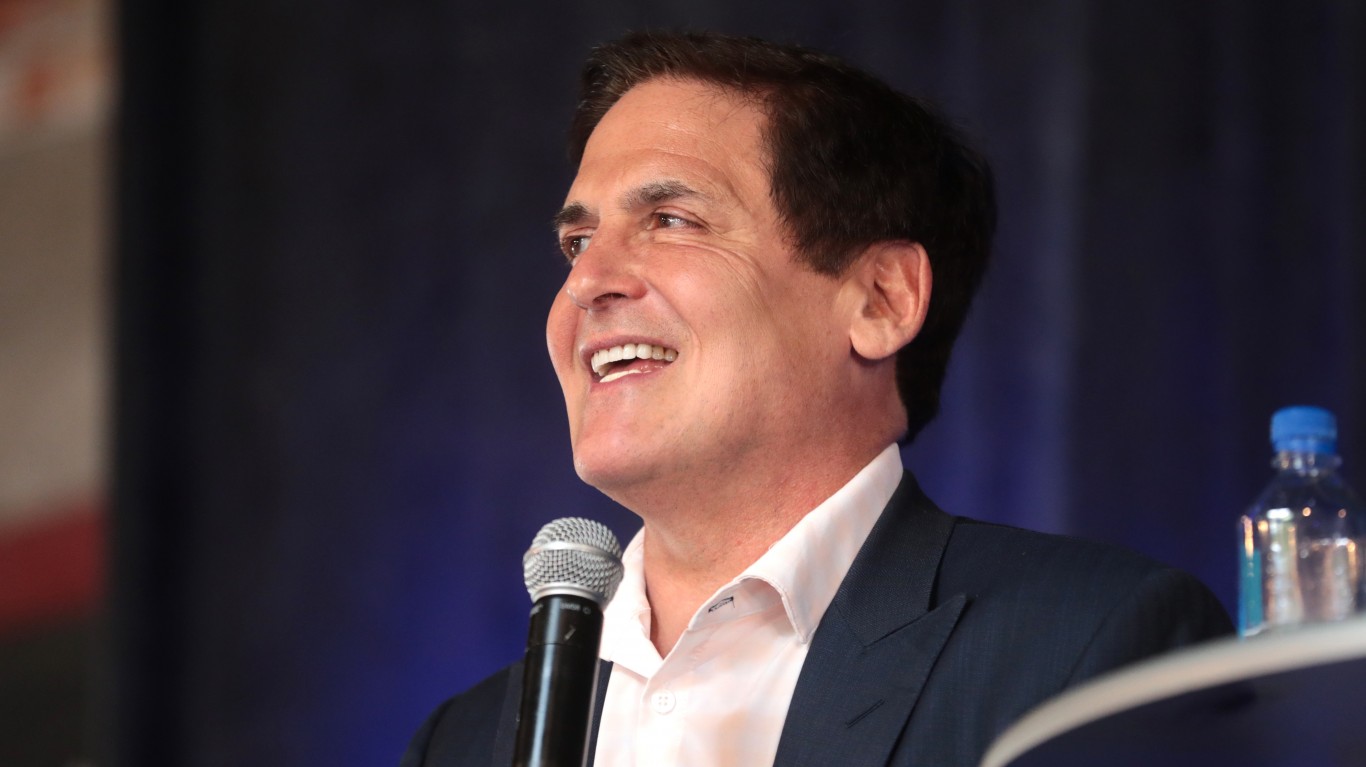
Mark Cuban is absolutely right when he says “if you’re happy when you’re poor, you’re gonna be happy when you’re rich”
Mark Cuban is well-known today as a billionaire entrepreneur and investor, famous for his years on Shark Tank and his former ownership of the Dallas Mavericks. But he wasn't always rich. Cuban's origins are humble. He was raised in a…

This post may contain links from our sponsors and affiliates, and Flywheel Publishing may receive compensation for actions taken through them.

Mark Cuban is well-known today as a billionaire entrepreneur and investor, famous for his years on Shark Tank and his former ownership of the Dallas Mavericks. He sold a majority stake to the Adelson and Dumont families in December 2023 at a team valuation of $3.5 billion, retaining a 27% interest in the franchise. The relationship with the new controlling owners deteriorated sharply from there. Cuban filed a Rule 202 pre-suit petition on July 6, 2026, alleging the majority owners had frozen him out of a lucrative real estate development tied to the franchise’s planned new arena at the Valley View site in North Dallas. He withdrew that petition in August 2026 after the Texas Business Court dismissed it without prejudice, and his attorneys signaled that the underlying dispute is far from settled. None of that turbulence, however, changes the philosophy Cuban has built his public life around: wealth is a tool, not a destination.
Cuban’s origins are decidedly humble. He grew up in a working-class family in Mt. Lebanon, a suburb of Pittsburgh, and hustled early, selling garbage bags and magazines door-to-door as a kid. He bootstrapped his way upward through bartending and software sales, eventually founding MicroSolutions, a computer consulting firm he sold to CompuServe (then an H&R Block subsidiary) for $6 million in 1990. He later co-founded Broadcast.com, which Yahoo acquired for $5.7 billion in stock in 1999, at the height of the dot-com boom. Cuban purchased the Dallas Mavericks in 2000 for approximately $285 million.
Because he did not grow up with money, Cuban learned to appreciate it once he had it. He also carries unusually clear-eyed advice for people trying to improve their financial situations.
Being wealthy isn’t everything
Money can make life easier. It funds experiences and possessions that provide real, if sometimes temporary, satisfaction. What money cannot reliably do is manufacture a contentment that was never there to begin with. That is not a small distinction: it shapes how people approach their careers, their relationships, and ultimately their sense of purpose.
Learning to be happy with what you have lets you move through the world as a genuinely content person, regardless of your net worth. It is an underrated skill, and one Cuban has spoken about directly. Cuban has said publicly that if you can be happy when you don’t have a lot of money, you are going to be happy when you’re rich. The corollary matters just as much: if you’re miserable when you’re broke, money alone is unlikely to fix that. Happiness depends far more on outlook than on net worth.
The shift toward real-world connection
Cuban’s thinking on fulfillment has grown in recent years to address the pull of constant digital engagement. He has advocated for stepping away from screens and prioritizing face-to-face interaction, arguing that genuine satisfaction in an increasingly automated world requires real, physical presence. To put capital behind that belief, Cuban made a seven-figure minority-stake investment in Burwoodland in January 2026. The New York-based live events producer runs more than 1,200 shows a year across the U.S., Canada, and Europe under its owned brands: Emo Night Brooklyn, Gimme Gimme Disco, Broadway Rave, and the emerging indie rock party All Your Friends. Together those brands have sold over 1.5 million tickets.
Cuban’s reasoning was plain in his public statement on the deal. “It’s time we all got off our asses, left the house and had fun,” he said. “In an AI world, what you do is far more important than what you prompt.”
Make the most of your time on the planet
Some people spend entire careers in brutally demanding jobs, absorbing constant stress, and end up with strained relationships with the people they care about most. Many reach retirement with real wealth accumulated and still regret the trade-offs they made to get there.
Working hard and saving diligently to reach financial stability is genuinely worthwhile. Being financially secure can lead to greater contentment, and that connection is real. The question worth asking is what you are giving up along the way, and whether the exchange holds up when you actually examine it.
At some point, stepping back and asking what matters most is worth the effort. When the pursuit of money is actively undermining your health or your closest relationships, that is a signal worth heeding. The goal of financial independence is to free up your life, not to consume it.
Consider a job that pays $400,000 a year but demands 12-hour days and weekend work, leaving no room for real time with family. Switching to a role at $100,000 might force spending adjustments, but it could restore something money cannot buy back: time. The numbers look worse on paper. The life might look considerably better in practice.
Redefining capital as a public utility
This pursuit of broader balance shows up in how Cuban has deployed his wealth. Through the Mark Cuban Cost Plus Drug Company, founded in 2022, he built a model centered on public benefit: bypassing traditional pharmaceutical markups to lower what patients pay for generic medications. A study published in the Annals of Internal Medicine on May 26, 2026, found that for commercially insured patients whose out-of-pocket costs exceeded $15 per prescription, Cost Plus Drugs offered cheaper prices nearly 80% of the time. For those paying more than $100 out of pocket, median savings ran about $119 per prescription, with costs in a common example dropping from roughly $140 under insurance to around $25 through Cost Plus.
That reach expanded further on May 18, 2026, when the White House announced the integration of Cost Plus Drugs, along with Amazon Pharmacy and GoodRx, into TrumpRx.gov. The expansion added more than 600 generic medications to the federal drug-pricing comparison platform. Cuban noted that Cost Plus supplies 559 of those generics, and he appeared at the White House event, setting aside political differences to back an initiative he views as a straightforward win for patients.
Rather than stay on the treadmill of accumulation, Cuban’s example suggests thinking carefully about what you want from life and what it will actually cost you to get there. Tools like a Future Value Calculator or an IRA Comparison Calculator can help you model how adjusting your career path or savings targets might change your long-term financial picture.
Ultimately, learning to be content with your life is more likely to produce lasting happiness than the balance in any bank or brokerage account.
Editor’s note: This update adds that Cuban’s Burwoodland investment was a seven-figure minority stake, per Music Business Worldwide, and that Cost Plus Drugs supplies 559 of the 600-plus generics now listed on TrumpRx.gov, a figure Cuban cited at the May 18, 2026, White House event.
Contact [email protected] for any questions or corrections.
Maurie Backman has more than a decade of experience writing about financial topics, including retirement, investing, Social Security, and real estate. Her work has appeared on sites that include The Motley Fool, USA Today, U.S. News & World Report, The Washington Post, and Kiplinger.
Prior to becoming a full-time financial writer, Maurie worked in the financial industry trading distressed debt. She then changed course and spent a few years designing electronic toys. After a stint in content marketing and UX, she shifted back into writing and has since covered everything from the housing market to estate planning to Medicare.
When she's not busy writing, Maurie can be found hiking, walking her dogs, driving her kids to their various sports practices and games, and curling up with a good book. She cooks on occasion and bakes way too often.