Dave Ramsey On Roth vs. Traditional 401(k)
Personal finance guru Dave Ramsey recently weighed in on the retirement planning debate between traditional 401(k) plans and a newer alternative called a Roth 401(k). His explanation stands out for its clarity and the force of its arithmetic.

This post may contain links from our sponsors and affiliates, and Flywheel Publishing may receive compensation for actions taken through them.

Personal finance guru Dave Ramsey recently weighed in on the long-running retirement debate between traditional 401(k) plans and their Roth counterpart. His case for the Roth option is worth examining closely, because he does something few financial commentators bother with: he shows the math in terms anyone can follow.
Few financial concepts have been laid out more cleanly in 45 seconds than what Ramsey managed in this video.
Here’s the full text of what Ramsey said:
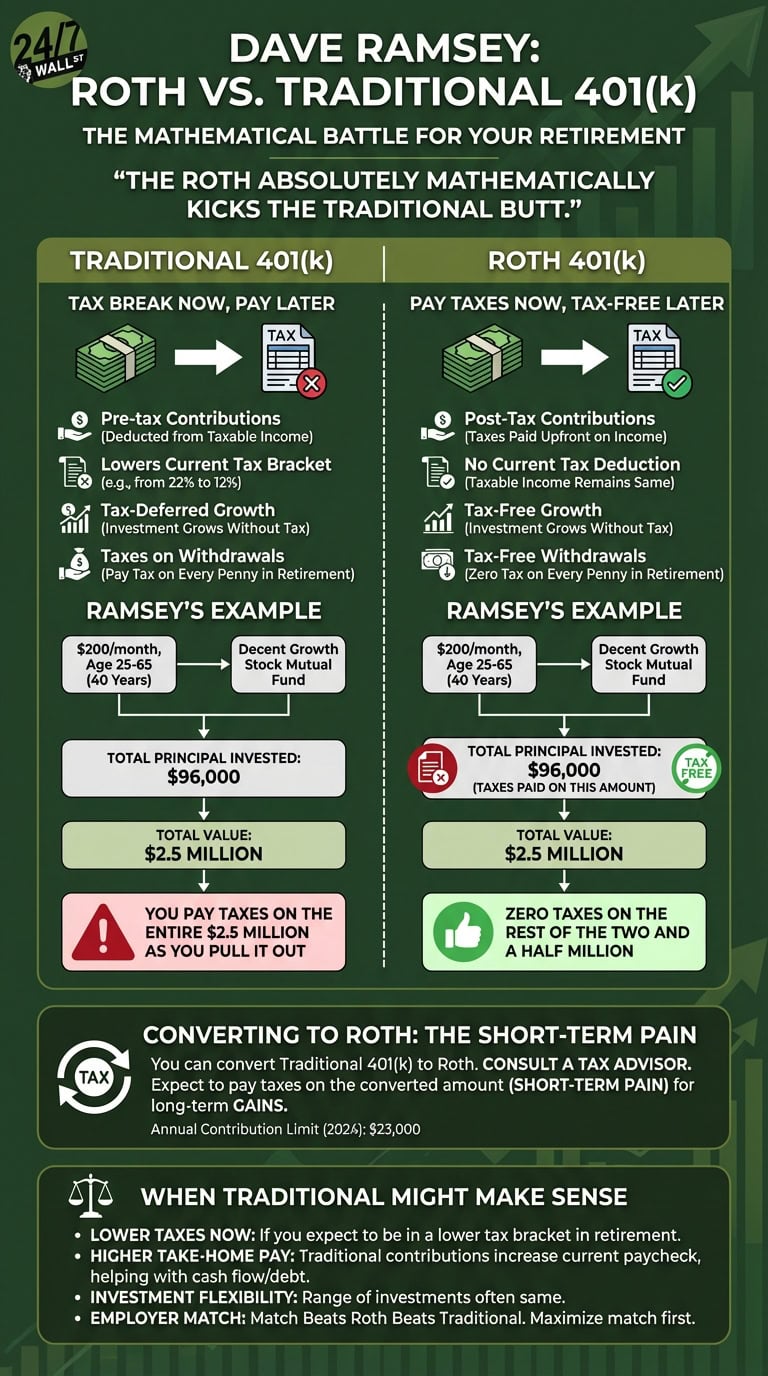
“The Roth absolutely mathematically kicks the traditional [IRA’s] butt. And here’s why: If you take $200 a month from age 25 to age 65, 40 years, and you invest that in a decent growth stock mutual fund, you’re gonna have $2.5 million dollars in there.
However, only $96,000 of the $2.5 million is actual principal that you put in. So if you did a traditional [401(k)], you would have got a tax break on $96,000. You would have not paid taxes yet on $96,000. But you’ll pay taxes on the entire $2.5 million as you pull it out.
If instead you did this with a Roth [401(k)], you would pay taxes on the $96,000 [before you put them in the plan as your contribution] and zero taxes on the rest of the two and a half million.”
That’s the argument in a nutshell: intuitive, punchy, and grounded in arithmetic. The $96,000 figure is simply $200 a month multiplied by 480 months (40 years), the total principal the hypothetical investor ever contributes. Everything else in that $2.5 million account is compounded growth. The mechanics are worth walking through step by step.
The History: 401(k) versus Roth 401(k)
The 401(k) plan traces its roots to 1978, when Congress passed the Revenue Act of 1978 and embedded Section 401(k) into the Internal Revenue Code. The plans gained traction in the early 1980s once the IRS issued implementing regulations, then spread rapidly through the 1990s as traditional pension plans steadily disappeared from the American workplace.
The Roth 401(k) arrived considerably later. Congress authorized it through the Economic Growth and Tax Relief Reconciliation Act of 2001, though employers could not actually offer the option until January 1, 2006. Traditional 401(k) plans have therefore been around for nearly 50 years, while the Roth version has been available for roughly 20. Despite that two-decade runway, a large share of workers still do not fully understand how the Roth option works or why it might be worth choosing.
Here is a simplified explanation. (Consult your tax advisor for guidance tailored to your situation.) Suppose you earn $50,000 annually. Between your own contributions and your employer’s match, you set aside 10% of your salary ($5,000) in a 401(k). Under the traditional structure, that $5,000 goes in pre-tax, reducing your taxable income to $45,000 and, in this example, moving you from the 22% bracket into the 12% bracket.
That is an immediate, tangible benefit. Your contributions then grow tax-deferred, meaning no taxes are owed on gains while the money compounds. The cost arrives at retirement, when you pay ordinary income tax on every dollar you withdraw, including all accumulated growth.
The Roth 401(k) reverses that timing entirely. You pay tax on your full $50,000 income upfront, then deposit your $5,000 contribution from the after-tax remainder. The account grows with no tax liability along the way, and every penny comes out tax-free in retirement, gains included. That structural difference is exactly what drives Ramsey’s $96,000 versus $2.5 million comparison.

Converting Your 401(k) to a Roth 401(k)
Ramsey’s preference for the Roth fits squarely within his broader retirement framework. His full playbook, spelled out on Ramsey Solutions, follows a three-step priority he calls “Match beats Roth beats traditional”: first, contribute enough to your 401(k) to capture the full employer match; second, max out a Roth IRA; third, direct any remaining savings back into the 401(k). He also recommends investing 15% of gross household income into retirement once consumer debt is eliminated and a full emergency fund is in place. For 2026, the Roth IRA contribution limit is $7,500 for those under 50 and $8,600 for those age 50 or older. The higher figure reflects a $1,100 catch-up amount, the first indexed increase to the IRA catch-up since SECURE 2.0 introduced cost-of-living adjustments for that figure.
If you are already years into a traditional 401(k), switching is not an all-or-nothing decision. You can open a Roth 401(k) alongside your existing account, or split new contributions between both, as long as you stay within the annual combined employee limit. For 2026, that ceiling is $24,500. Workers age 50 or older can add a catch-up contribution of $8,000, raising the total to $32,500. A separate super catch-up provision applies to workers who turn 60, 61, 62, or 63 during 2026: they can contribute $11,250 in place of the standard $8,000 catch-up, pushing the overall ceiling to $35,750 for that age group.
You can also shift existing funds from a traditional 401(k) into a Roth 401(k), or convert the entire account, provided your employer’s plan permits it. One important wrinkle under SECURE 2.0: workers age 50 or older who earned more than $150,000 in FICA wages from their plan’s sponsoring employer in 2025 must designate all 2026 catch-up contributions as Roth after-tax dollars. That $150,000 threshold is indexed annually by the IRS. The Treasury and IRS issued final regulations on this rule on September 15, 2025 (IR-2025-91), which were published in the Federal Register the following day. Those regulations formally apply to taxable years beginning after December 31, 2026, but plans are required to operate under reasonable, good-faith compliance throughout 2026.
For those pursuing financial independence and early retirement (FIRE), a Roth Conversion Ladder offers another strategic path. The technique involves systematically moving funds into Roth accounts during low-income years, which can allow access to converted principal before age 59.5 without the standard early-withdrawal penalty, provided the five-year seasoning rule is satisfied for each conversion.
Tax law in this area is genuinely complex, and converting a traditional account to Roth triggers upfront taxes on the amount you move. A professional tax advisor can help you weigh both the timing and the cost. Ramsey’s position is straightforward: absorbing a short-term tax hit is well worth it, given the long-term advantage of drawing down a far larger balance completely tax-free in retirement.
When a Traditional 401(k) Might Make Sense
Ramsey consistently recommends the Roth when a plan offers one, but the traditional 401(k) has genuine merits in specific circumstances. Deferring taxes can be the smarter move for several kinds of savers:
-
Lower Taxes Later: If you expect to be in a meaningfully lower tax bracket in retirement than you are today, deferring taxes until then can shrink your lifetime tax bill. Retirees who significantly reduce spending often land well below their peak-earning bracket, making the traditional option genuinely advantageous rather than simply a default choice.
-
Cash Flow Today: Traditional contributions reduce taxable income immediately, keeping more of each paycheck accessible. That extra liquidity matters when you are paying down high-interest debt or juggling tight household expenses alongside retirement saving.
-
Asset Location Strategy: Some investors coordinate account types deliberately, parking high-yield bonds in traditional accounts and high-growth equities in Roth accounts. The goal is to minimize taxes on assets most likely to generate ordinary income, while letting the highest-growth positions compound entirely tax-free.
-
Expanded Flexibility via 529 Rollovers: SECURE 2.0 created a useful option for families holding unused college savings. Up to $35,000 in excess 529 plan funds can be rolled over into the beneficiary’s Roth IRA over time, provided the 529 account has been open for at least 15 years and the destination Roth IRA is owned by the 529 beneficiary. The provision lets families repurpose education savings for retirement in a tax-efficient way rather than triggering taxes and a 10% penalty on nonqualified withdrawals.
Editor’s note: This article was updated to clarify that the IRS issued final Roth catch-up regulations on September 15, 2025 (IR-2025-91), published in the Federal Register on September 16, 2025, and that the $1,100 IRA catch-up for 2026 is the first indexed increase to that figure under SECURE 2.0.
Contact [email protected] for any questions or corrections.
Joel South covers large-cap stocks, dividend investing, and major market trends, with a focus on earnings analysis, valuation, and turning complex data into actionable insights for investors.
He brings more than 15 years of experience as an investor and financial journalist, including 12 years at The Motley Fool, where he served as an investment analyst, Bureau Chief, and later led the Fool.com investing news desk. He has also co-hosted an investing podcast and appeared across TV and radio discussing market trends.