Northwestern Mutual’s 2025 Planning & Progress Study: Half of American Millionaires Think Their Financial Planning Needs Work
Northwestern Mutual’s 2025 Planning & Progress Study reveals that nearly half of American millionaires (49%) say their financial planning needs improvement, and only 36% describe themselves as wealthy. People who reached seven figures are reassessing their plans and finding them…

This post may contain links from our sponsors and affiliates, and Flywheel Publishing may receive compensation for actions taken through them.

Northwestern Mutual’s 2025 Planning & Progress Study reveals that nearly half of American millionaires (49%) say their financial planning needs improvement, and only 36% describe themselves as wealthy. People who reached seven figures are reassessing their plans and finding them inadequate. The reality: if a million dollars does not feel like enough, the rest of the country has every right to ask what “on track” actually means in 2026.
The confidence gap
The Northwestern Mutual data describes people who saved, invested, and ran the math themselves. The big takeaway is that 79% of American millionaires describe their net worth as self-made, compared with only 12% who inherited it and the 5% who got it through a windfall. Roughly one in two still rate their own plan as inadequate, a gap that sits between net worth and confidence.
Part of that gap stems from advisor usage: 74% of millionaires work with a financial advisor, more than double the 34% rate among the general population, and those with advisors feel significantly more secure and expect to retire two years earlier. Two years of retirement is a real number, suggesting the “needs improvement” verdict reflects the habit of constantly stress-testing a plan against the world around it rather than regret.
The external environment
The world surrounding these plans is not especially calming, and that backdrop shapes how even high‑net‑worth households interpret their own readiness. Inflation remains a persistent source of unease. The Consumer Price Index reached 330.213 in April 2026, near the top of its 12‑month range, signaling that price pressures have not fully settled. Core PCE, the Federal Reserve’s preferred measure of underlying inflation, registered 129.28 in the same month and also sat near the upper end of its recent range.
At the same time, the Fed has lowered its target rate by 0.75% over the past year and has held it at 3.75% since December 11, 2025. That combination helps borrowers and compresses the returns available to savers, which forces households to revisit assumptions built during a period when cash and short‑term instruments paid more. In an environment where prices remain firm and income from safe assets softens, even well‑constructed plans feel like they need another round of stress testing.
The cost-of-living reality
Location shapes what a million dollars can actually do, and the differences are large enough to influence how people judge their own financial readiness. Some parts of the country carry higher housing, tax, and everyday living costs, while others stretch the same dollars much further. A seven‑figure portfolio in a coastal metro supports a very different lifestyle than the same balance in a lower‑cost region. The Bureau of Economic Analysis tracks these variations through regional price indexes, and the spread across states and cities is wide enough that any honest financial plan has to account for it. Purchasing power is not a single national number. It is a local experience that changes the way households interpret what “enough” really means.
The broader household picture
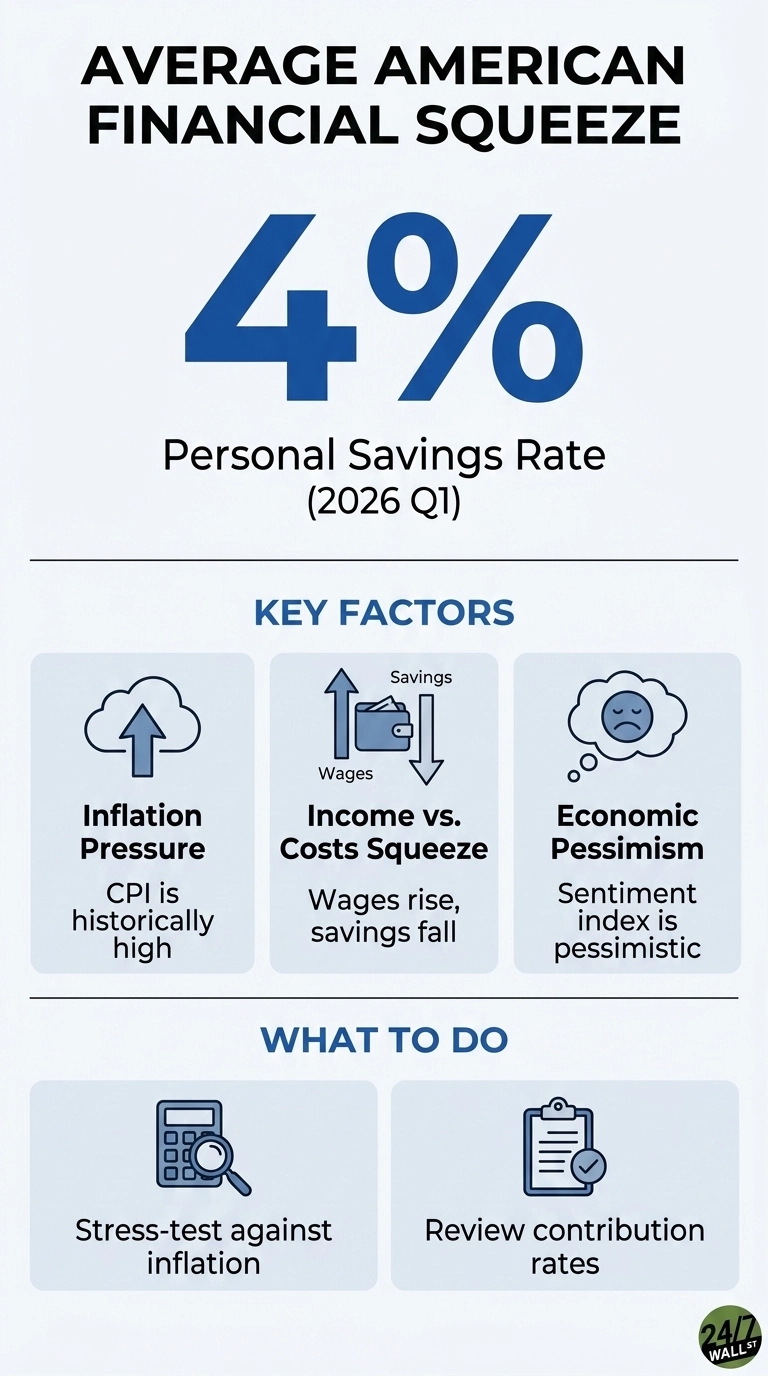
For everyone outside the millionaire bracket, the numbers are tighter. Per capita disposable personal income in the first quarter of 2026 was $68,617, and the personal savings rate fell to 4%, down from 6.2% in the first quarter of 2024. On the plus side, wage growth continues, with average hourly earnings reaching $37.41 in April 2026, up from $36.12 a year earlier and $34.76 in April 2024. The job market is steady, with unemployment at 4.3% in April 2026. The downside is that households are only saving a smaller slice of their larger paychecks, a textbook signal that cost-of-living pressure is absorbing the raise.
Legacy priorities shift
The wealthy are rethinking what comes after. Only 53% of millionaires expect to leave an inheritance or charitable gift, and among those who do, just 12% identify leaving something for the next generation as their single most important financial goal. The classic image of a millionaire stockpiling for grandchildren is fading as needs shift toward funding a longer retirement, hedging against inflation, and covering healthcare costs, crowding legacy out of the top priority.
Context for the data
If 49% of self-made millionaires think their plan needs work in an environment of cooling inflation expectations, falling rates, and rising wages, the relevant question for everyone else concerns what their own plan is designed to do. The Northwestern Mutual data documents a mood, not a verdict. Reviewing contribution rates, stress-testing a retirement number against today’s inflation readings, and writing down what a plan is supposed to do are steps the millionaires in the survey appear to be taking. The million-dollar mark does not retire the homework.
Contact [email protected] for any questions or corrections.
David Beren has been a Flywheel Publishing contributor since 2022. Writing for 24/7 Wall St. since 2023, David loves to write about topics of all shapes and sizes. As a technology expert, David focuses heavily on consumer electronics brands, automobiles, and general technology. He has previously written for LifeWire, formerly About.com. As a part-time freelance writer, David’s “day job” has been working on and leading social media for multiple Fortune 100 brands. David loves the flexibility of this field and its ability to reach customers exactly where they like to spend their time. Additionally, David previously published his own blog, TmoNews.com, which reached 3 million readers in its first year. In addition to freelance and social media work, David loves to spend time with his family and children and relive the glory days of video game consoles by playing any retro game console he can get his hands on.