The Savings Habit That Won’t Shut Off: Why 39% of Retirees Hoard Their Wealth
The Allianz Center for the Future of Retirement 2026 Annual Retirement Study surfaced a finding that rarely gets attention in standard personal finance coverage. After decades of disciplined saving, a meaningful share of retirees cannot bring themselves to use the…

This post may contain links from our sponsors and affiliates, and Flywheel Publishing may receive compensation for actions taken through them.

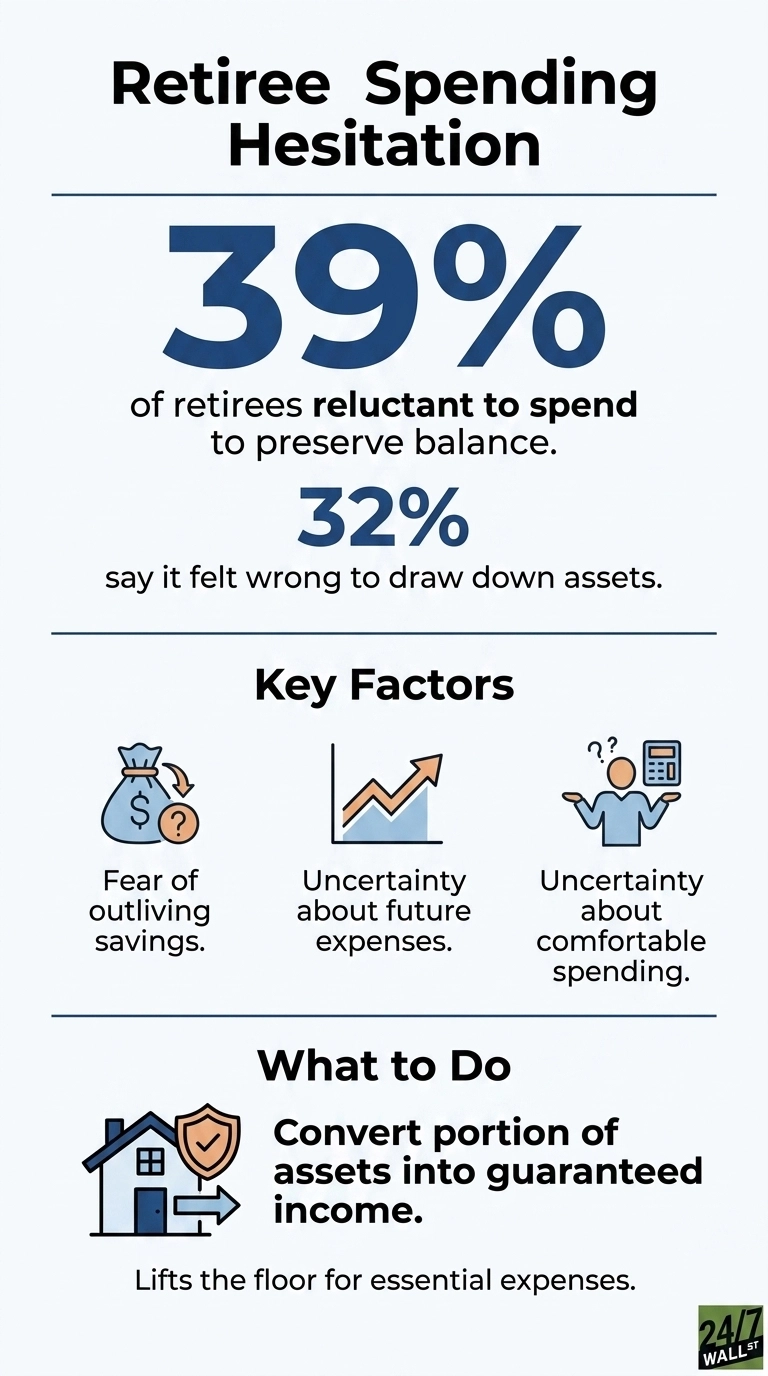
The Allianz Center for the Future of Retirement 2026 Annual Retirement Study surfaced a finding that rarely gets attention in standard personal finance coverage. After decades of disciplined saving, a meaningful share of retirees cannot bring themselves to use the money they set aside. Thirty-two percent say it felt wrong to start drawing down their assets after accumulating them for so long, and 39% are reluctant to spend at all, driven by a desire to preserve their account balance. The balance on the retirement projection is only half the story. The behavior that follows is the other half, and it is the part most pre-retirees never plan for.
The Habit That Will Not Switch Off
Forty years of saving builds a reflex: when the paycheck arrives, a slice goes to the 401(k), and the rest gets budgeted. Retirement is supposed to flip that reflex, making the portfolio the paycheck. The Allianz data documents how often that switch fails to flip. The research identifies three core reasons retirees hesitate: fear of outliving savings, uncertainty about future expenses, and uncertainty about how much they can comfortably spend.
None of those concerns is unreasonable. What the official press release adds is scope. Seven in 10 (71%) working Americans say they anticipate being reluctant to spend in retirement in order to preserve their account balance as much as possible. That anticipated reluctance does not dissolve once the paycheck stops. According to the study, 42% of respondents worry they will regret spending too much money early in retirement, and 65% say the inconsistency of retirement expenses makes it challenging to plan a stable financial future. Kelly LaVigne, VP of consumer insights at Allianz Life, noted that people spend most of their lives building savings, and it can feel uncomfortable or even wrong to spend that money later.
Inflation has reinforced all three of those concerns. Core PCE, the Federal Reserve’s preferred inflation gauge, sat at the 90.9th percentile of its historical distribution as of April 2026, with the index climbing from 126.1 in June 2025 to 129.6 in April 2026. CPI hit 332.4 in April 2026 after rising in nearly every prior month. Year over year, the PCE price index was up 3.7% through June 2026, according to the Bureau of Economic Analysis. For a retiree drawing from a finite portfolio, every monthly grocery bill is a reminder that the pot has to stretch further than it did a year ago.
Pre-Retirees Are Calibrating to the Wrong Number
The Allianz study also exposes a calibration problem at the other end of the timeline. Sixty percent of non-retired Americans expect to spend less than 75% of their current income in retirement, while only 45% of actual retirees report spending that little. Pre-retirees are planning for a leaner future than most retirees actually live, which understates the income they will need and makes the eventual decision to spend feel riskier than it is.
Macro consumption data points in the same direction. Healthcare spending climbed from $3,649.4 billion in November 2025 to $3.7 trillion in April 2026, and housing services rose from $3.8 trillion to $3,930.7 billion over the same period. Two of the largest categories in a retiree’s budget keep expanding, regardless of how carefully someone budgeted them down in a planning spreadsheet.
The Savings Rate Is Falling, and the Cushion Is Thinner
The broader population is already spending more of what comes in. The personal savings rate fell to just 2.7% in June 2026, per the Bureau of Economic Analysis, continuing a slide from 6.2% in the first quarter of 2024. That is a sharp erosion of the buffer between income and consumption, and it is happening across the population, not just among retirees. University of Michigan consumer sentiment registered 51.7 in August 2026 (final reading), still below the 1st percentile of the index’s entire history and a recessionary signal. The macro backdrop validates retiree caution at a gut level, even when the math on an individual portfolio would support steady drawdowns.
Why Guaranteed Income Quiets the Anxiety
The Allianz study points to one factor that consistently lowers the psychological barrier to spending. Seventy-seven percent of respondents say a guaranteed income stream in retirement would reduce their anxiety about spending. Social Security is the largest such stream for most households, and BEA data confirms its scale. Social Security transfer receipts totaled $1.6 trillion in the first quarter of 2026, up from $1.4 trillion two years earlier. A predictable monthly check covers essential expenses, reframing portfolio withdrawals as funding for everything above the floor rather than as survival money that might run out.
A Number Without a Spending Plan Is Half a Plan
The retirement industry spends most of its energy on the accumulation question: how big does the balance need to be? The Allianz data argues that the decumulation question deserves equal weight. A retirement strategy, the study argues, starts with understanding what spending will realistically look like after leaving the workforce.
Pre-retirees calibrating to a 75% replacement rate should pressure-test that assumption against categories that keep rising regardless of personal choice. Healthcare and housing are the two that matter most. Retirees uncomfortable with portfolio withdrawals can convert a portion of assets into guaranteed income to lift the floor. The Allianz survey identifies that as the single most effective lever for reducing spending anxiety. A balance is one input. A spending plan is what determines how that balance actually sustains a retirement.
Editor’s note: This article has been updated to include data from the Allianz Life official press release published July 21, 2026, including that 71% of working Americans anticipate being reluctant to spend in retirement and that 42% fear regretting early overspending. The personal savings rate has been updated to 2.7% in June 2026 per the Bureau of Economic Analysis, and University of Michigan consumer sentiment has been updated to the final August 2026 reading of 51.7.
Contact [email protected] for any questions or corrections.
David Beren has been a Flywheel Publishing contributor since 2022. Writing for 24/7 Wall St. since 2023, David loves to write about topics of all shapes and sizes. As a technology expert, David focuses heavily on consumer electronics brands, automobiles, and general technology. He has previously written for LifeWire, formerly About.com. As a part-time freelance writer, David’s “day job” has been working on and leading social media for multiple Fortune 100 brands. David loves the flexibility of this field and its ability to reach customers exactly where they like to spend their time. Additionally, David previously published his own blog, TmoNews.com, which reached 3 million readers in its first year. In addition to freelance and social media work, David loves to spend time with his family and children and relive the glory days of video game consoles by playing any retro game console he can get his hands on.