The Allianz Study Found That 67% of Americans Worry Social Security Won’t Last Their Full Retirement
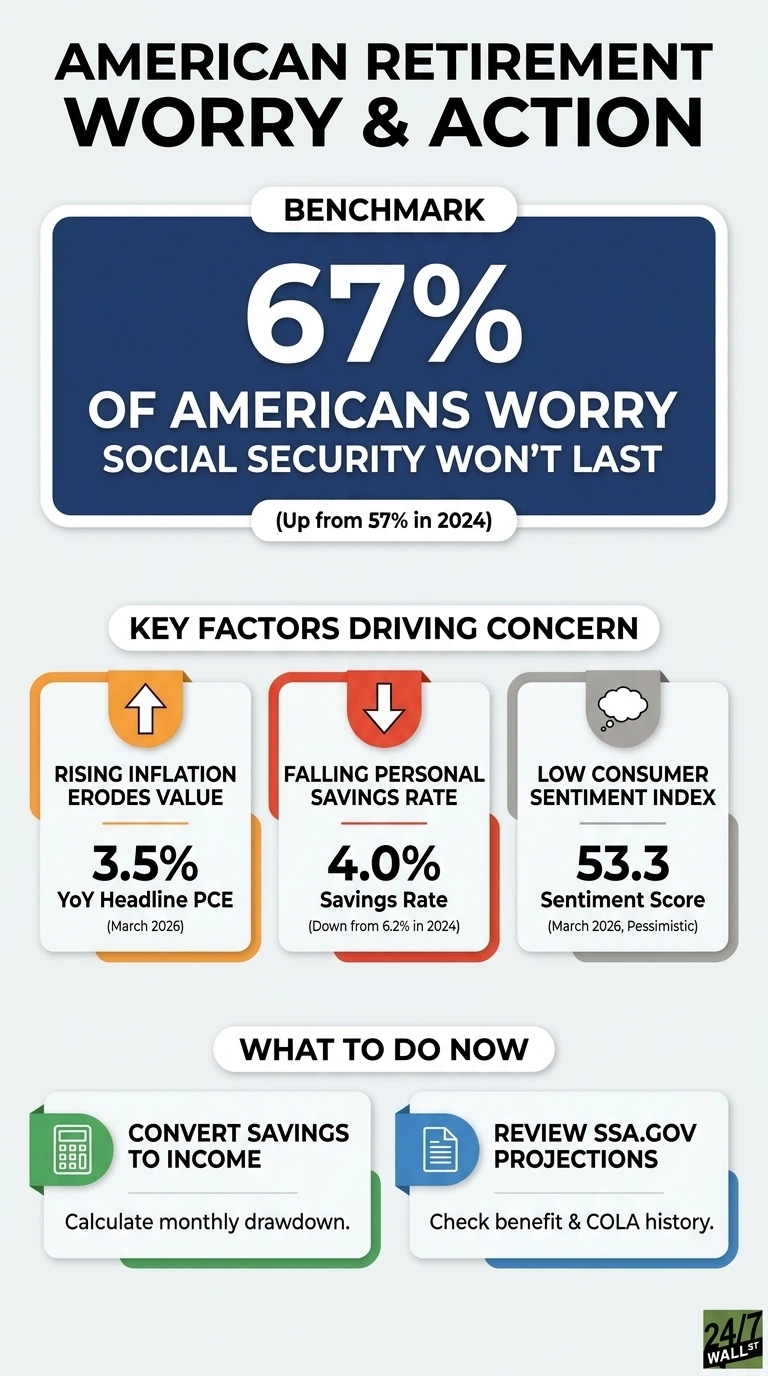
The Allianz 2025 Annual Retirement Study added a single statistic that shifted the conversation about retirement readiness. The big takeaway is that 67% of Americans worry Social Security will not last through their full retirement, up from 57% in 2024.…

This post may contain links from our sponsors and affiliates, and Flywheel Publishing may receive compensation for actions taken through them.

The Allianz 2025 Annual Retirement Study added a single statistic that shifted the conversation about retirement readiness. The big takeaway is that 67% of Americans worry Social Security will not last through their full retirement, up from 57% in 2024. A ten-point jump in twelve months is the kind of move that signals something beyond ordinary news cycle anxiety, and the broader economic backdrop helps explain why the worry is compounding rather than fading.
A Ten-Point Jump in One Year
The Allianz finding marks a sharp move in retirement confidence. In a single survey cycle, the share of Americans expecting Social Security to fall short of their needs moved from a slim majority to roughly two-thirds of the country. That shift is happening against a consumer mood that was already fragile. The University of Michigan Consumer Sentiment Index stood at 48.2 in May 2026, down 4 points from March, which is yet another reason retirement security worries are layering atop broader pessimism about household finances.
The labor market backdrop remains stable, with the unemployment rate holding at 4.3% in April 2026 and weekly jobless claims coming in at 200,000 for the week ending May 2, 2026, near historic lows. The anxiety appears structural as Americans are looking at the program itself and questioning whether the math works for their retirement horizon.
Confusion Sitting Next to Distrust
The Allianz data points to a second problem that travels alongside the worry: most Americans do not fully understand how Social Security works. Only 25% of respondents understand that Social Security benefits are adjusted for inflation, and just 21% correctly identify how Social Security fits into a complete retirement income plan. Three-quarters of the country is making retirement decisions without a clear picture of the benefits they are counting on or doubting.
Inflation reinforces why that confusion matters, as headline PCE inflation ran at 3.5% year-over-year in March 2026, with core PCE at 3.2% and services inflation at 3.38%. Services include the categories that dominate a retiree’s budget: housing, healthcare, and insurance. Social Security’s annual cost-of-living adjustment is designed to track inflation, but a household that does not know the COLA exists has no way to weigh it against the prices they actually see at the pharmacy or on the mortgage statement.
The Self-Funded Reality Most Have Not Planned For
If Social Security is going to do less of the work, savings will have to do more. The Allianz numbers suggest most households are not positioned for that handoff. Only 45% of Americans say they know how they will turn their savings into income in retirement, while 53% believe that simply having a retirement account, such as a 401(k) or IRA, will be enough. Owning the account and knowing how to draw it down are two different skills.
The savings rate has been moving in the wrong direction for that transition. According to the Bureau of Economic Analysis, the personal saving rate slipped from 6.2% in the first quarter of 2024 to 4.0% in the first quarter of 2026. Per‑capita disposable income climbed to $68,617 over the same period, yet households still directed a larger share of that income toward consumption rather than saving. Social Security continued to shoulder a large share of retirement income as well, paying out about $1.63 trillion in benefits in the first quarter of 2026, a reminder of how much retirees still rely on a program that many workers say they no longer trust.
What the Data Points Toward
Appetite for an alternative is already evident, with 92% of Americans saying a product offering guaranteed income in retirement would help them financially support the life they want, and 74% preferring financial products that protect against major losses, even if it means forgoing bigger gains. Whether that demand gets met through annuities, bond ladders against a 10-year Treasury yielding 4.38%, or pension-style payouts, the survey reads as a preference for predictability over upside.
Three data-grounded reference points sit alongside the 67% worry figure. The Social Security Administration publishes individualized benefit projections and COLA history at ssa.gov. The Allianz survey indicates more than half of savers have not converted 401(k) and IRA balances into a monthly income figure. Current PCE readings sit in a 3% to 3.5% annual range, above the 2% level the Federal Reserve targets.
Contact [email protected] for any questions or corrections.
David Beren has been a Flywheel Publishing contributor since 2022. Writing for 24/7 Wall St. since 2023, David loves to write about topics of all shapes and sizes. As a technology expert, David focuses heavily on consumer electronics brands, automobiles, and general technology. He has previously written for LifeWire, formerly About.com. As a part-time freelance writer, David’s “day job” has been working on and leading social media for multiple Fortune 100 brands. David loves the flexibility of this field and its ability to reach customers exactly where they like to spend their time. Additionally, David previously published his own blog, TmoNews.com, which reached 3 million readers in its first year. In addition to freelance and social media work, David loves to spend time with his family and children and relive the glory days of video game consoles by playing any retro game console he can get his hands on.