You Have $1 Million. Should You Retire In Sarasota Or Naples?
A couple in their mid-60s has done everything right. The mortgage is paid off, retirement accounts are healthy, and Social Security will cover a meaningful share of monthly expenses. Now comes the fun decision. They want Florida’s Gulf Coast, warm…

This post may contain links from our sponsors and affiliates, and Flywheel Publishing may receive compensation for actions taken through them.

A couple in their mid-60s has done everything right. The mortgage is paid off, retirement accounts are healthy, and Social Security will cover a meaningful share of monthly expenses. Now comes the fun decision. They want Florida’s Gulf Coast, warm winters, beaches, waterfront restaurants, and a place where the grandkids will actually want to visit. Two cities keep appearing on every retirement shortlist: Sarasota and Naples.
From a distance, the two look nearly identical. Both sit on the Gulf. Both draw affluent retirees. Both offer sunshine, golf, boating, arts, and access to some of Florida’s most beautiful water. Yet retirees who choose one rarely end up in the other, and the reasons have surprisingly little to do with the beach itself. The real differences surface in housing costs, insurance premiums, healthcare access, traffic, dining, and the total portfolio required to sustain the same lifestyle. For a couple working from the same balance sheet, Sarasota and Naples produce two very different retirements.
What A Million Dollars Plus Social Security Actually Pays
A $1 million portfolio drawn at a conservative 4% produces $40,000 in year one. Add $3,000 a month in Social Security and you reach $76,000 gross annually. Florida charges no individual income tax, and a meaningful share of Social Security is shielded at the federal level, so take-home lands somewhere in the high $60,000s after the standard Medicare Part B premium of $202.90 per month per person and modest federal tax. That works out to roughly $5,700 a month to spend.
That is a real budget, but not a lavish one. The figure is identical in both cities. What changes entirely is what $5,700 buys the moment you step outside.
The Housing Math That Decides Everything
Housing is where the two cities diverge sharply. In Sarasota, single-family homes have a median value around $460,000 as of mid-2026, according to Zillow data. Naples single-family homes list for a median closer to $676,000, with same-specification homes in gated communities typically running 25% to 40% above comparable Sarasota properties. The broader Collier County metro median sits near $735,000, versus roughly $525,000 for the Sarasota County metro. On a $1 million net worth, that gap is the entire story.
The Sarasota retiree can purchase a tidy single-family home inland, or a well-kept condo closer to Siesta Key, and still keep $500,000 or more invested. The Naples retiree, buying anything resembling the same home in a comparable neighborhood, often ends up house-rich and portfolio-light, with half or more of the nest egg tied up in walls and roof. That shift changes the withdrawal math: the 4% rule now runs against a smaller invested base, and income drops accordingly.
The Lifestyle Gap Created By The Same $1 Million
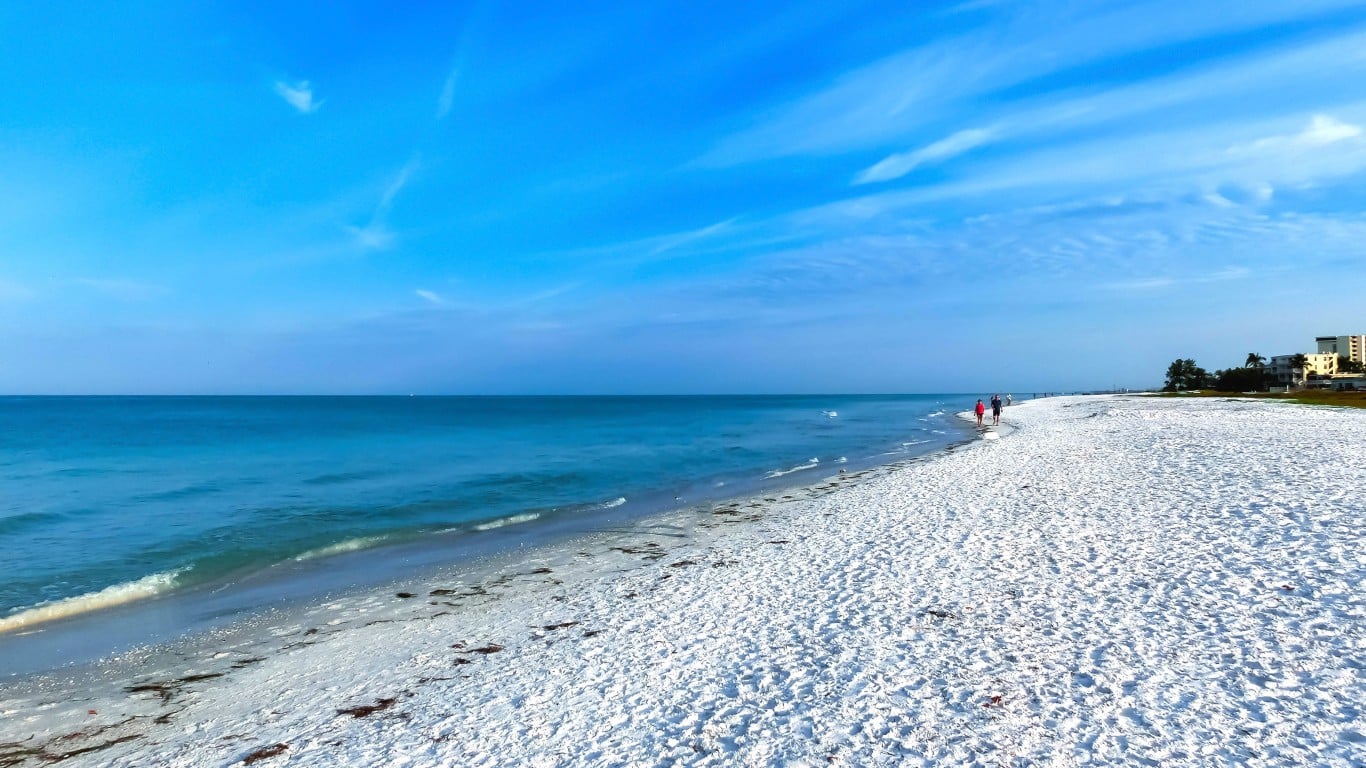
Sarasota’s cultural credentials have only grown stronger in recent years. Siesta Key, just a short drive from downtown, was ranked the No. 1 beach in the United States by U.S. News and World Report in 2026 and placed No. 28 globally on the World’s 50 Best Beaches, making it the only American beach to crack that top-28 threshold. That standing matters for lifestyle value: world-class sand and clear Gulf water within minutes of daily life, without the price tag Naples commands.
At $76,000 annually, a Sarasota retirement funds a recognizable upper-middle life. A modest detached home or well-kept condo, a membership at one of the city’s cultural anchors, regular dinners out, and one or two trips a year all fit within the budget. Rent and restaurant prices in Sarasota run measurably below Naples, so the same evening out costs less and leaves more room to maneuver.
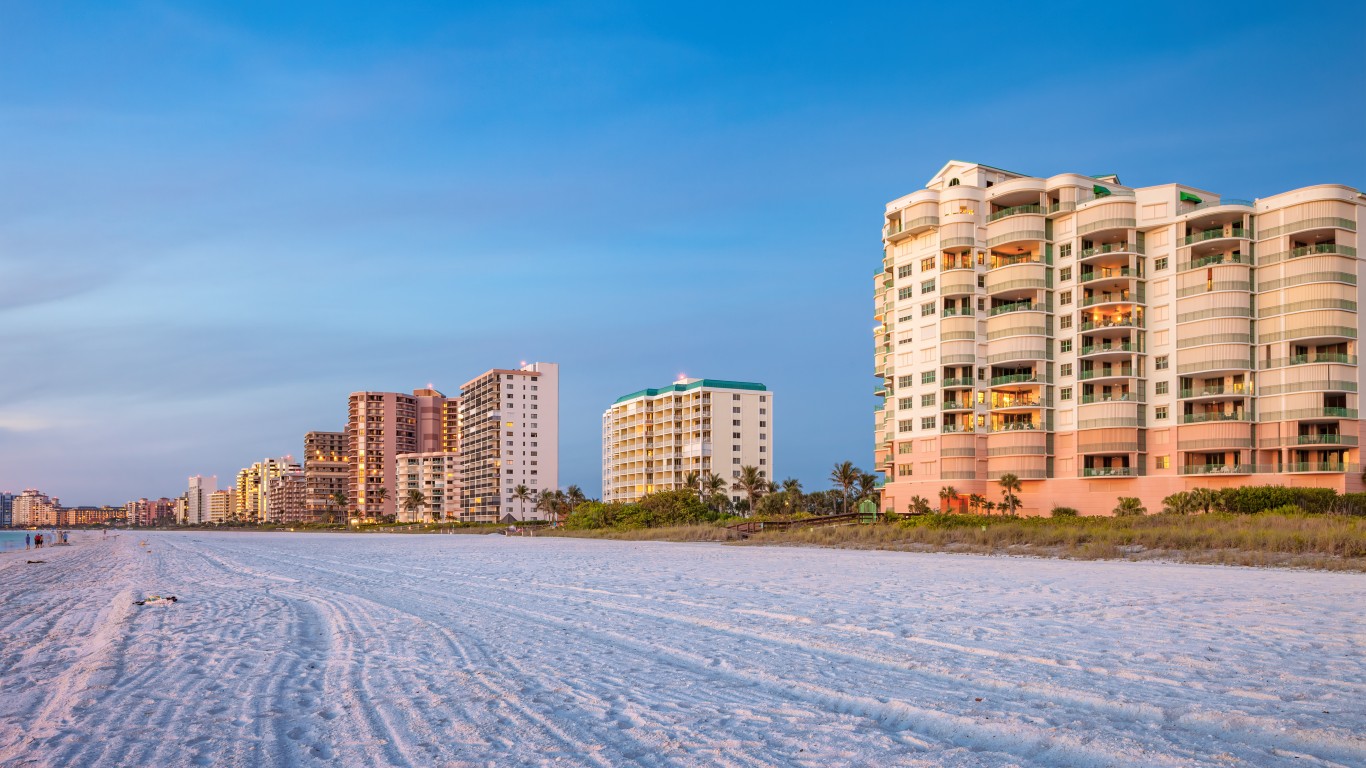
In Naples, that same income buys a quieter, more constrained version of the city’s reputation. You can live there comfortably, but the country-club life that defines the brand, the waterfront condo, the boat slip, sits out of reach without drawing down principal. Helping an adult child with a down payment or absorbing a surprise $20,000 medical bill bends the Naples plan in a way it simply does not bend the Sarasota plan.
Where The Extra Cost Of Naples Shows Up
The biggest difference rarely shows up in the home price. It shows up after closing. Naples retirees face some of the highest carrying costs on Florida’s Gulf Coast, and insurance is the most visible line item. Florida’s average homeowners premium hit $8,292 in 2025, roughly three times the national average, and is projected to reach $8,458 by year-end 2026 according to Insurify. The statewide market is finally showing signs of stabilization: Citizens Property Insurance approved an 8.7% average rate decrease effective in 2026, and more than 17 new private carriers have entered the market since legislative reforms in 2022 and 2023. Even so, coastal Southwest Florida counties including Collier continue to carry elevated wind and flood exposure, and barrier-island properties remain among the most expensive to insure anywhere in the state.
Property taxes compound the effect, since Naples homes generally carry higher assessed values. Add HOA fees, club memberships, landscaping expectations, and the everyday cost of living in a community built around affluent seasonal residents, and the annual budget can easily run $15,000 to $20,000 higher than a comparable retirement in Sarasota. On a total income of roughly $75,000 to $80,000, that gap is not trivial. It can represent the travel budget, the emergency reserve, the ability to help grandchildren, or simply the financial cushion that makes retirement feel secure rather than precarious.
The Retirement Risk Nobody Sees
The risk that quietly derails Florida retirements is the compounding interaction of insurance costs, healthcare inflation, and fixed-rate withdrawals against a portfolio that must last potentially thirty years. That structural pressure often matters more than near-term market volatility. The 10-year Treasury currently yields around 4.55%, which supports a modestly more generous safe withdrawal rate than the near-zero environment of a decade ago. But higher yields do nothing to slow coastal wind premiums or the IRMAA surcharges that kick in once portfolio withdrawals push modified AGI above $109,000 for individuals or $218,000 for couples filing jointly.
A Naples retiree forced to draw principal to cover an insurance spike is on a materially worse glide path within a decade, even when both retirees started from an identical balance sheet. The math is unforgiving over thirty years when the base is eroding rather than compounding.
The Verdict And The Crossover Number
At a $1 million portfolio, Sarasota is the stronger financial proposition. It delivers much of the same Gulf Coast lifestyle, world-class beaches, restaurants, arts, boating, and warm winters, while preserving meaningful room in the budget for travel, family, healthcare surprises, and the insurance costs that remain elevated even in a stabilizing market. The retirement functions without constantly testing its own margins.
Naples offers a more upscale version of the same dream, but at this asset level the costs begin competing with the lifestyle itself. Higher home prices, insurance premiums, and everyday expenses absorb a larger share of available income. The math starts to shift in Naples’s favor somewhere closer to $2.5 million in investable assets, where the financial pressure eases and the city’s premium amenities can be fully enjoyed without sacrificing flexibility elsewhere.
Same portfolio. Same Social Security check. Two very different retirements. Sarasota lets the million dollars support the life. In Naples, a disproportionate share of the retirement is spent supporting the house. In a state where insurance costs remain structurally elevated even as the market stabilizes, that difference matters more than most retirees appreciate until they’re already committed.
Editor’s note: This update adds current 2026 home price benchmarks for both markets (Sarasota median around $460,000, Naples single-family median list price around $676,000), refreshes the 10-year Treasury yield to approximately 4.55%, incorporates Florida homeowners insurance data showing average premiums projected at $8,458 for 2026 alongside the Citizens Property Insurance 8.7% rate reduction, and notes Siesta Key’s 2026 rankings as the No. 1 U.S. beach by U.S. News and World Report and No. 28 globally on the World’s 50 Best Beaches list.
Contact [email protected] for any questions or corrections.
Drew Wood has edited or ghostwritten nine books and published more than 1,500 articles on investing, business, politics, travel, world cultures, wildlife, and earth science. He holds a doctorate and four master's degrees and has nearly 30 years of college teaching experience. His travels have taken him to 25 countries, including three years living in Ukraine.