Let’s Be Real. For Most Retirees, Only One Florida Beach Town Actually Works
Most of the Florida coastline has already priced out the median retiree, and the list of towns that still work is shorter than you think. One Atlantic-side town still closes the math, but the numbers that get you there are…

This post may contain links from our sponsors and affiliates, and Flywheel Publishing may receive compensation for actions taken through them.

We see this question almost weekly: someone in their late 50s or early 60s has a modest but real portfolio, a mental picture of walking to the beach with coffee, and wants to know if Florida still works. The short answer, once you actually price it out, is that most of the coastline no longer does. Naples, Destin, Sarasota, Vero Beach, and the Keys have all priced out the median retiree.
What remains, for a household bringing roughly a million to a million and a half in investable assets plus Social Security, is essentially one workable option on the Atlantic side: New Smyrna Beach. Here is what it takes to make that math close.
Why the Rest of the Florida Coast Fell Off the List
Florida’s tax code remains a genuine draw. The state now ranks 5th overall on the 2026 State Tax Competitiveness Index, with no individual income tax at all. The squeeze comes from somewhere else entirely: the cost of living has run ahead of income for several years running. Florida’s Regional Price Parity sits at 103.4, the 11th highest in the country, while real income ranks only 29th. That gap between what things cost and what residents earn is the retiree squeeze in one number.
Layer on the housing picture, and the math for trophy markets gets very uncomfortable. The Case-Shiller national home price index came in at 330.87 in April 2026, with year-over-year growth running at just 0.8%. Prices are barely moving nationally, yet beachfront inventory in premium Florida markets remains priced well above what a normal retirement portfolio can support. The market hasn’t corrected, it has simply stalled at heights the median retiree cannot reach.
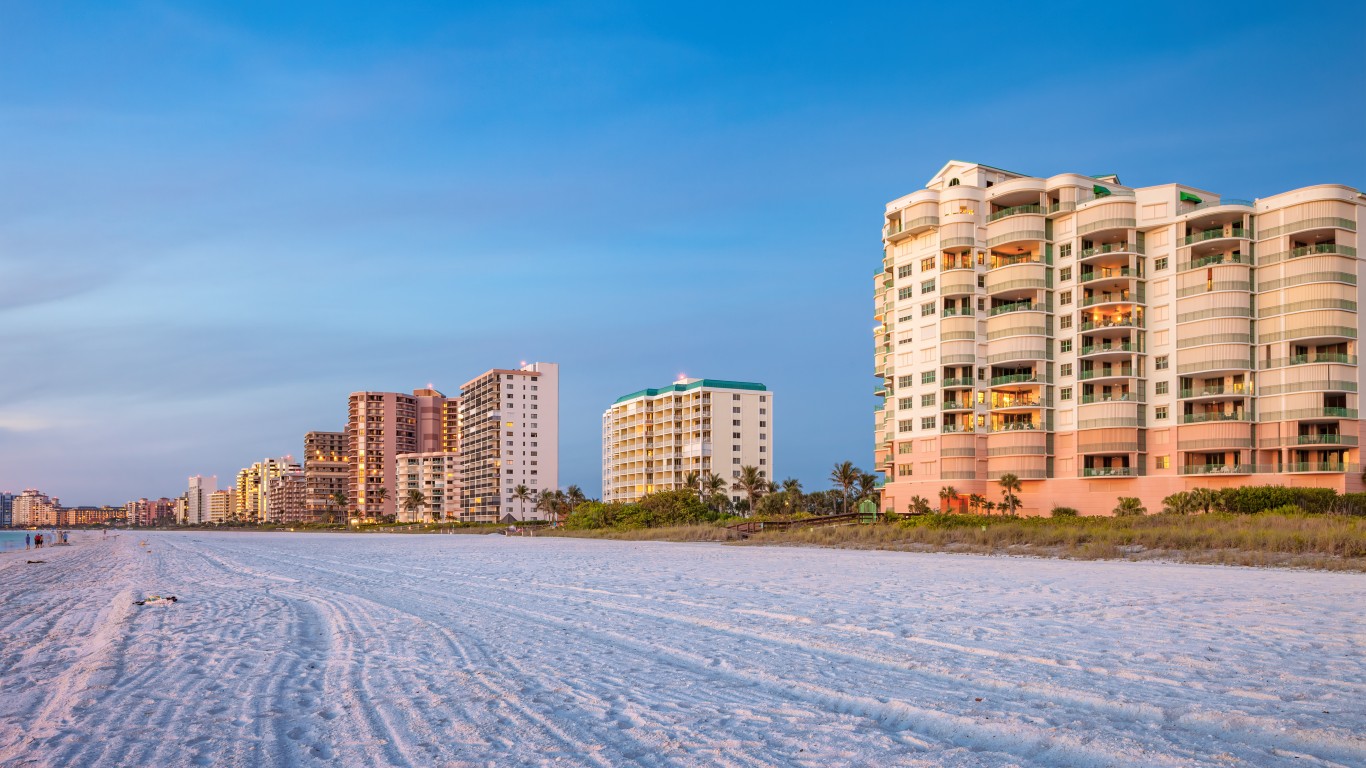
New Smyrna Beach works because it is a genuine walkable beach town where single-family inventory still trades in the upper-$400s rather than the mid-$700s. Volusia County millage is manageable, and the Atlantic side has historically absorbed less hurricane damage per decade than the Gulf coast from Fort Myers north to the Panhandle. For a median retiree household, it is the last place on the Florida coast where the numbers can actually be balanced.
The Real Cost Picture for a Couple, in Current Dollars
Assume a paid-off or nearly paid-off three-bedroom within a few blocks of the beach, bought for around $475,000, which aligns with the current median sale price in the area. Homestead exemption applies, Save Our Homes caps future assessment growth at 3%, and property taxes settle near $4,800 a year. Homeowners insurance eats the budget: expect $6,500 to $8,500 annually for a non-elevated inland-of-A1A structure, and more if east of the bridge. Flood insurance through NFIP adds another $900 to $1,800. Utilities, including summer AC, run about $3,600. HOA or condo fees can easily add $8,000 to $14,000 and break the model, which is precisely why the single-family path is the one that pencils.
Healthcare for a pre-Medicare couple on an ACA silver plan in Volusia County, with income managed to hit subsidy cliffs, runs $9,000 to $14,000 in premiums plus out-of-pocket. Post-65, budget standard Medicare Part B, a Plan G supplement, and Part D, plus dental, at roughly $8,500 per person. Food for two at the USDA Moderate-Cost plan lands near $12,600 annually. Add transportation with one replacement vehicle amortized, reserves for roof and HVAC, gifts, travel, and federal taxes on IRA withdrawals, and the working budget for two settles at roughly $82,000 a year in today’s dollars.
Running the Portfolio Math
Social Security is the anchor. The 2026 COLA came in at 2.8%, which lifted the average retired worker’s monthly benefit to roughly $2,084 as of mid-2026. For a dual-earner couple claiming at full retirement age, combined benefits in the range of $52,000 annually represent a reasonable planning baseline. That leaves a $30,000 gap between guaranteed income and the $82,000 budget.
At a 4% withdrawal rate appropriate for a 65-year-old couple with a 30-year horizon, closing that gap requires a $750,000 portfolio. Add a $75,000 reserve for the insurance and roof shocks that beach towns produce on a reliable schedule, and the minimum investable asset target lands at roughly $825,000 on top of the house. Retire at 60 instead of 65 and the number climbs sharply: five years of full ACA premiums must be funded, and the withdrawal rate falls to 3.3% over a 35-year horizon, pushing the target closer to $1.3 million.
The Insurance Line Is the Whole Story
The single factor that undoes most Florida beach retirement plans is the long-term compounding trajectory of homeowners insurance. Florida’s average annual premium hit $8,292 in 2025, an 18% jump from 2024, and projections point to another 2% increase through year-end 2026. The statewide market is showing some signs of stabilization: tort reform legislation has reduced litigation losses, Citizens Property Insurance cut its rates 8.7% statewide in 2026, and nearly 20 new private carriers have entered the market since the 2022 reforms. Those are real improvements, but coastal premiums remain among the highest in the nation, rebuild costs are still rising, and wind exposure is a fact no statute can change.
The deeper planning problem is compounding. A $7,000 coastal premium growing at even a moderate pace over the years quietly consumes the purchasing power that a 2.8% COLA is supposed to protect. The retirees who make New Smyrna Beach work price this in from day one. They buy a smaller, newer, or hurricane-retrofitted structure to keep the premium in a manageable range, they carry a dedicated insurance reserve inside the portfolio, and they treat the flood zone map as a shopping filter, not a footnote.
The number that makes this scenario viable, all in, is roughly $825,000 in investable assets on top of a paid-off $475,000 home, two Social Security streams claimed at full retirement age, a 4% withdrawal rate, and an insurance line treated as a growth item rather than a fixed cost. Anywhere else on the Florida coast, the same household needs closer to $1.5 million, and the insurance pressure still builds over time. New Smyrna Beach is the one town where a normal retirement portfolio and a beach still occupy the same sentence.
Editor’s note: This article was updated to reflect Florida’s current 5th-place ranking on the 2026 State Tax Competitiveness Index (from 4th on the 2025 index), the corrected Case-Shiller national home price index reading of 330.87 for April 2026, the current New Smyrna Beach median home price of approximately $470,000 to $499,000, and the latest Florida homeowners insurance data showing an average statewide premium of $8,292 in 2025 with a projected further rise through 2026, alongside new context on 2022-era tort reform and its partial market stabilization effect.
Contact [email protected] for any questions or corrections.
I am a long time investor and student of business, and believe finding good companies that can become great investments is the best game on earth. After 20 years of writing and researching the public markets it is clear that individuals have never had more tools and information to take control of their financial lives. From ETFs and $0 commissions to cryptos and prediction markets there has never been a greater democratization of access to investing.
I write to help people understand the investments available to them so they can make the best choice for their portfolio, whether they're starting out or looking for income in retirement.