Never Worry About Money Again: Retire to The Woodlands, Texas, at 65 on $1.1 Million
The Woodlands can look like the best of both retirement worlds: an upscale master-planned community north of Houston in a state with no income tax and a reputation for lower costs. But retiring there at 65 with $1.1 million is…

This post may contain links from our sponsors and affiliates, and Flywheel Publishing may receive compensation for actions taken through them.
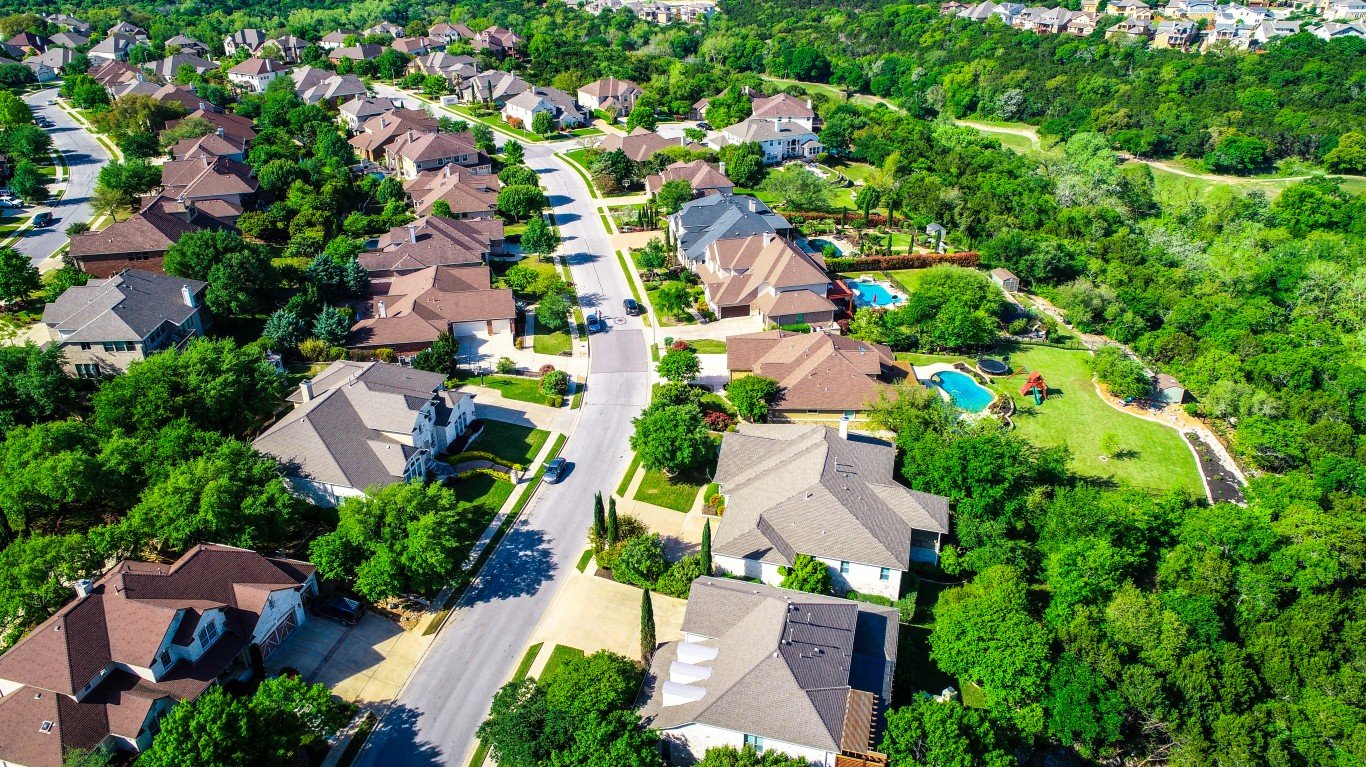
The Woodlands can look like the best of both retirement worlds: an upscale master-planned community north of Houston in a state with no income tax and a reputation for lower costs. But retiring there at 65 with $1.1 million is not the same as retiring in “average Texas.” The housing, property tax, insurance, and Medicare numbers have to be built around The Woodlands itself, because that is where this plan either works or quietly breaks.
What The Woodlands actually costs, not what Texas costs
Texas as a whole remains modestly cheaper than the national average, but The Woodlands sits well above that statewide picture. It is a master-planned community north of Houston where Redfin showed a median sale price of about $627,000 over the three months ending April 2026, compared with about $345,000 for Houston in March 2026. If you are buying in at 65, the housing decision drives everything. A $500,000 downsized patio home, bought outright, leaves you with $600,000 in invested assets. A $650,000 buy leaves $450,000. Either way, this scenario assumes a paid-off house.
Assume the paid-off $500,000 home. Effective property tax in The Woodlands can run near 2% or more before exemptions, so a headline bill around $10,000 to $11,000 is a reasonable planning estimate. Texas homeowners age 65 or older can claim the over-65 exemption in addition to the standard homestead exemption, and the school-tax ceiling limits the school district portion after qualification. County, hospital district, and Township levies can still rise, so plan on roughly $8,500 settling into a slow drift upward. Texas homeowners insurance averaged $3,506 in 2025, and local quotes vary by roof, carrier, deductible, and replacement cost, so $3,500 is a reasonable starting point rather than a ceiling. Utilities can run about $3,600 in a climate that needs heavy air conditioning, and routine maintenance plus HOA-type costs can add another $4,500.
That is roughly $20,000 a year just to keep the house standing before you eat, drive, travel, or see a doctor.
The rest of the budget, and the math on $1.1 million
At 65 you are Medicare eligible. Standard Part B in 2026 runs $202.90 a month, with a $283 annual deductible. Add a Medigap plan, Part D, dental and vision, and a realistic out-of-pocket reserve, and a single person should plan on about $7,500 a year for healthcare. Food on the USDA Moderate plan for an older single adult is closer to $4,800 to $5,700 a year after the single-person adjustment, though dining out can push the food category higher. Transportation, including a replacement vehicle reserve, can run $5,500. Discretionary spending, travel, gifts, and the small luxuries that justify living in The Woodlands rather than Conroe add about $10,000. Federal taxes on the withdrawal pattern below may be roughly $3,500. Texas has no state income tax, which is the structural reason this scenario can work at all.
The working budget lands closer to $55,000 to $57,000 a year, depending on whether the food number includes restaurant spending and how much cushion is built into healthcare and insurance. Average annual household spending was $78,535 in 2024, so this is still a deliberately trimmed retirement for someone living in an upscale community.
How Social Security affects the plan
Social Security at 65, for someone whose full retirement age is 67, is reduced by about 13.3% versus the full-retirement-age benefit. If the unreduced benefit would otherwise be close to the 2026 average retired-worker benefit of about $2,071 a month, claiming at 65 would produce roughly $1,795 a month, or about $21,500 a year. That leaves a $33,500 to $35,500 gap against a $55,000 to $57,000 budget. A 4% withdrawal from the full $1.1 million would produce $44,000, but after a $500,000 home purchase, the investable portfolio is closer to $600,000, where a 3.5% withdrawal produces only $21,000. The plan works only because Social Security plus withdrawals can cover the budget after the house is paid off, not because a 4% draw on $1.1 million remains available.
The line item nobody prices correctly
The over-65 school-tax ceiling is the headline feature of Texas retirement, and it does real work. What it does not do is freeze the rest of your tax bill, freeze your insurance premium, or stop Township and other non-school levies from drifting. Pair that with Texas insurance inflation and you are looking at a housing carrying cost that can rise faster than Social Security’s 2.8% COLA for 2026. Over a 25-year retirement, that gap can become one of the biggest threats to this plan: the slow drift of fixed costs on a house in a community that keeps getting more desirable.
The version that works is specific: a paid-off home around $500,000, about $600,000 left in invested assets, a balanced portfolio, withdrawals held near 3.5% in the early years, Social Security claimed at 65 or later, and a real plan for property tax and insurance escalation that the over-65 school-tax ceiling only partially solves. Build the budget around that escalation rather than around today’s number, and the scenario can hold through a 25-year horizon. Anchor it to today’s number, stretch for a $650,000 house, or let insurance and property taxes outrun the plan, and the margin gets thin quickly.
What makes The Woodlands work
The Woodlands can work for a 65-year-old retiree with $1.1 million, but only if the home purchase is controlled and the retirement budget is built around local carrying costs rather than statewide averages. The danger is not that Texas is secretly unaffordable. It is that an upscale, high-demand community can turn a paid-off house into a rising-cost asset through property taxes, insurance, maintenance, and utilities. Keep enough of the portfolio liquid after the purchase, and the plan has a reasonable margin. Spend too much on the house, and the margin disappears before the investment plan has a chance to do its job.
Contact [email protected] for any questions or corrections.
Drew Wood has edited or ghostwritten nine books and published more than 1,500 articles on investing, business, politics, travel, world cultures, wildlife, and earth science. He holds a doctorate and four master's degrees and has nearly 30 years of college teaching experience. His travels have taken him to 25 countries, including three years living in Ukraine.