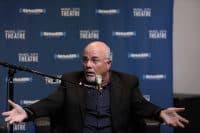
529 Savings Plan or Trump Account? Dave Ramsey Calls Trump Accounts a “Thump-My-Chest Thing”
When a mom asked Dave Ramsey whether to switch her family’s college savings into Trump Accounts, his answer surprised even fans of the new program, and his reasoning cuts right to the heart of what most parents get wrong about…

This post may contain links from our sponsors and affiliates, and Flywheel Publishing may receive compensation for actions taken through them.

A mom in Baby Step 5 (save for your children’s college fund) called The Ramsey Show with a question many parents are wrestling with after the recent Trump Account launch. She and her husband had already opened 529 College Savings Plans for their two daughters, ages 10 and 20, each holding about $1,500. Her question: “We were debating whether to get an ESA or do the Trump Accounts, not the $1,000, but the regular investing. And I wanted to know your thoughts on which one we should get.” The family made clear they wanted guidance on where to direct regular contributions, not on whether to claim the free $1,000 government deposit.
Dave Ramsey’s answer was blunt. “I would just keep using your 529s.“ On the newer option, he added: “The Trump Accounts are all right, but largely it’s a Trump thump-my-chest thing… It’s not like it’s something really substantially earth-shatteringly new, other than it’s got a big T on it for him.”
Why the 529 Savings Plan Wins Specifically for College Savings
Ramsey and co-host George Kamel make a strong case, built on three levers: tax treatment, contribution room, and investment control. Kamel put the tax point plainly: “The Trump Accounts are going to be taxable income. The 529, if used for college, is completely tax-free and it stays in your control. As far as the financial benefits, the 529 wins every time.”
There is also a structural constraint that Kamel’s point only hints at. During a child’s “growth period” (birth through age 17), Trump Account funds must be invested in low-cost U.S. equity index funds tracking the S&P 500 or a similar broad domestic index, with expense ratios capped at 0.10%. Parents cannot choose individual stocks, bonds, international funds, or most actively managed options during those years. A 529 plan, by contrast, typically offers a full menu of mutual funds that the account owner can swap out when performance lags.
The tax math is worth spelling out. Consider a parent putting $300 a month into a 529 for 15 years. If the account grows to roughly $90,000, about $36,000 of that total represents investment gains. Withdrawing those funds for tuition, room and board, or books produces zero federal tax on the gains. Run the same dollars through a taxable brokerage account and those gains face long-term capital gains rates when sold. For a family in the 15% capital gains bracket, that amounts to roughly $5,400 paid to the IRS on identical investment performance.
On contribution room, Kamel drew the second line: “The 529 has way higher contribution limits. There’s really no practical limit compared to a Trump Account’s $5,000 a year. And the ESA is $2,000 a year.” That comparison holds up. The IRS sets no annual cap on 529 contributions, though contributions above $19,000 per donor per beneficiary in 2026 require gift tax reporting. Trump Accounts are capped at $5,000 per child per year from all contributors combined, and Coverdell ESAs remain capped at $2,000 per beneficiary regardless of who contributes. Always verify your specific limits with a tax professional before making large deposits.
Ramsey also addressed the concern that a 529 locks you into underperforming funds: “The proper 529, the ones we like and recommend, will allow you to select the mutual fund to put in the 529, and if it’s underperforming, you could deselect it and select a different one. And just like you could do with a Roth IRA or something like that, same exact process.” That fund flexibility is something Trump Accounts simply cannot match during the growth years.
The 529 Only Makes Sense After Parents Fund Their Own Retirement
Kamel was direct that parents must put their own financial security first: “Parents need to be investing 15% into their own retirements first. Then save for college next, because that’s coming up a whole lot sooner than your kid’s retirement.” The sequencing matters because retirement savings enjoy tax advantages and, in most cases, decades of compounding runway that college savings cannot match.
Where Trump Accounts Still Fit
None of this means Trump Accounts lack merit. Enrollment reached 7 million children by late July 2026, with Treasury Secretary Scott Bessent calling the program “the most successful launch in government history.” Bessent has also noted that 86% of enrolled families earn less than $200,000, and that the accounts aim to create a new generation of shareholders among families that have historically been “left on the sidelines of Wall Street.” Since that milestone, Treasury released employer guidance in August 2026 allowing workers to direct pre-tax contributions toward their children’s Trump Accounts, with more than 50 companies already committed to the program. Then, in early September 2026, Bessent announced that automatic enrollment is coming, a move projected to push total participation from roughly 7 million toward 70 million children.
The $1,000 federal seed deposit, available to children born between January 1, 2025, and December 31, 2028, is genuinely new money for families who claim it. For parents who have already maxed their retirement contributions and their 529, a Trump Account adds another tax-deferred vehicle with a long growth runway before distributions begin at 18. For the specific question this caller asked, though, Ramsey’s answer was straightforward: the account you already have, funded consistently, beats chasing the shiny new option.
The Bottom Line
For parents saving specifically for college, the 529 Savings Plan offers the strongest combination of tax-free growth, high contribution limits, and broad investment flexibility. Trump Accounts and ESAs have a place in a family’s broader financial picture, but Ramsey’s advice is clear: fund your own retirement first, then keep contributing to the college account you already have.
Editor’s note: This pass corrected Treasury Secretary Bessent’s quote to reflect his precise phrasing (“most successful launch in government history”) and added post-publication context: the August 2026 Treasury employer guidance allowing pre-tax contributions to Trump Accounts, the September 2026 announcement of coming automatic enrollment projected to expand participation toward 70 million children, and Bessent’s statistic that 86% of enrolled families earn under $200,000.
Contact [email protected] for any questions or corrections.
Thomas Richmond is a financial writer and content strategist with 5+ years of experience covering stocks and financial markets. He has published over 500 articles focused on individual stock analysis, helping investors better understand business fundamentals, stock valuations, and long-term opportunities.
Thomas previously served as a Content Lead at TIKR, a stock research platform, where he helped scale the company’s blog to hundreds of articles per month and contributed to a weekly newsletter reaching more than 100,000 investors.
Outside of work, Thomas enjoys weight lifting and soccer.