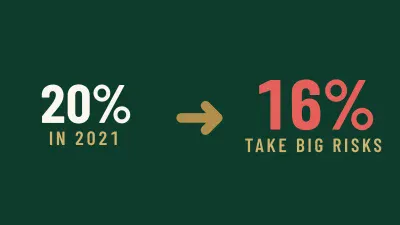
Only 16% of Americans Say They’re Willing to Take Big Investment Risks, Down From 20% in 2021
Americans are getting more cautious with their money, but playing it safe carries a price that most savers never see coming. One simple question, not a risk score, shows how to protect your portfolio without losing ground to inflation.

This post may contain links from our sponsors and affiliates, and Flywheel Publishing may receive compensation for actions taken through them.
A few rough years can change how much risk anyone wants to take. Since 2021, Americans have dealt with higher prices, pricier loans, and a stock market that didn’t move in a straight line. Many people have grown more careful with their money, and new survey data measures how many.
In the FINRA Foundation’s National Financial Capability Study, which surveys over 25,000 adults every three years, the share of U.S. adults willing to take risks with financial investments fell to 16% in the 2024 wave. That’s down from 20% in 2021. “Willing” here means people rated themselves an 8 to 10 on a 10-point scale, the top three spots.
Most people stayed in the market. The same study found 34% of adults held investments outside retirement accounts in 2024, compared with 35% in 2021. That means stocks, bonds, or funds in a regular brokerage account, outside a 401(k) or IRA. The share of Americans holding investments outside retirement accounts has barely changed, even as their willingness to take financial risks has declined.
The broader mood helps explain it. The University of Michigan’s consumer sentiment index, a monthly read on how upbeat people feel about the economy, was 48.1 in September 2026, down from 71.8 in November 2024. When people feel squeezed, they tend to play it safer.
Younger Adults Still Lean In, But Less Than They Used To
Age is the biggest factor, as FINRA found 23% of adults 18 to 34 are willing to take big risks, versus 18% of those 35 to 54 and just 8% of those 55 and older. That pattern tracks with time horizon, since younger people have decades to recover from a bad year.
Income made little difference, with risk appetite at 15% for lower earners and 18% for higher earners. Even so, young people pulled back the most. In FINRA’s related investor survey, investors under 35 willing to take substantial risks dropped from 24% in 2021 to 15% in 2024.
Why Playing It Safe Can Backfire For Retirees
Getting more conservative with age is normal. Whether it’s smart depends on how far you take it, since both too much and too little risk carry costs.
Too much risk near retirement means a market drop can hit right when you need to withdraw money. If stocks fall 30% and you have to sell to pay the bills, you lock in losses on those shares and miss any recovery they might have delivered. Our coverage of stock allocations for older savers in their late fifties and beyond digs into this, and we also put together a free guide on why those first few years of withdrawals can do major damage.
Too little risk is quieter but just as real. Retirement can last decades. If your money grows slower than prices rise, it buys a little less every year.
What Inflation Does To A Safe Portfolio Over 25 Years
Consider a simple example: $100,000 and 3% annual inflation. A very conservative mix earns 2.5% a year. A balanced mix of stocks and bonds earns 6%. These are assumptions only, and no return is guaranteed.
In today’s dollars, the conservative portfolio would be worth about $88,500 after 25 years. Its buying power shrank even though the balance grew. The balanced portfolio would be worth about $205,000 in today’s dollars. That example skips withdrawals, and a balanced mix will have rough years along the way. Still, a very conservative mix costs you in lost buying power.
A Simple Way To Split Your Money
Most people don’t have to pick one extreme. A common approach splits money by when you’ll need it. Keep near-term spending, such as a couple of years of expenses, in cash, Treasury bills, or CDs. That money won’t swing with the market, so a downturn won’t force a sale. Keep the long-term money invested for growth. Our coverage of CDs and Treasury bills walks through current options for that safe bucket.
This setup lets conservative people stay conservative where it counts. It also keeps the rest of their savings working against inflation.
One Question That Settles The Risk Debate
The drop from 20% to 16% tells us Americans feel more nervous. The right level of risk for any one person depends on more than mood. A number on a 10-point scale reflects mood, and mood changes with headlines.
A better guide is one plain question: when will I actually need this money? Money for next year’s bills goes somewhere steady. Money for 15 years from now can handle some bumps. Answer that first, and the right level of risk usually follows.
Contact [email protected] for any questions or corrections.
David Beren has been a Flywheel Publishing contributor since 2022. Writing for 24/7 Wall St. since 2023, David loves to write about topics of all shapes and sizes. As a technology expert, David focuses heavily on consumer electronics brands, automobiles, and general technology. He has previously written for LifeWire, formerly About.com. As a part-time freelance writer, David’s “day job” has been working on and leading social media for multiple Fortune 100 brands. David loves the flexibility of this field and its ability to reach customers exactly where they like to spend their time. Additionally, David previously published his own blog, TmoNews.com, which reached 3 million readers in its first year. In addition to freelance and social media work, David loves to spend time with his family and children and relive the glory days of video game consoles by playing any retro game console he can get his hands on.