The Roth IRA Mistake That Turns $5,275 a Month in Tax-Free Dividends Into a Tax Bill

This post may contain links from our sponsors and affiliates, and Flywheel Publishing may receive compensation for actions taken through them.
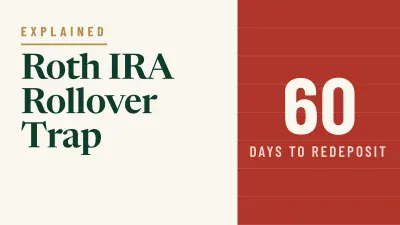
Moving a Roth IRA to a new brokerage by asking the old firm to mail a check can create a tax problem. Under IRS rules, a check made out to the owner starts a deadline, and missing it can turn tax-free income into taxable income.
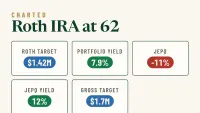
An income portfolio also raises the risk, as a Roth paying $5,275 a month comes to $63,300 a year, all of it tax-free while the account stays intact. Below is a six-holding Roth built for that target, with yields based on prices and annualized payouts as of November 12, 2026.
How a Mailed Check Breaks a Roth
When the old firm cuts a check in the owner’s name, that’s an indirect rollover. The money has to land back in an IRA within 60 days. If it doesn’t, IRS Publication 590-A treats it as a taxable distribution, and any deposit after the deadline counts as a regular contribution.
A second rule also applies. Publication 17 allows only one rollover from an IRA to another IRA in any 1-year period, and it groups traditional, Roth, and SIMPLE IRAs together as one account for that limit.
For a Roth owner who isn’t yet qualified (under 59½, or a Roth held for less than five years), the earnings in a non-qualified distribution can be taxed, according to Publication 590-B. Those dollars also leave the Roth’s tax shelter for good. Putting a large sum back as a regular contribution exceeds the annual limit, and the IRS charges a 6% excise tax on Roth excess contributions for each year the excess stays put.
That 6% charge is one of several IRS rules that quietly drain retirement accounts over time. Our free guide maps out nine of them here. In addition, direct trustee-to-trustee transfers aren’t limited. Per Publication 17, that includes a check the old firm makes payable to the new custodian, even if the owner delivers it (IRS Publication 17).
What $63,300 a Year Takes in a Roth
The six holdings below produce a weighted yield of about 8.3%. Dividing $63,300 by that yield calls for a Roth balance of roughly $760,000.
Nasdaq Covered Calls Drive the Biggest Payout
NEOS Nasdaq 100 High Income ETF (NASDAQ:QQQI) holds Nasdaq-100 stocks and sells call options on the index, collecting a fee called a premium. Its June filing lists short calls on the Nasdaq-100 index. It has a 20% weight, yields about 14.7% and supplies roughly 35% of the income. Selling calls caps the fund’s gains when tech stocks rally.
A Low-Cost Fund of High-Dividend U.S. Stocks
Holding high-dividend U.S. stocks for 0.38% a year, iShares Select Dividend ETF (NASDAQ:DVY) delivers about 6% of the income at a 15% weight and a 3.3% yield. Its quarterly payouts swing from $1.62 in December 2025 to $1.33 in September 2026.
Casino Rent With Room to Cover the Dividend
Gaming and Leisure Properties (NASDAQ:GLPI) is a REIT, a company that holds property and passes most of its rent to shareholders. It holds 71 facilities leased to 8 tenants. It gets a 15% weight, yields about 8.4%, and provides roughly 15% of the income. The quarterly dividend rose to $0.82 from $0.78 this year, and 2026 AFFO (a REIT cash-flow measure) guidance is $4.11 to $4.12 per share against a $3.28 annual dividend.
Monthly BDC Checks at a Premium Price
Monthly checks come from Trinity Capital (NASDAQ:TRIN), a business development company, or public lender to growth companies. It switched to monthly payouts of $0.17 in 2026. At a 15% weight and a yield of about 11.3%, it covers roughly 20% of the income. Shares near $18 trade above its $13.61 net asset value per share, with net leverage at 117% debt-to-equity.
Smoke-Free Growth Funds a Rising Dividend
Philip Morris International (NYSE:PM | PM Price Prediction) sells Marlboro alongside smoke-free products that now exceed 40% of revenue. At a 15% weight and a 3.2% yield, it adds about 6% of the income. Philip Morris raised its quarterly dividend 9% to $1.60 in October, up from its inaugural $0.46 payout in 2008.
Floating-Rate Loans That Pay Less as Rates Fall
Senior loans, first in line for repayment with floating rates, fill State Street Blackstone Senior Loan ETF (NYSEARCA:SRLN). Its payouts track short-term rates, so income falls when the Fed cuts. It takes a 20% weight, yields about 7.2%, and supplies roughly 17% of the income. The monthly payout dropped from $0.32 in February 2024 to about $0.24 now, with the Fed funds upper bound at 4%.
Protecting a $760,000 Roth During a Move
For a Roth of roughly $760,000 paying $5,275 a month, the move should start at the new brokerage as a direct transfer, and anyone already holding a rollover check is on the deadline from the day the money arrived.
However, putting it into a Roth within 60 days keeps the rollover intact, provided no other IRA rollover happened in the prior year. After the deadline, Publication 590-A lists three routes to a waiver: automatic relief, self-certification, or a private letter ruling. Starting May 1, 2027, Rev. Proc. 2026-33 establishes a new IRA correction process, while existing waiver and self-certification procedures remain available in the meantime.
Contact [email protected] for any questions or corrections.
David Beren has been a Flywheel Publishing contributor since 2022. Writing for 24/7 Wall St. since 2023, David loves to write about topics of all shapes and sizes. As a technology expert, David focuses heavily on consumer electronics brands, automobiles, and general technology. He has previously written for LifeWire, formerly About.com. As a part-time freelance writer, David’s “day job” has been working on and leading social media for multiple Fortune 100 brands. David loves the flexibility of this field and its ability to reach customers exactly where they like to spend their time. Additionally, David previously published his own blog, TmoNews.com, which reached 3 million readers in its first year. In addition to freelance and social media work, David loves to spend time with his family and children and relive the glory days of video game consoles by playing any retro game console he can get his hands on.