She Is Spending Her 60s Quietly Moving a $420,000 IRA Into a Roth, $45,000 a Year. When the IRS Shows Up at 75 to Set Her Withdrawals, There Will Be Almost Nothing Left to Tax

This post may contain links from our sponsors and affiliates, and Flywheel Publishing may receive compensation for actions taken through them.
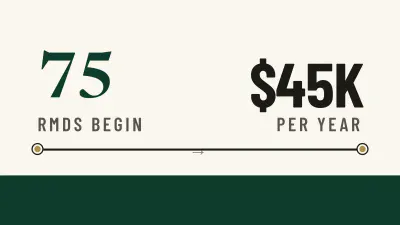
Once a year, a woman in her 60s moves $45,000 from her traditional IRA into a Roth, then sets aside cash and makes any required estimated tax payments. The traditional account started at $420,000, and she’s shrinking it on purpose. She’d rather pay tax now, at rates she can see coming, than leave her older self and her heirs facing a bigger bill later.
She’s doing what’s called a staged Roth conversion. Three things decide whether it pays off: tax brackets, Medicare premiums, and mandatory withdrawals. If she starts early enough and keeps converting, much of her money may sit in a Roth by the time RMDs begin, and Roth IRAs have no lifetime RMDs for their original owners.
Why Smaller Slices Can Cost Less Tax
A conversion counts as ordinary income in the year it happens. Federal law adds to gross income any amount that “would be includible were it not part of a qualified rollover contribution”[1] under 26 U.S.C. § 408A(d)(3)(A)(i). IRS Publication 590-A says these amounts are “normally included in income on your return for the year that you converted them”.
Brackets are why the annual routine matters. In 2026, a single filer’s standard deduction is $16,100. If she had no other income, a $45,000 conversion would leave $28,900 of taxable income.
Of that $28,900, the first $12,400 is taxed at 10%, and the remaining $16,500 is taxed at 12%. For 2026, the 22% rate only kicks in on taxable income over $50,400. Most retirees have Social Security or pension income on top, so her actual rate depends on that mix. Still, she decides how much of each year’s income is taxable.
Converting all $420,000 at once would put a single filer well past the 35% rate, which applies to 2026 income over $256,225. Spreading the same dollars across her 60s keeps more of them taxed at lower rates.
Medicare Sees the Same Income Two Years Later
Conversions also raise Medicare premiums as Part B premiums are based on income from an earlier tax year, generally a two-year lookback[2], so a conversion at 63 can raise what she pays at 65. In 2026, the standard premium is $202.90[2] a month for single filers with income up to $109,000.
Above that line, a surcharge called IRMAA is added. A one-time $420,000 conversion would put a single filer in the level for income over $205,000 and under $500,000[2], where Part B costs $649.20 a month. A $45,000 portion usually stays under the first threshold unless she has a lot of other income.
What Her RMDs Look Like at 75
For the most part, RMD start age depends on birth year. People born on or after January 1, 1960 start at 75, while those born between 1951 and 1959 start at 73. In her story, age 75 means she was born in 1960 or later.
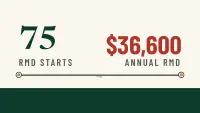
The annual RMD equals the prior year-end balance divided by a factor from the IRS Uniform Lifetime Table. At 75, that factor is 24.6. A $420,000 balance left alone would force a first withdrawal of about $17,073, and that’s before any investment growth.
The factor drops to 20.2 by 80, so the required share of the account rises every year.
Her Roth stays out of this math entirely. The IRS states that “the RMD rules do not apply to Roth IRAs or Designated Roth accounts while the owner is alive.” With the traditional IRA nearly empty, 24.6 divides a small balance. Missing an RMD still triggers a 25% excise tax on the shortfall, which drops to 10% if she fixes it within the correction window.
Trade-Offs Before Copying Her Plan
She’s paying tax years before the law requires it, and the money she sends the IRS stops growing. The plan works best when today’s bracket is the same as or lower than the one she expects later, and when she pays the tax from savings outside the IRA. If she paid it out of the conversion itself, less money would reach the Roth.
Conversions also make less sense for people who expect a lower bracket later or who plan to give IRA money to charity. Charitable transfers of up to $111,000 in 2026 can count toward RMDs without adding to taxable income. Heirs still face distribution rules on an inherited Roth, generally emptying it within ten years, but they can usually take that money out tax-free. State income taxes can change the math too.
For anyone in their 60s with a large traditional IRA, the years between retirement and when mandatory withdrawals begin are often the lowest-income years they’ll have, and the one stretch when they fully control their taxable income (we sized up that quiet window, and how to use it for conversions, in a free Roth guide here: The Roth Window).
The decision is worth reviewing every year: how much can move into the Roth while staying under the next tax bracket and the next IRMAA threshold.
Contact [email protected] for any questions or corrections.
David Beren has been a Flywheel Publishing contributor since 2022. Writing for 24/7 Wall St. since 2023, David loves to write about topics of all shapes and sizes. As a technology expert, David focuses heavily on consumer electronics brands, automobiles, and general technology. He has previously written for LifeWire, formerly About.com. As a part-time freelance writer, David’s “day job” has been working on and leading social media for multiple Fortune 100 brands. David loves the flexibility of this field and its ability to reach customers exactly where they like to spend their time. Additionally, David previously published his own blog, TmoNews.com, which reached 3 million readers in its first year. In addition to freelance and social media work, David loves to spend time with his family and children and relive the glory days of video game consoles by playing any retro game console he can get his hands on.