She’ll Retire at 64 With $380,000 in a 401(k) and Convert Nothing for 11 Years. At 75 It Will Be About $650,000, and the IRS Will Set Her First Withdrawal at $26,400, Whether She Needs It or Not

This post may contain links from our sponsors and affiliates, and Flywheel Publishing may receive compensation for actions taken through them.

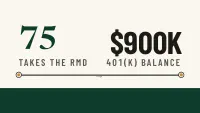
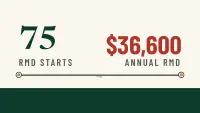
Imagine a 64-year-old who retires with $380,000 in a traditional 401(k). The good news is that other money covers the bills, so the account sits untouched. She converts none of it to a Roth for 11 years. By the time her RMDs begin, the balance has grown to about $650,000. Her first required minimum distribution (RMD) is roughly $26,400, and she must take it whether she needs the money or not, and if the account is entirely pretax, the full withdrawal is taxable.
How the IRS Sets Her First Withdrawal
Her start age depends on her birth year. Federal law sets the applicable age at 75 for anyone born on or after January 1, 1960, under 26 U.S.C. § 401(a)(9)(C)(v)(II). People born earlier start sooner. Someone born in 1959, for example, starts at 73.
IRS Publication 590-B lays out the math in one step. The calculation takes the account balance as of December 31 of last year and divides it by the age-based factor set by the IRS. At 75, that factor is 24.6, so her balance divided by it comes to about $26,423.
Each year after that, the factor shrinks, so each later withdrawal takes a bigger share of what’s left. With a 401(k), the IRS says RMDs “must be taken separately from each of those plan accounts,” which is stricter than the IRA rule that allows the total to be taken from any of the owner’s IRAs. Skipping the withdrawal triggers a 25% excise tax on the shortfall. If she missed the whole thing, that would be $6,600.
Why Money She Didn’t Ask for Still Costs Her
A required withdrawal counts as taxable income even when the money isn’t needed. Under 26 U.S.C. § 402(a), plan distributions are taxed “in the taxable year of the distributee in which distributed.”[1] Every dollar lands on her return as ordinary income, even if it goes straight into a savings account. For 2026, the 22% bracket starts at $50,400 of taxable income for single filers. The standard deduction is $16,100, with an additional $2,050 for those 65 or older and a separate senior deduction of up to $6,000 for eligible taxpayers.
RMD income also affects how her Social Security is taxed. Under 26 U.S.C. § 86, as income rises, up to 85%[2] of benefits can become taxable. For 2026, a typical retiree collects an estimated $2,071 a month. Every RMD dollar counts toward the income test, so a withdrawal she never wanted can make more of that check taxable.
Medicare premiums also depend on her income. In 2027, the standard Part B premium is $209.40[3] a month for single filers with income up to $112,000. If her income goes past that line, IRMAA, the income-based surcharge, raises the total to $293.10[3]. Her RMD alone won’t get her there. Once Social Security, a pension, and investment income are added, though, the margin below the threshold shrinks every year as the required share grows.
What Her 11 Years Before RMDs Could Have Done
From 64 to 75, she has no paycheck and no RMDs yet, so her taxable income may be lower than in her working years. That gap is when partial Roth conversions are often considered. She’d pay ordinary income tax on each amount she converts in the year she converts it. After that, the money sits in a Roth, and Roth IRAs have no RMDs while the owner is alive.
The usual approach is to fill the low brackets. In 2026, a single filer pays 12% on taxable income above $12,400, up to the point where the 22% rate starts. If she converts just enough each year to use that room, she shrinks the pretax balance the IRS will later divide by 24.6.
A smaller balance at 75 means a smaller forced withdrawal and a smaller tax bill on it, and it also puts less pressure on her Social Security taxes and her Medicare level. Conversions also count as income. Once she’s on Medicare at 65, IRMAA thresholds matter. Each year’s conversion has to be checked against them, or it can raise the premiums it was meant to reduce.
What to Watch Before Age 75
Some of the rules are still being settled. In March 2026, IRS Announcement 2026-7 said parts of the upcoming final RMD regulations will apply no earlier than 6 months after they’re published. Until then, taxpayers must use a reasonable, good-faith reading of the law, but the core formula stays the same either way: last year’s balance divided by the factor for the owner’s age.
Leaving a 401(k) untouched until RMDs begin postpones the tax decision to a year the IRS picks, on a balance the market sets. With roughly a decade between retirement and that first RMD, she can choose to pay some of that tax earlier, in brackets she picks.
Contact [email protected] for any questions or corrections.
David Beren has been a Flywheel Publishing contributor since 2022. Writing for 24/7 Wall St. since 2023, David loves to write about topics of all shapes and sizes. As a technology expert, David focuses heavily on consumer electronics brands, automobiles, and general technology. He has previously written for LifeWire, formerly About.com. As a part-time freelance writer, David’s “day job” has been working on and leading social media for multiple Fortune 100 brands. David loves the flexibility of this field and its ability to reach customers exactly where they like to spend their time. Additionally, David previously published his own blog, TmoNews.com, which reached 3 million readers in its first year. In addition to freelance and social media work, David loves to spend time with his family and children and relive the glory days of video game consoles by playing any retro game console he can get his hands on.