Washington’s $2 Billion Apple Harvest Is Underway. At 63, Three Months in the Orchard Don’t Have to Cost a Full Year of Social Security.
Washington's apple harvest is hiring at wages that could quietly collide with your Social Security check, but the math behind that collision surprises most people who run the numbers.

This post may contain links from our sponsors and affiliates, and Flywheel Publishing may receive compensation for actions taken through them.
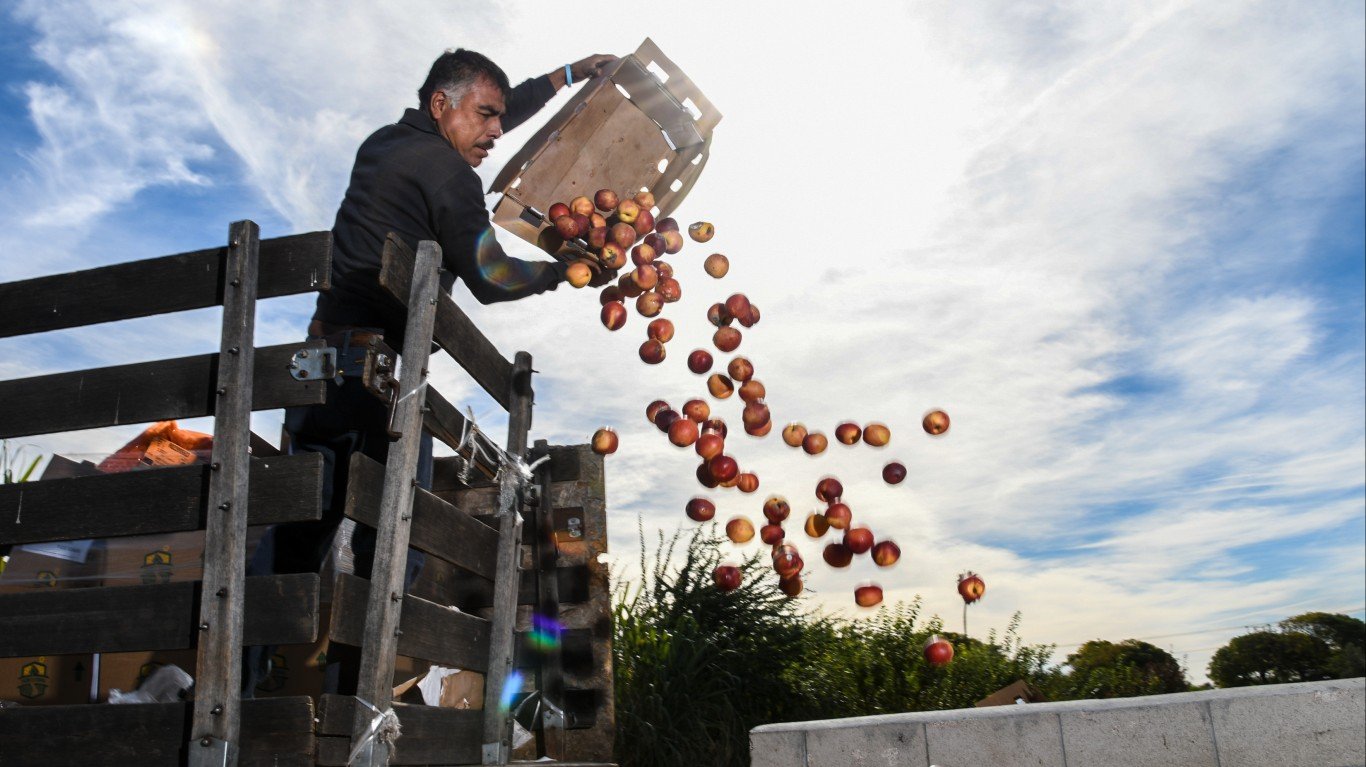
Washington is heading into a roughly $2 billion apple harvest expected to produce 176 million bushels, about 62% of the U.S. crop. The seasonal hiring is just as real. One current Washington job order is seeking 193 workers for apple harvest from Aug. 15 through Nov. 15 at a guaranteed $17.13 an hour.
For a 63-year-old already drawing Social Security, three months in the orchard can bring in welcome money. The natural worry is whether taking the job means giving up the benefit he just started counting on. Usually, the first number to check is much simpler than that.
Three Months May Never Reach the Earnings Limit
For someone born in 1960 or later, full retirement age (FRA) is 67. Until then, Social Security applies an earnings test to wages and net self-employment income. In 2026, someone under FRA all year can earn $24,480 before Social Security begins withholding $1 in benefits for every $2 above the limit.
Suppose our 63-year-old takes a three-month orchard job at $17.13 an hour and works 40 hours a week for 13 weeks. That comes to roughly $8,900. If those are his only wages for the year, he is nowhere near the $24,480 limit. Social Security has nothing to withhold. Even at $20 an hour, the same 13-week stretch produces about $10,400. Again, comfortably below the annual threshold. The harvest can therefore replace some retirement income without automatically taking anything away from Social Security.
All or Nothing?
No. Crossing the earnings limit does not make the entire Social Security benefit disappear.
Now suppose the worker has other wages and finishes the year with $30,000 of earned income. Only $5,520 sits above the 2026 limit. Under the $1-for-$2 rule, that produces $2,760 of required benefit withholding. That is meaningful, but it is nowhere close to losing an entire year of Social Security. And benefits withheld under the earnings test are not simply forfeited.
At FRA, Social Security recalculates the monthly benefit to account for months in which payments were withheld because of excess earnings. The adjustment can raise the check going forward. The bigger risk is misunderstanding the rule and either turning down useful work unnecessarily or budgeting for Social Security payments that will temporarily be withheld.
Escape Hatch
There is a second rule that matters if 2026 is also the worker’s first year receiving Social Security. SSA has a special monthly rule designed largely for people who retire partway through a year after already earning more than the annual limit. In 2026, someone under FRA can generally receive a full check for any whole month in which wages are $2,040 or less, provided the other conditions are met. The rule applies for one year, usually the first year of retirement.
So imagine a 63-year-old who earned heavily before retiring, then works the apple harvest and stops completely in November. His annual wages might exceed $24,480 by a wide margin. But qualifying months after the harvest can still produce full Social Security checks if his wages fall below the monthly limit. That is much different from assuming one strong harvest wipes out the entire year’s benefits.
The Harvest Paycheck Still Reaches the Tax Return
The earnings test is only one calculation. Wages also feed adjusted gross income (AGI), which can determine how much of Social Security becomes federally taxable. For a single filer, combined income above $25,000 can make some benefits taxable, while income above $34,000 can result in up to 85% of benefits being included in taxable income. The thresholds for married couples filing jointly are $32,000 and $44,000.
That does not mean the orchard job stops making sense. It means the useful comparison is the after-tax paycheck against any Social Security withholding, not the gross wage by itself. Seasonal wages can also help the eventual benefit if they replace a weaker year among the 35 years Social Security uses in its calculation.
Put the Harvest Beside the Social Security Calendar
Before grabbing the ladder, three details deserve a look:
- Add up total 2026 wages. Three months of orchard work by itself may stay comfortably below the $24,480 earnings limit.
- Check whether this is the first year of benefits. If annual earnings are already high, the special monthly rule may protect qualifying months after the seasonal job ends.
- Estimate the tax effect. Wages that never trigger benefit withholding can still make more Social Security taxable.
Phasing out of full-time work has its own quirks though, and we mapped the four tax traps that catch semi-retirees in a free guide here. Washington may grow nearly two-thirds of America’s apples this season. For a 63-year-old willing to work a few months of that harvest, Social Security does not necessarily have to take a bite out of the paycheck.
Contact [email protected] for any questions or corrections.
Gerelyn Terzo is the author of dividend investing handbook "Dividend Investing Strategies: How to Have Your Cake & Eat It Too." A veteran financial journalist, she covers agri-finance for outlets like Global AgInvesting and the broader stock market and personal finance for 24/7 Wall Street. She began at CNBC and later helped launch Fox Business in New York. Gerelyn currently resides in Woodland Park, Colorado and dabbles in nature photography as a hobby.