





Retirees facing low bond yields have turned to high-dividend equity strategies, but not all approaches deliver the stability fixed-income investors need. The challenge is finding yield that won’t disappear when markets turn.
What SPYD Actually Delivers
SPDR Portfolio S&P 500 High Dividend ETF (NYSEARCA:SPYD | SPYD Price Prediction) holds the 80 highest-yielding S&P 500 stocks, equally weighted, delivering a 4.7% yield with a 0.07% expense ratio. For a retiree with $200,000 invested, that’s roughly $9,400 in annual income at minimal cost.
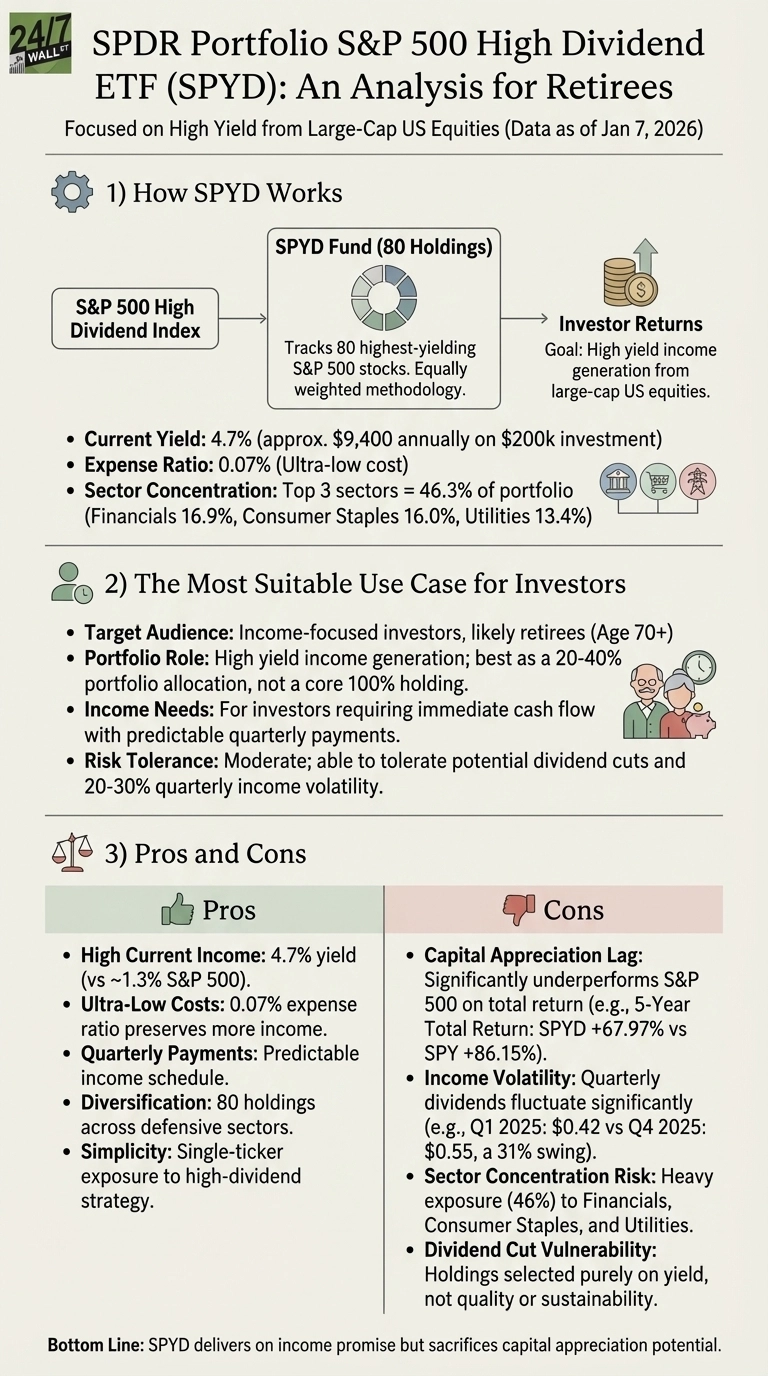
The fund collects dividends from mature, cash-generating businesses. Unlike covered-call strategies that sacrifice upside for premium income, SPYD captures full appreciation potential. The equal-weight approach means no single company dominates—top holdings like CVS Health (NYSE:CVS) and Merck (NYSE:MRK) each represent just 1.6% to 1.8% of assets.
The Sector Concentration Reality
SPYD’s yield pursuit creates predictable sector tilts. Financials comprise 16.9% of assets, Consumer Staples 16%, and Utilities 13.4% – nearly half the portfolio. This makes sense: banks, utilities, and consumer staples typically pay higher dividends than growth sectors.
The tradeoff is stark underperformance during growth-driven markets. Over the past year, SPYD returned 5.6% versus the S&P 500’s 17% gain. The five-year gap is similar: 68% total return versus 86% for the broader index. Technology represents just 1.2% of SPYD compared to roughly 30% in the S&P 500.
Dividend Volatility Retirees Must Accept
SPYD’s quarterly distributions fluctuate significantly. In 2025, payouts ranged from $0.42 per share in March to $0.55 in December—a 31% swing. This reflects the fund’s mechanical selection: it simply buys the highest yielders, regardless of dividend quality or sustainability.
Some holdings present genuine risks. CVS Health, the largest position, reported a 0.12% profit margin with earnings down 43% year-over-year, raising questions about dividend coverage. Ford Motor (NYSE:F) offers a reasonable 51% payout ratio but carries a beta of 1.63, meaning significantly higher volatility than the broader market.
Who Should Avoid This Fund
Retirees in their 60s with 20-plus year time horizons should think carefully. The total return gap compounds over time—SPYD’s 10-year performance trails the S&P 500 by nearly 100 percentage points. For someone needing portfolio growth to fund three decades of retirement, sacrificing appreciation for current yield creates sequence-of-returns risk.
Retirees who cannot tolerate income variability should look elsewhere. If your budget depends on consistent quarterly payments, SPYD’s 20% to 30% dividend swings create planning challenges that stable bond income does not.
A Quality Alternative Worth Considering
The Schwab U.S. Dividend Equity ETF (NASDAQ:SCHD) takes a different approach. Rather than mechanically buying the highest yielders, SCHD screens for dividend quality, requiring 10 consecutive years of payments and strong fundamentals. The result is a 3.8% yield versus SPYD’s 4.7%, but with better risk-adjusted returns and more diversified sector exposure including 8.2% in technology.
SCHD’s $71 billion in assets dwarfs SPYD’s $7.4 billion, providing superior liquidity. Its holdings include established dividend growers like The Coca-Cola Company (NYSE:KO) and The Home Depot (NYSE:HD) rather than yield-chasing value traps.
SPYD’s 4.7% yield and sector concentration toward financials, consumer staples, and utilities reflect a high-income strategy that sacrifices growth potential. The fund’s quarterly dividend volatility ranging from $0.42 to $0.55 per share in 2025 and 5-year total return of 68% versus the S&P 500’s 86% illustrate the trade-offs between current income and total return that retirees must evaluate based on their individual circumstances.













 Top Gaining Stocks
 Top Losing Stocks