6 Chip Stocks Set to Benefit Most From Big Tech Tariff Exemption
The Trump administration plans to exempt certain companies from upcoming tariffs on advanced semiconductors. The exemptions are tied to Taiwan Semiconductor Manufacturing Co.’s (NYSE: TSM | TSM Price Prediction) $165 billion investment in U.S. factories, and the goal is to…

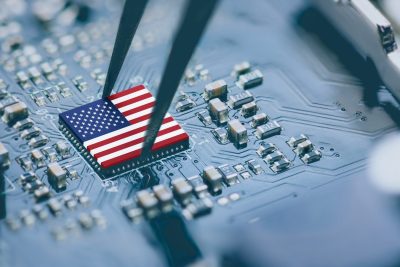
The Trump administration plans to exempt certain companies from upcoming tariffs on advanced semiconductors. The exemptions are tied to Taiwan Semiconductor Manufacturing Co.’s (NYSE: TSM | TSM Price Prediction) $165 billion investment in U.S. factories, and the goal is to protect the AI data center buildout from rising costs while pressuring manufacturers to shift production to the United States.
Tariff exemptions are reshaping competitive dynamics in Big Tech’s semiconductor supply chain. Six companies stand to capture disproportionate benefits through explosive AI infrastructure growth, data center dominance, and manufacturing footprints that minimize tariff exposure.
Qualcomm: Supply Constraints Limit Upside
Qualcomm (NASDAQ: QCOM) faces headwinds that temper tariff exemption benefits. Q1 FY26 revenue hit $12.30 billion, up 5% year-over-year, with QCT segment revenue of $10.61 billion and Automotive revenue reaching $1.10 billion, up 15%. Memory supply constraints are crimping handset outlook.
Shares fell 21.85% over the past month and trade 18.78% below year-end 2025 levels. RSI at 26.28 as of February 9, 2026, signals deeply oversold conditions. Management guided Q2 revenue to $10.2 billion to $11.0 billion, citing supply chain bottlenecks. With quarterly earnings declining 1.8% year-over-year despite 5% revenue growth, margin pressure limits Qualcomm’s ability to capitalize on favorable trade policy.
Apple: Manufacturing Exposure Creates Volatility
Apple (NASDAQ: AAPL) benefits from tariff exemptions but carries the highest manufacturing sensitivity. Q1 FY26 revenue reached $143.80 billion, up 16% year-over-year, with iPhone revenue hitting a record $85.27 billion. Services contributed $30.01 billion, up 14%, while the installed base expanded to 2.5 billion active devices.
Tariff exemptions matter more for Apple because iPhone production concentrates in regions where component tariffs directly impact bill-of-materials costs. Shares gained 5.98% over the past month and trade 1.11% above year-end levels. RSI sits at 63.22, indicating healthy momentum. The company’s 27% profit margin and 35.4% operating margin provide cushion, but tariff policy changes create earnings volatility that AI-focused pure plays avoid.
AMD: Rapid AI Scaling Drives Recovery
Advanced Micro Devices (NASDAQ: AMD) is accelerating its AI franchise. Q4 FY25 revenue hit $10.30 billion, up 34.5% year-over-year, with Data Center revenue reaching $5.4 billion, up 39%. Client and Gaming segments contributed $3.9 billion, up 37%. Management guided Q1 FY26 revenue to $9.8 billion.
The stock doubled over the past year, gaining 100.82%, though shares pulled back 12.29% over the past week. This correction pushed RSI to 45.15. AMD’s 217.1% year-over-year quarterly earnings growth demonstrates its ability to scale AI revenue rapidly. With 34.1% quarterly revenue growth and data center momentum, AMD benefits from tariff exemptions on high-margin AI accelerators while competing directly with Nvidia.
Broadcom: AI Semiconductor Revenue Doubling
Broadcom (NASDAQ: AVGO) emerges as a major tariff exemption winner through custom AI chips. Q4 FY25 revenue hit $18.02 billion, up 28% year-over-year, with AI semiconductor revenue up 74%. Q1 FY26 guidance signals explosive growth, with revenue expected at $19.1 billion and AI semiconductor revenue projected to double year-over-year to $8.2 billion.
Shares climbed 54.35% over the past year and gained 3.87% in the past week. RSI at 54.73 suggests building momentum. The company’s 36.2% profit margin and 31.8% operating margin reflect pricing power in custom silicon. Analysts set a $458.59 target price, with 49 buy or strong buy ratings versus one hold and zero sells. Broadcom’s exposure to hyperscaler AI buildouts positions it to capture tariff savings while selling high-value custom chips.
TSMC: The Linchpin of the Global AI Shield
Taiwan Semiconductor Manufacturing sits at the epicenter of the tariff exemption strategy, leveraging its unprecedented $165 billion U.S. investment to secure its dominance. In Q4 FY25, revenue reached $33.73 billion, up 20.5% year-over-year, driven by the aggressive ramp of 3nm and 5nm nodes, which now account for over 60% of wafer sales. Full-year 2025 revenue surged 35.9% to $122.42 billion, with net margins holding at a robust 45.1%.
The proposed “rebate program” serves as a powerful tailwind; by committing to expand its Arizona complex to 11 or more fabs, TSMC has secured a framework to import components tariff-free at 2.5 times its planned U.S. capacity. Shares gained 1.88% on February 9, 2026, closing at $355.41, bolstered by January revenue growth of 37%. With an RSI of 64.77, the stock is approaching overbought territory but remains supported by a massive $52 billion to $56 billion capex budget for 2026. As the primary manufacturer for Nvidia, Apple, and AMD, TSMC’s ability to “earn” and reallocate tariff exemptions to its hyperscaler clients cements its position as the ultimate gatekeeper of the AI infrastructure buildout.
Nvidia: AI Infrastructure Dominance Cements Top Position
Nvidia (NASDAQ: NVDA) stands as the clearest tariff exemption beneficiary, combining massive scale with unprecedented AI demand. Q3 FY26 revenue hit $57.01 billion, up 62% year-over-year, with Data Center revenue reaching $51.2 billion, up 66%. Blackwell platform sales are off the charts, driving Q4 guidance to $65 billion. Networking revenue surged 162% year-over-year to $8.2 billion, while Gaming added $4.3 billion, up 30%.
Shares gained 46.4% over the past year and trade 1.9% above year-end levels. RSI at 55.36 indicates neutral momentum with upside potential. The company’s 53% profit margin and 63.2% operating margin create massive operating leverage. With 62.5% quarterly revenue growth and 66.7% quarterly earnings growth, Nvidia captures tariff exemption benefits on imported components while selling GPUs at premium prices. Analysts maintain a $253.62 target price, with 60 of 64 analysts rating the stock buy or strong buy.
The Tariff Exemption Winners Share Common Traits
Tariff exemption benefits accrue most to companies with explosive AI infrastructure growth and minimal manufacturing exposure to consumer electronics. TSMC anchors this dynamic as the primary “exemption engine,” while Nvidia and Broadcom lead with data center revenue doubling or growing 60% plus. AMD scales rapidly from a smaller base. Apple benefits but carries iPhone production risk, and Qualcomm trails due to supply constraints that offset trade policy gains.
Contact [email protected] for any questions or corrections.
Trey has been an editor and author at 24/7 Wall St. for more than a decade, where he has published thousands of articles analyzing corporate earnings, dividend stocks, short interest, insider buying, private equity, and market trends. His comprehensive coverage spans the full spectrum of financial markets, from blue-chip stalwarts to emerging growth companies.
Beyond 24/7 Wall St., Trey has created and edited financial content for Benzinga and AOL's BloggingStocks, contributing additional hundreds of articles to the investment community.
Trey's editorial expertise extends across multiple publishing environments. He served as production editor at Dearborn Financial Publishing and development editor at Kaplan, where he helped shape financial education materials. Earlier in his career, he worked as a writer-producer at SVE. His freelance editing portfolio includes work for prestigious clients such as Sage Publications, Rand McNally, the Institute for Supply Management, the American Library Association, Eggplant Literary Productions, and Spiegel.
Outside of financial journalism, Trey writes fiction and has been an active member of the writing community for years, moderating workshop sessions at regional conventions.