




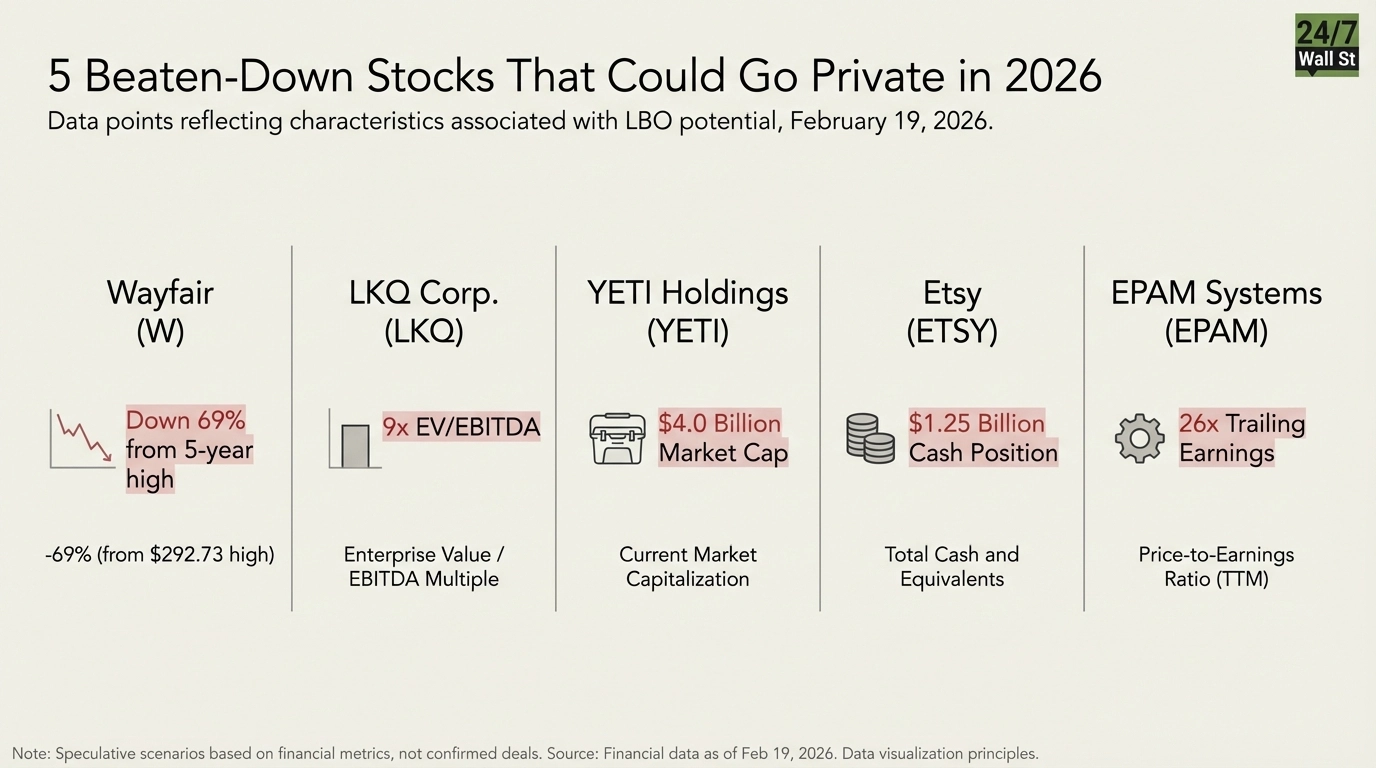
Private equity firms are sitting on a record amount of dry powder, and leveraged buyout financing has improved as interest rates stabilize. Mid-cap public companies with strong brands and cash flows are trading at multi-year lows, creating conditions that analysts associate with increased take-private activity. These five stocks, four of which just reported Q4 results, combine depressed valuations, manageable market caps, and characteristics that make them attractive LBO candidates in 2026.
Wayfair: The Largest Bet
Wayfair (NYSE: W) presents the most challenging but potentially rewarding go-private scenario. After its Q4 report, the online home goods retailer traded at $81.35, down 72% from its five-year high of $292.73. The $11.9 billion market cap pushes the upper limits of typical PE deals, but the operational turnaround is compelling.
In Q3 2025, Wayfair delivered $3.3 billion in revenue, as well as adjusted EBITDA of $224 million, a 133% year-over-year increase. The 6.8% EBITDA margin was the highest outside the pandemic period. The company still posted a $116 million GAAP net loss and carries negative shareholders’ equity of $2.8 billion. The biggest red flag: co-founder Steven Conine and CEO Niraj Shah have been systematically selling shares in the $98 to $119 range over the past three months, contradicting the typical pre-LBO accumulation pattern.
LKQ: The Textbook LBO Profile
LKQ (NASDAQ: LKQ) operates in the unglamorous but essential alternative auto parts business. Trading at $33.22, down 13% over the past year, the company’s $8.5 billion market cap and EV/EBITDA of 9x offer classic LBO economics.
LKQ generated $387 million in free cash flow in Q3 2025, providing ample debt servicing capacity, and holds $15.6 billion in total assets against $6.5 billion in shareholders’ equity. CEO Justin Jude noted the company is “gaining market share in a down market in North America” with more than 9% organic growth in the Specialty business. Overall organic revenue declined 1.2%, and coordinated executive selling at $33.41 in January 2026 is a cautionary signal.
YETI: The Brand Play
YETI Holdings (NYSE: YETI) is the smallest and most digestible target on this list. At $49.43, the stock trades 34% below its five-year high of $75, with a $4.0 billion market cap well within PE appetite for consumer brands.
Q4 2025 revenue of $538.7 million beat estimates, though gross margin fell to 58.4% due to tariff headwinds. CEO Matt Reintjes noted this was the company’s strongest quarter of the year, driven by a recovery in the Drinkware category and continued international expansion, which grew 25%. Furthermore, YETI accelerated its buyback program significantly in the final months of the year. Tariff-related margin compression remains a near-term risk that could complicate deal financing.
Etsy: The Marketplace Under Pressure
Etsy (NASDAQ: ETSY) has fallen 81% from its five-year high of $227.27 and is now trading at $44.05. The $4.4 billion market cap and $1.40 billion cash position are characteristics that have historically drawn PE interest.
Q4 2025 results were mixed, with revenue of $881.6 million missing estimates, EPS of $0.92 topping expectations, and net income declining 14.8% year-over-year to $110.7 million. However, the core marketplace saw GMS recover slightly to $3.29 billion, though active sellers continued to decrease. At 30x trailing earnings, Etsy is not a screaming bargain despite the stock’s decline.
EPAM Systems: The Most Compelling Case
EPAM Systems (NYSE: EPAM) is the strongest go-private candidate. The IT services and digital engineering firm trades at $141, down 63% from its five-year high of $376.
Despite the stock’s collapse, the business is accelerating due to acquisitions. Q4 2025 revenue of $1.41 billion grew 12.8% year-over-year, with contributions from the NEORIS and First Derivative acquisitions accounting for roughly 7.2% of the total growth. Financial services was up 20%, but software/hi-tech growth remained muted. EPAM holds $1.30 billion in cash and $3.65 billion in shareholders’ equity with no significant debt, and it bought back 1.16 million shares in Q4. The $9.3 billion market cap is manageable for large PE firms. Geopolitical concerns about Eastern European operations have weighed on the stock, creating the valuation disconnect that makes LBOs attractive. At 26x trailing earnings with accelerating growth, EPAM displays financial characteristics that analysts associate with go-private candidates.
Speculative Scenarios, Not Confirmed Deals
None of these companies has announced a go-private transaction or confirmed PE interest. These rankings reflect financial characteristics that typically attract LBO activity, including compressed valuations, manageable debt loads, and strong cash generation. Actual deal probability depends on management willingness, board dynamics, financing availability, and regulatory conditions beyond pure financial metrics.




















 Top Gaining Stocks
 Top Losing Stocks
