




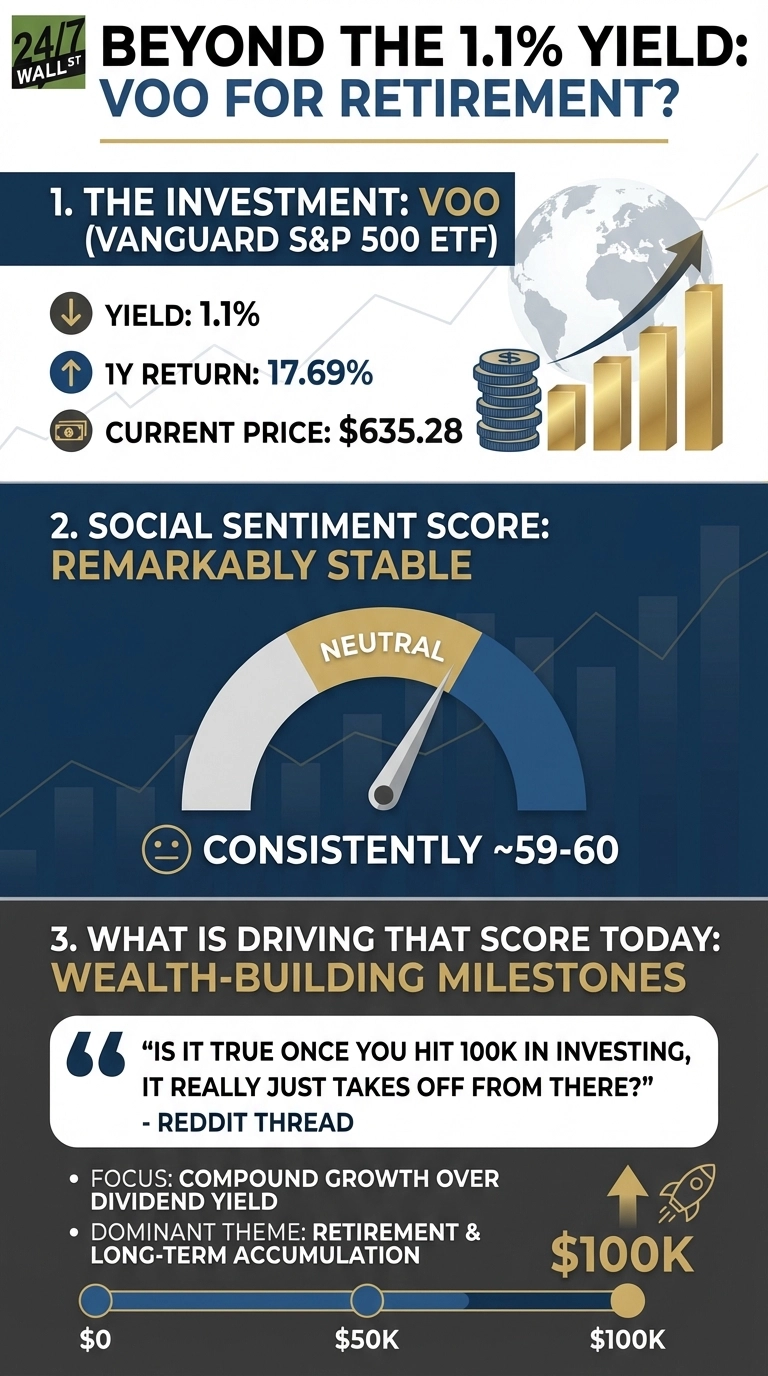
Even if you are a stock market newbie, there is a better than good chance you know that VOO sits at the center of nearly every personal finance conversation online, not because it is flashy, but because it works. Vanguard S&P 500 ETF (NYSEARCA:VOO) has become the default answer to almost any investing question, from a 25-year-old wondering what to do with a windfall to someone debating whether to pay off their mortgage. The sentiment score on Reddit has held steady at roughly 59 to 60 across the past week, month, and quarter, which tells its own story: nobody is panicking, and nobody is euphoric. VOO is just there, quietly doing its job.
The fund currently trades at $636, up 15% over the past year and 76% over five years, which is pretty incredible for a fund with $1.5 trillion in net assets and an expense ratio of just 0.03%, it is one of the most cost-efficient ways to own a broad slice of the U.S. economy.
The $100K Milestone Is Driving the Conversation
The most engaging VOO thread of the past month asked a simple question: “Is it true once you hit 100k in investing, it really just takes off from there?” It pulled 3,404 upvotes and 1,371 comments on r/investing, with VOO cited repeatedly as the core holding behind that compounding effect. The discussion reflects how Reddit investors actually think about VOO: not as an income vehicle, but as the engine of long-term wealth accumulation.
Is it true once you hit 100k in investing, it really just takes off from there?
by u/[OP] in investing
“Is it true once you hit 100k in investing, it really just takes off from there? I keep hearing this and want to know if it’s actually true or just a motivational thing people say.” — u/[OP], r/investing
VOO’s 1.1% Yield Is a Feature, Not a Bug
Ultimately, the yield question matters more as investors ask whether VOO’s 1.1% dividend yield has merit, knowing that it sits well below the current 10-year Treasury yield of 4.03% and even below the 2.2% inflation rate, meaning dividend income alone does not keep pace with rising prices. The portfolio is also heavily weighted toward technology at 34.1%, with the top three holdings, NVIDIA, Apple, and Microsoft, accounting for roughly 19.7% of the fund alone. That concentration drives the growth story but compresses the yield.
For younger investors, that trade-off is clearly acceptable. The debate worth watching is whether that calculus holds for investors within a decade of retirement, where income and sequence-of-returns risk start to matter more than raw appreciation.














 Top Gaining Stocks
 Top Losing Stocks
