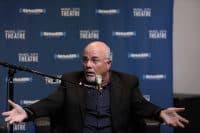
Dave Ramsey: “You Can’t Put $2,500 Away Because You Got $86,000 in Debt Sucking the Bone Marrow Out of Your Life”
A couple approaching 40 with $86,000 in debt and a $200,000 household income called into The Dave Ramsey Show in March 2026 asking a question that reveals a common panic response to late-start retirement anxiety: should they split their focus…


A couple approaching 40 with $86,000 in debt and a $200,000 household income called into The Dave Ramsey Show in March 2026 with a question that captures one of the most common panic responses to late-start retirement anxiety: should they split their focus and contribute 15% to retirement right now, even while paying off the debt?
Ramsey’s answer was blunt. “You can’t put $2,500 away right now because you got 86,000 freaking dollars in debt sucking the bone marrow out of your life.” His argument is about sequencing: clearing the debt first unlocks the full cash flow needed to make retirement investing work on an accelerated timeline.
The Verdict: Ramsey Is Right, and the Math Proves It
The instinct to split contributions between debt payoff and retirement investing feels responsible. In practice, it usually makes both goals slower.
Ramsey ran his own projection on the call: $2,500 per month invested from age 45 to 65 would yield $2.5 million. That figure assumes roughly 12% annualized returns, his standard assumption based on long-run S&P 500 historical averages. Through the end of 2025, the S&P 500’s actual 10-year compounded rate sat at 14.8%, confirming that focused, long-horizon investing can produce a retirement balance most Americans never reach.
The key phrase is “focused investing,” and that only becomes possible after the debt is gone. $2,500 per month represents exactly 15% of a $200,000 annual income. Right now, debt service is consuming that cash. Trying to invest half of it while slowly paying down the debt does not split the difference; it just extends both timelines.
Note: The Split Focus figure above is a rough illustrative estimate only, not a calculated projection from verified data. It is intended to show directional tradeoffs, not precise outcomes.
If this couple divides their monthly surplus between debt and a retirement account, they extend the payoff timeline from roughly one year to two or three. Compounding rewards intensity, not divided attention. Every additional month of high-rate debt is a month of compounding working against them rather than for them.
What Debt Is Actually Costing Them in August 2026
The $86,000 in debt is actively working against this couple. According to the Federal Reserve’s G.19 consumer credit data, compiled by LendingTree, the average APR for credit card accounts accruing interest reached 22.15% in the second quarter of 2026, up from 21.52% in Q1. At those rates, a high-balance account can easily generate well over $10,000 in annual interest charges alone. That is money flowing straight to the lender, neutralizing whatever investment returns this couple might generate on the side.
The broader economic environment reinforces the urgency to act. The Federal Reserve held the federal funds rate steady at a target range of 3.5% to 3.75% at its June 2026 meeting, the first such decision under new Fed Chair Kevin Warsh, though three officials dissented in favor of an immediate rate increase. The June dot-plot showed most FOMC members expect year-end rates to land between 3.6% and 4.1%, up sharply from the prior forecast of 3.25% to 3.75%. For a couple carrying high-interest debt, the guaranteed “return” of eliminating a 22%-plus credit card balance far outweighs the uncertainty of market returns, regardless of where the Fed moves next.
The national savings picture underscores how rare this couple’s position actually is. The U.S. personal savings rate was just 2.7% in June 2026 and ticked back up to 3.0% in July, according to the Bureau of Economic Analysis. Both readings reflect the broader squeeze on household finances. The PCE price index, the Federal Reserve’s preferred inflation gauge, stood at 3.7% year-over-year in both June and July 2026, well above the Fed’s 2% target, after reaching a cycle high of 4.1% in May. Most households have no realistic path to aggressive debt payoff. This couple, with a $200,000 income and a tight payoff window, does.
Social Security Pressure: Why the Safety Net Is Shakier Than It Looks
The case for building personal retirement assets independently of Social Security has never been clearer. The One Big Beautiful Bill Act, signed into law on July 4, 2025, included an enhanced deduction for senior citizens and made permanent the lower income tax rates from the 2017 Tax Cuts and Jobs Act. Those provisions directly reduce taxes paid on Social Security benefits, which in turn reduces the tax revenue flowing back into the trust funds.
The June 2026 Social Security Trustees Report confirmed the financial consequences. The OASI trust fund, which covers retirement and survivor benefits, is now projected to be exhausted in the fourth quarter of 2032, one quarter earlier than the prior forecast, a shift the trustees attributed in part to the legislation’s effect on benefit taxation. The actuarial deficit over the 75-year long-range period widened to 4.42% of taxable payroll, up from 3.82% in last year’s report. If depletion occurs on schedule, ongoing payroll tax revenue would cover only about 78% of scheduled benefits. For a couple now in their late 30s counting on that safety net roughly 25 years from now, the case for personal retirement savings is stronger than it has been in a generation.
Who This Advice Fits and Who Should Think Twice
Ramsey’s sequencing logic works well for a specific profile: a household with income above $150,000 and debt scheduled to clear within 18 months or so. This caller fits squarely within that profile. By 45, they can be debt-free and ready to deploy $2,500 per month toward retirement with 20 years of compounding ahead.
The approach is less clear-cut for households with lower incomes or longer debt timelines. Delaying all retirement contributions for several years can mean forfeiting years of employer match and compounding, costs that are difficult to recover. For those situations, a hybrid approach that captures at least the full employer 401(k) match while aggressively attacking high-rate debt may be more appropriate. The underlying principle stays the same in either case: attack the highest-rate debt relentlessly, and do not let late-start anxiety push you into a diluted strategy that accomplishes neither goal efficiently.
What to Do If You’re in a Similar Position
For anyone with high-interest debt and a realistic payoff timeline, the sequencing argument is sound. Clear the debt, then redirect the full freed cash flow to retirement accounts. Within that, use tax-advantaged accounts first: capture the full employer 401(k) match immediately, since that is a guaranteed return no market can replicate, then prioritize a Roth IRA for tax-free growth once the debt is gone.
The concrete next step: lock in your debt payoff date, build a month-by-month cash-flow plan, and model your post-debt compounding using the calculator at investor.gov. The math behind Ramsey’s advice is sound. Credit card APRs for accounts carrying balances are running at 22.15%, the Social Security trust fund faces its tightest projected timeline in years, and inflation continues to run well above the Fed’s target. The cost of delay is measurable in both directions.
Editor’s note: This update incorporates the latest Bureau of Economic Analysis data showing the PCE price index eased to 3.7% year-over-year in both June and July 2026 (down from the May 2026 cycle high of 4.1%), updates the personal savings rate to 2.7% in June and 3.0% in July per BEA, adds context from the June 2026 FOMC meeting noting three dissenting votes for a rate increase, replaces the unverifiable $168.6 billion Social Security cost estimate with the confirmed 4.42% of taxable payroll actuarial deficit figure from the SSA’s own 2026 Trustees Report, and attributes the credit card APR figure to the Federal Reserve’s G.19 consumer credit data as compiled by LendingTree.
Contact [email protected] for any questions or corrections.
I am a long time investor and student of business, and believe finding good companies that can become great investments is the best game on earth. After 20 years of writing and researching the public markets it is clear that individuals have never had more tools and information to take control of their financial lives. From ETFs and $0 commissions to cryptos and prediction markets there has never been a greater democratization of access to investing.
I write to help people understand the investments available to them so they can make the best choice for their portfolio, whether they're starting out or looking for income in retirement.