Rory McIlroy Defends Masters While Closing $2B Learfield Deal—Here’s His Wealth Blueprint
Rory McIlroy completed the rarest double in sports and finance this April. He defended his 2026 Masters title, cementing back-to-back majors and a career Grand Slam defense, while simultaneously closing a reported $2 billion acquisition of Learfield through TPG Sports.…

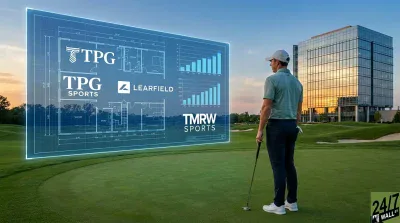
Rory McIlroy completed the rarest double in sports and finance this April. He defended his 2026 Masters title, cementing back-to-back majors and a career Grand Slam defense, while simultaneously closing a reported $2 billion acquisition of Learfield through TPG Sports. One week, two landmark achievements. The symmetry is deliberate.
McIlroy’s estimated net worth exceeds $330 million, built across three distinct phases that any serious wealth-builder can study. The blueprint is structured, patient, and increasingly institutional.
Phase 1: Accumulate Through Performance
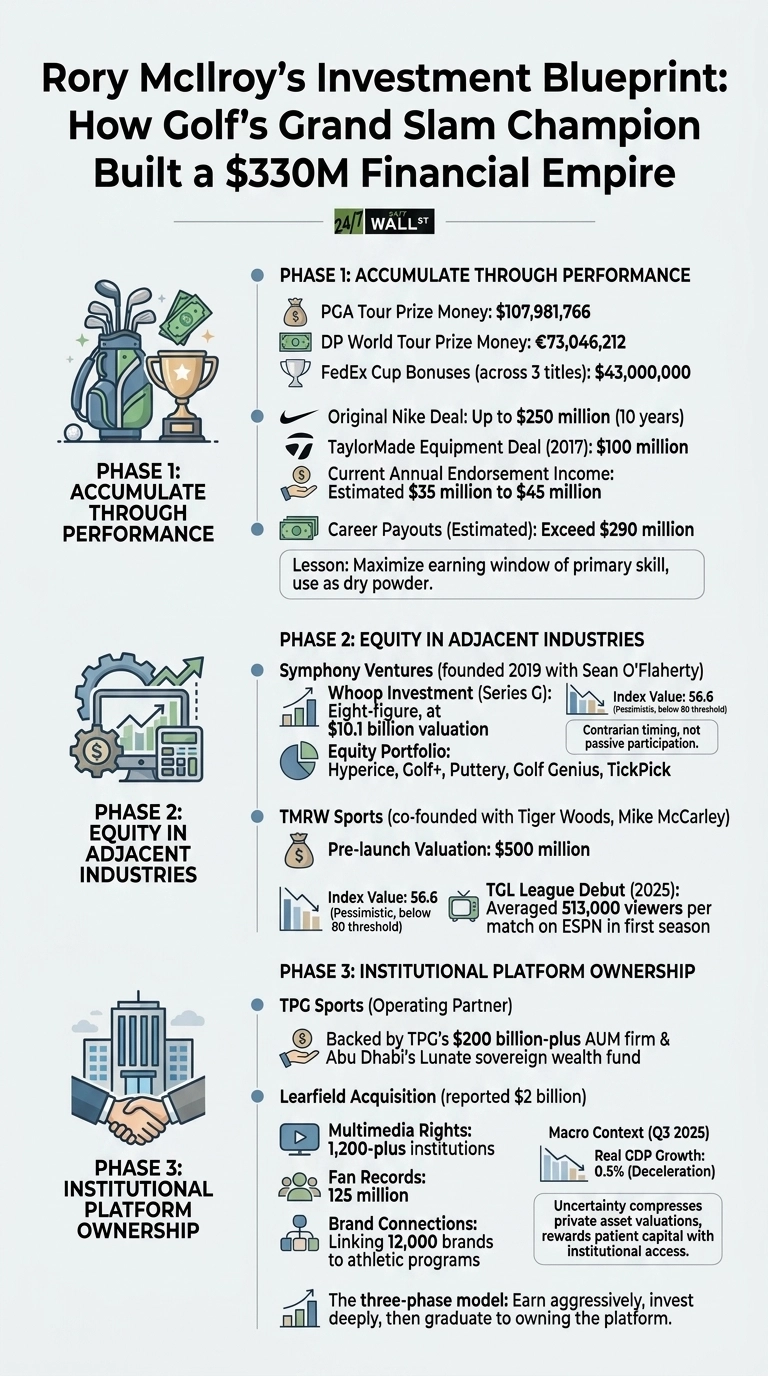
The foundation is prize money and endorsements, deployed at elite scale. McIlroy has earned $107,981,766 in PGA Tour prize money, €73,046,212 on the DP World Tour, and $43,000,000 in FedEx Cup bonuses across three titles. His original Nike deal reached up to $250 million over 10 years, followed by a $100 million TaylorMade equipment deal signed in 2017. Current endorsement income is estimated at $35 million to $45 million annually. Total estimated career payouts exceed $290 million.
The lesson: maximize the earning window of your primary skill, then use that capital as dry powder for everything that follows.
Phase 2: Equity in Adjacent Industries
In 2019, McIlroy founded Symphony Ventures with agent Sean O’Flaherty, targeting sports technology and golf infrastructure. The portfolio includes an eight-figure investment in Whoop’s Series G round at a $10.1 billion valuation, early equity in Hyperice, and positions in Golf+, Puttery, Golf Genius, and TickPick. These are consumer-facing bets made during a period when the University of Michigan Consumer Sentiment index sat at 56.6 as of February 2026, well below the neutral 80 threshold. Contrarian timing, not passive participation.
He also co-founded TMRW Sports with Tiger Woods and Mike McCarley, valued at $500 million pre-launch. The TGL league debuted in 2025 and averaged 513,000 viewers per match on ESPN in its first season.
Phase 3: Institutional Platform Ownership
This is where McIlroy separates himself from celebrity investors. As an Operating Partner at TPG (NASDAQ:TPG | TPG Price Prediction) Sports, backed by TPG’s $200 billion-plus AUM firm and anchored by Abu Dhabi’s Lunate sovereign wealth fund, he is building infrastructure. The Learfield acquisition gives the platform access to multimedia rights for 1,200-plus institutions, 125 million fan records, and connections linking 12,000 brands to athletic programs.
The macro backdrop supports the thesis. Real GDP growth decelerated to 0.5% in Q3 2025, creating the kind of uncertainty that compresses private asset valuations and rewards patient capital with institutional access. McIlroy has both.
The three-phase model is transferable in principle if not in scale: earn aggressively, invest in sectors you understand deeply, then graduate to owning the platform rather than just the equity.
Contact [email protected] for any questions or corrections.