Scott Galloway Says the SpaceX IPO Has ‘No Anchor.’ Here’s Why I Think He’s Wrong.
Scott Galloway has made a pointed case against the SpaceX IPO. His core argument deserves a fair hearing before I explain why I think he lands wrong. Galloway’s Case, Fairly Stated SpaceX’s valuation has run from roughly $350 billion in…


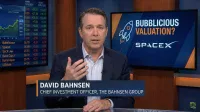
Scott Galloway has made a pointed case against the SpaceX IPO. His core argument deserves a fair hearing before I explain why I think he lands wrong.
Galloway’s Case, Fairly Stated
SpaceX’s valuation has run from roughly $350 billion in May 2025, to $800 billion in December 2025, to $1.25 trillion in February 2026, now targeting roughly $1.8 trillion at IPO. That’s roughly a 5x move in under a year. Drawing on NYU Stern’s Aswath Damodaran, Galloway argues that “investors have already decided they want SpaceX and are now working backwards to justify the price.”
Wall Street bankers have cycled through Boeing, AT&T, Palantir, GE Vernova, and Vertiv as peer candidates without landing on a clean comp. Galloway’s conclusion: “When bankers can’t find a peer, it usually means the valuation has no anchor, and this one doesn’t appear to have an anchor.”
He flags the 30% retail allocation as a signal of institutional skepticism, points to Saudi Aramco as a cautionary tale, and notes the empirical pattern of IPO underperformance over one to three years post-listing. These are real concerns. Valuation discipline matters. Founder worship is not an investment thesis.
Where I Think He’s Wrong
I’ve been studying category-defining businesses for over a decade, and the “no peer” problem Galloway identifies is actually the strongest argument for SpaceX’s uniqueness, not against its valuation.
Alphabet (NASDAQ:GOOGL | GOOGL Price Prediction) had no clean search peer at its IPO. Amazon (NASDAQ:AMZN) had no peer for its e-commerce-plus-cloud combination. Today, Alphabet carries a market cap of roughly $4.1 trillion and Amazon sits at roughly $2.7 trillion. Comp-table resistance turned out to be a feature of their structural uniqueness, not evidence of unanchored pricing.
SpaceX is three businesses stacked into one: dominant reusable heavy-lift launch, an operational global broadband constellation with paying subscribers in Starlink, and national security work through Starshield and DoD contracts. No single public company does all three. That’s why bankers cycled through comps. The sum of the parts doesn’t fit neatly into any existing column.
The valuation jumps tracked real operational milestones, not just sentiment. Starship development progress, Starlink reaching profitability inflection, and expanding government contracts drove each markup window. That’s different from pure narrative inflation.
On the Aramco comparison: Aramco was a slow-growth, politically controlled oil producer with limited optionality. SpaceX is a growth compounder with genuine platform optionality across launch, broadband, and national security. The businesses share a record-IPO headline and nothing else structurally.
Prediction markets currently put a 74.5% probability on IPO by June 30, 2026, with the consensus valuation range landing between $1.5 trillion and $2.5 trillion. That’s not irrational exuberance. That’s a market pricing a genuinely unique infrastructure business.
Galloway’s warning about discipline is worth hearing. His conclusion about SpaceX is too pessimistic. At $1.8 trillion, SpaceX is expensive. The question is whether SpaceX can grow into that price, and I think the answer is yes, with the absence of a clean comp being exactly why.
Contact [email protected] for any questions or corrections.
I've been writing about stocks and personal finance for 20+ years. I believe all great companies are tech companies in the long run, and I invest accordingly.