Can XRP or Cardano Catch Solana on the Way to $100?
Three names come up every time crypto investors debate the next big breakout: XRP (CRYPTO: XRP), Solana (CRYPTO: SOL), and Cardano (CRYPTO: ADA). All three have real-world use cases, and offer serious profit potential due to their wild price swings.…

This post may contain links from our sponsors and affiliates, and Flywheel Publishing may receive compensation for actions taken through them.

Three names come up every time crypto investors debate the next big breakout: XRP (CRYPTO: XRP), Solana (CRYPTO: SOL), and Cardano (CRYPTO: ADA). All three have real-world use cases, and offer serious profit potential due to their wild price swings.
But let’s be honest up front: this isn’t really a three-way race. Solana already trades near $87, so a $100 price is a short hop away. Meanwhile, XRP and Cardano are nowhere close, and both would need to multiply many times over and reach market caps in the trillions.
Instead, we’re using Solana as the benchmark here. It reflects what a coin actually near $100 looks like, and that’s the yardstick we hold XRP and Cardano against to see how far they really have to go. To work it out, we looked at the coin prices, trading volume, market structure, and what’s happening on-chain right now.
XRP’s Supply Structure and the Challenge Of Reaching $100

For XRP to reach $100, its market cap would need to hit roughly $6.09 trillion, based on the current circulating supply of 60.9 billion tokens. Right now XRP trades around $1.37. And despite the recent dip, it’s not all bad news—trading volume is up 67%, which points to traders repositioning rather than walking away from the asset.
Ripple’s CTO Emeritus, David Schwartz, said plainly that anyone promising $100 is “not telling the truth.” His reasoning is that if investors genuinely believed XRP had even a 10% shot at $100 in the next few years, they’d be buying aggressively at today’s price, not selling. The fact that they’re not tells you how few people actually hold that belief with real money behind it.
However, the deeper problem is XRP’s legal status. Almost every big XRP move has come from a legal or regulatory event, not from network growth or transaction volume. So, that has to change for Ripple’s wins to actually push the token price.
XRP has real utility, growing ETF adoption, and institutional backing, but hitting $100 needs more than bullish momentum—its entire supply structure has to work in its favor.
Solana: The Benchmark That’s Already Within Reach
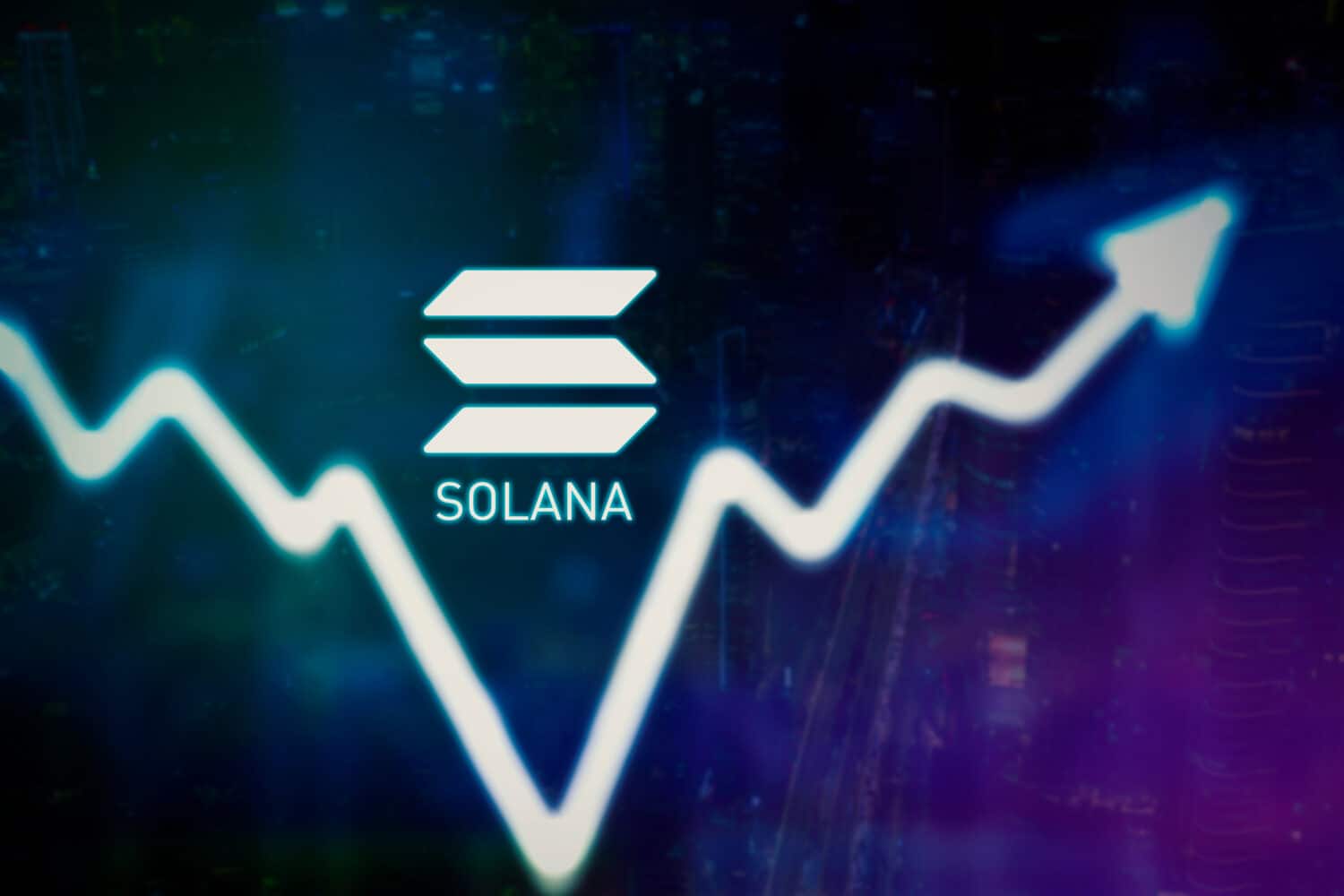
We all know there’s no way XRP or Cardano can catch up to Solana in a race to reach a hundred dollars. That’s not the argument here, instead, we used Solana as a benchmark because it shows what a coin genuinely close to $100 looks like.
SOL trades around $86.70, down roughly 30% from where it started the year and about 70% below its all-time high of $293. The Solaprice has underperformed, but $100 is only a short move from its current price—and there are real upgrades close to mainnet that could see it hit that milestone quickly.
Firedancer is already live on mainnet and running on more than 20% of Solana’s active validators, with adoption expected to keep climbing through 2026. The more validators run it, the smaller the risk that a bug in a single client takes down the whole network. And that’s the moment institutional compliance teams stop seeing Solana’s reliability as a risk and start seeing it as a feature.
Then there’s Alpenglow. The upgrade entered its community test cluster on May 11 and replaces Solana’s current consensus system with a design that cuts transaction finality from 12.8 seconds to about 150 milliseconds—roughly an 85x improvement. At Consensus Miami 2026, co-founder Anatoly Yakovenko said mainnet could arrive “next quarter” if testing keeps going smoothly.
Cardano’s Ecosystem Expansion And Its Long-Term Price Potential
Cardano has been hovering around $0.25 for the past few days, down a fraction over the past 24 hours. A lot of investors believe ADA will hit $100, but its supply is about 35 billion coins—so $100 would mean a $3.5 trillion market cap, bigger than most of the world’s largest tech companies.
In March 2026, Cardano’s DeFi total value locked passed $450 million, a 300% jump from a year earlier. That kind of growth rarely shows up in the price straight away, but it lays the groundwork.
Cardano’s main drivers are still the rollout of Plutus V3, which improves smart contract functionality, and the CIP-1694 governance model—both of which keep drawing long-term ecosystem interest. The Leios upgrade and Midnight sidechain are in the pipeline too.
Cardano is building slowly and deliberately, so its recovery depends on ADA reclaiming the $0.30 to $0.35 resistance zone.
So What Does this Mean For XRP And Cardano?
Of the three cryptos, Solana is the only coin in which a $100 price is an active conversation, not a distant dream—it’s only about 15% away at today’s price near $87. Several analysts see it hitting $100 by mid-2026, with December forecasts ranging between $150 and $200.
XRP needs a 7,200% gain to hit $100, along with a $6.09 trillion market cap, while Cardano needs to climb more than 400 times over to a $3.5 trillion market cap. Most analysts treat both as extremely long-term targets, with 2035–2040 the earliest realistic window for XRP. That’s over a decade away, under the best conditions.
Our Take
If you’re after which of the three coins reaches $100 first, it’s Solana, and it’s not even close—possibly even before the second half of the year.
That said, the real lesson is what Solana reveals about the other two. XRP and Cardano are long-game bets, measured in years of structural change that hasn’t happened yet. So the smart move is to treat their low prices for what they are: low cost cryptos, with room for growth. So, what to check is how high they can realistically go if you’re holding any of them for the long-term.
Contact [email protected] for any questions or corrections.
Sam Daodu is a crypto analyst who's spent nearly a decade making blockchain understandable—no easy task when most whitepapers read like fever dreams. He writes for 24/7 Wall St., covering Bitcoin, altcoins, and crypto market analysis for investors. Before crypto, he was a tech writer (back when explaining "the cloud" was peak innovation). Since 2018, he's written for CoinTelegraph, Yahoo Finance, The Block, Cryptonews, Zypto, Rain, and more—basically anywhere people want crypto news without the headache. Sam runs MacLabs Marketing, a content agency for crypto brands tired of sounding like AI wrote their website. He also publishes free crypto education on his site for Web3 enthusiasts who think "gas fees" is a typo. When he's not writing or staring at charts, Sam's either: - Watching anime (currently convinced One Piece has better tokenomics than most altcoins) - At the gym sculpting himself into a Greek god - Listening to the music your mum warned you only bad boys listen to Connect: LinkedIn | Email | MacLabs Marketing