Did SpaceX’s $28.5 Trillion Bombshell Reveal Elon Musk’s Genius — or Peak Galaxy Brain?
The stock market has spent the past year rewarding companies tied to artificial intelligence, data centers, and energy infrastructure. Yet all of those themes may soon take a back seat to a single IPO. On June 12, SpaceX is expected…

The stock market has spent the past year rewarding companies tied to artificial intelligence, data centers, and energy infrastructure. Yet all of those themes may soon take a back seat to a single IPO. On June 12, SpaceX is expected to begin trading publicly in what many investors believe could become the largest IPO in history. And after the company filed its S-1 registration statement with the SEC, one number immediately stood out: a claimed total addressable market (TAM) of $28.5 trillion.
That is not a typo. The figure is larger than the inflation-adjusted size of the entire U.S. economy, which the Bureau of Economic Analysis estimates at roughly $24.17 trillion in real GDP terms.
So, is this Elon Musk’s “galaxy brain” moment — visionary thinking few others can comprehend — or a wildly ambitious extrapolation that borders on science fiction?
A $28.5 Trillion Market Is Almost Impossible to Comprehend
According to the S-1 filing, SpaceX sees its opportunity stretching across launch services, satellite internet, defense, global communications, Earth observation, lunar infrastructure, and eventually interplanetary transportation. The filing argues that humanity’s long-term economic expansion into space could create a market worth tens of trillions of dollars.
Here’s what makes the figure so staggering:
| Market or Economy | Estimated Value |
| SpaceX TAM | $28.5 trillion |
| U.S. real GDP | $24.17 trillion |
| Global semiconductor industry | $975 billion |
| Global commercial aviation market | $283 billion |
| Global launch industry today | Under $20 billion |
The contrast matters. Even Nvidia (NASDAQ:NVDA | TSLA Price Prediction), now worth over $5.2 trillion, built its empire serving a market that already existed. SpaceX is attempting to value markets that largely do not.
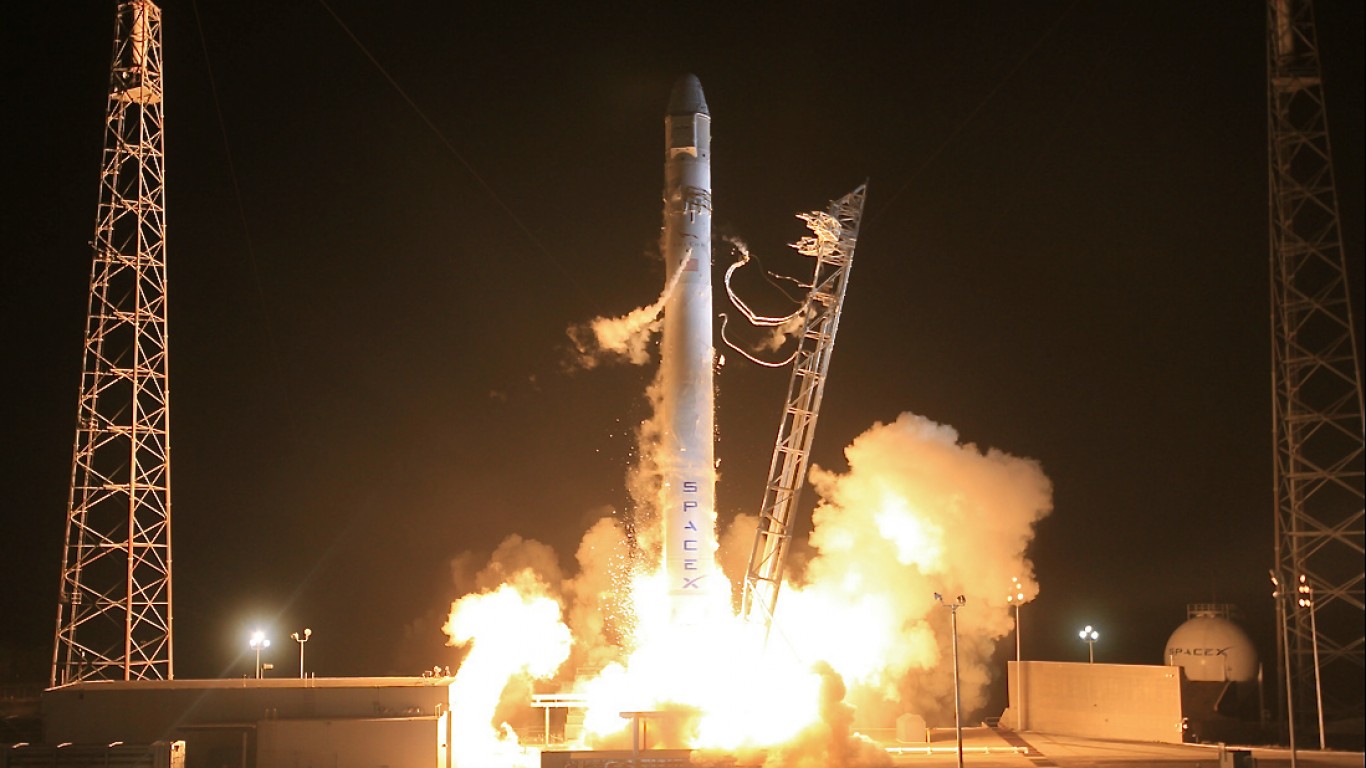
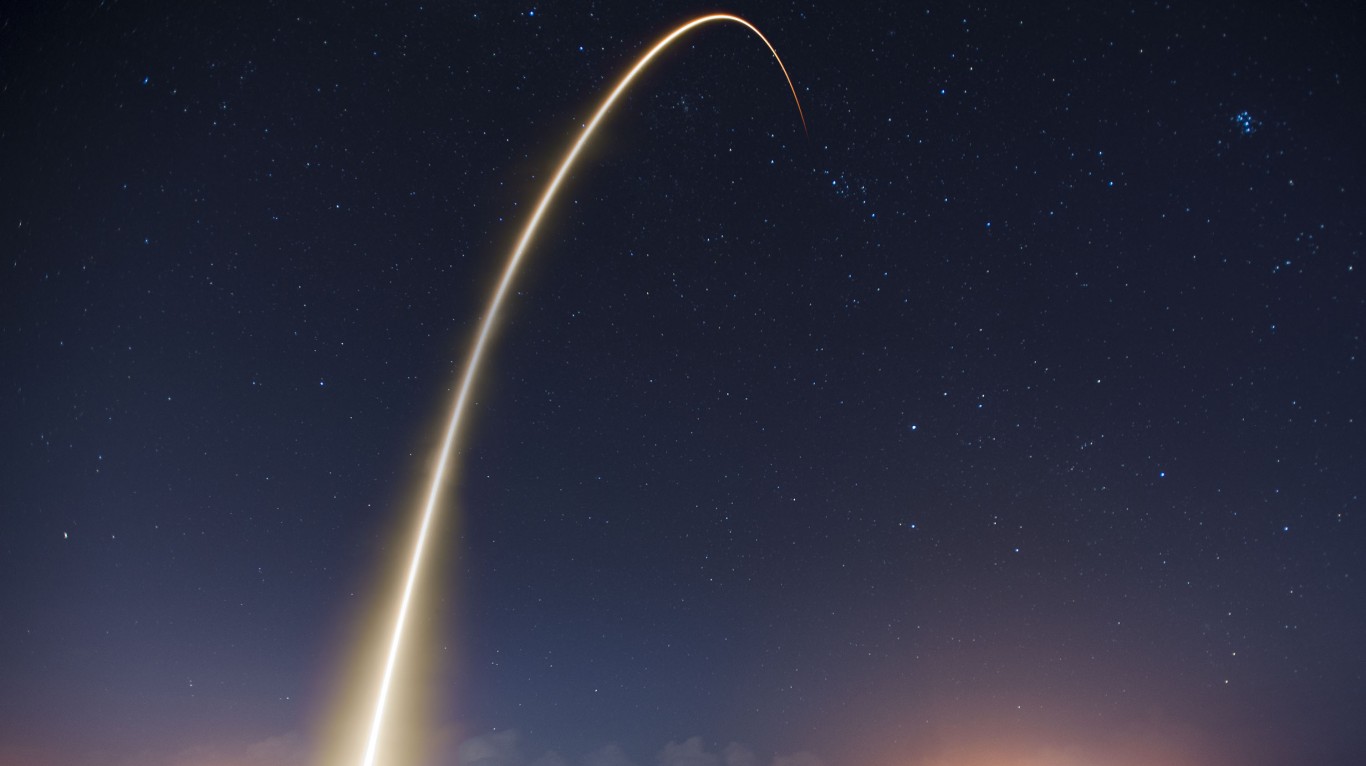
Granted, Musk has earned the right to make investors pause before dismissing him. Fifteen years ago, reusable rockets sounded absurd. Today, SpaceX routinely lands Falcon 9 boosters and even catches massive Starship rocket stages in midair using mechanical arms — something that looked more like science fiction than industrial engineering.
That said, the leap from reusable rockets to a $28.5 trillion economy requires assumptions stacked on assumptions.
The Entire Thesis Depends on Technologies That Barely Exist
Let’s break down what SpaceX is really asking investors to believe.
First, Starlink must evolve from a fast-growing satellite internet service into a dominant global communications platform. The company disclosed in its filing that Starlink has 10.3 million subscribers across 164 countries. That is impressive growth, but telecom remains fiercely competitive and capital intensive.
Second, Starship must become commercially viable. The rocket is still in testing, and several launches have ended explosively. Yet SpaceX’s TAM calculations appear heavily dependent on dramatically reducing launch costs to unlock new industries.
Third, governments and corporations must actually spend meaningful money in orbit and beyond it. Space manufacturing, lunar mining, orbital data centers, and Mars colonization remain speculative businesses with limited current demand.
In short, the $28.5 trillion figure is less a forecast and more a roadmap of what Musk believes civilization itself could become.
Surprisingly, that may not be entirely irrational.
Betting Against Musk Has Been Expensive
Many investors dismissed Tesla (NASDAQ:TSLA) when Musk argued electric vehicles would dominate transportation. In 2010, Tesla generated just $117 million in annual revenue. By 2025, total revenue exceeded $94.8 billion. Similarly, NASA once relied heavily on expensive government contractors. Today, SpaceX launches more payload mass into orbit annually than most nations combined.
No matter how you look at it, Musk has repeatedly commercialized technologies critics considered unrealistic.
The key question for investors is timing. A $28.5 trillion TAM only matters if the company can monetize even a small fraction of it within a reasonable investment horizon. Amazon (NASDAQ:AMZN) built cloud computing into a profit machine within a decade. Colonizing Mars could take generations — and SpaceX warns the effort may never be profitable.
Key Takeaway
SpaceX’s IPO filing reveals something larger than a space company. It reveals Elon Musk’s belief that humanity’s economic future will eventually extend beyond Earth itself. That may sound outrageous. It may also prove partially correct.
Smart investors should recognize both realities at once. The $28.5 trillion TAM is built on speculative assumptions, unproven technologies, and markets that barely exist today. But when all is said and done, Musk has a history of turning improbable ideas into functioning businesses before competitors even understand the opportunity.
The June 12 IPO will not simply test investor appetite for another growth stock. It will test whether Wall Street is willing to fund one of the boldest economic visions ever placed in an SEC filing.
Contact [email protected] for any questions or corrections.
After two decades of patrolling the dark corners of suburbia as a police officer, Rich Duprey hung up his badge and gun to begin writing full time about stocks and investing. For the past 20 years, he’s been cruising the markets looking for companies to lock up as long-term holdings in a portfolio while writing extensively on the broad sectors of consumer goods, technology, and industrials. Because his experience isn’t from the typical financial analyst track, Rich is able to break down complex topics into understandable and useful action points for the average investor. His writings have appeared on The Motley Fool, InvestorPlace, Yahoo! Finance, Money Morning, and, of course, 24/7 Wall St. He has been featured in both U.S. and international publications, including MarketWatch, Financial Times, Forbes, Fast Company, and USA Today.