Amazon vs. Microsoft: Which Cloud Stock Wins for Patient Investors?
If you’re a patient, retirement-focused investor weighing Amazon (NASDAQ:AMZN | AMZN Price Prediction) against Microsoft (NASDAQ:MSFT), the question is straightforward: Which mega-cap cloud stock deserves a core slot in a long-duration portfolio right now? Both run the world’s two largest…

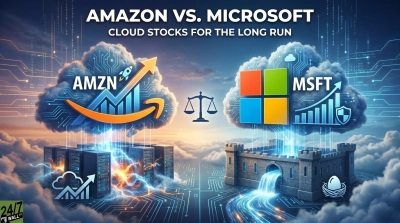
If you’re a patient, retirement-focused investor weighing Amazon (NASDAQ:AMZN | AMZN Price Prediction) against Microsoft (NASDAQ:MSFT), the question is straightforward: Which mega-cap cloud stock deserves a core slot in a long-duration portfolio right now? Both run the world’s two largest public clouds.
Both are pouring tens of billions into AI infrastructure. But only one is built for the retirement investor’s mandate of income, quality, and capital preservation. Here’s the verdict across three dimensions that actually matter.
Dimension 1: On Income and Capital Returns, Microsoft Wins
This is the cleanest call in the comparison. Microsoft pays a dividend with a yield of 1% and a per-share payout of $3.56, with the next dividend date set for June 11. In Q2 FY26 alone, Microsoft returned $12.7 billion to shareholders via dividends and buybacks, up 32% year over year, split between $7.42 billion in repurchases and $6.76 billion in dividends.
Amazon returns capital differently: it pays no dividend and runs no formal buyback cadence. For an investor drawing income or compounding dividends in a tax-advantaged account, that’s a structural deficit no amount of growth narrative can fix.
Dimension 2: On Growth Trajectory, Amazon Has an Edge
Here Amazon flexes. AWS revenue hit $37.6 billion in Q1, growing 28%, its fastest pace in 15 quarters, with operating margin holding at 38%. Total Q1 26 revenue reached $181.52 billion, up 17% YoY, and EPS of $2.78 came in well ahead of the $1.73 consensus, beating expectations. CEO Andy Jassy noted AWS is landing “landmark compute commitments from OpenAI, Anthropic, and Meta”, including up to 5 GW of Trainium capacity for Anthropic.
Microsoft’s Azure grew 40% and its AI run rate hit $37 billion, up 123% YoY, but Azure doesn’t disclose standalone revenue. Amazon’s slot win comes from absolute scale plus reacceleration: total revenue is $181.5 billion vs. Microsoft’s $82.9 billion, and AWS is reclaiming share. If your only metric is “which cloud is reaccelerating from a bigger base,” Amazon takes it.
Contact [email protected] for any questions or corrections.
Joel South covers large-cap stocks, dividend investing, and major market trends, with a focus on earnings analysis, valuation, and turning complex data into actionable insights for investors.
He brings more than 15 years of experience as an investor and financial journalist, including 12 years at The Motley Fool, where he served as an investment analyst, Bureau Chief, and later led the Fool.com investing news desk. He has also co-hosted an investing podcast and appeared across TV and radio discussing market trends.