3 Oil Pipeline Stocks Paying You to Wait in June
Energy markets have been anything but calm this spring. WTI crude swung from a 12-month low of $55.44 in December 2025 to a peak of $114.58 on April 7, 2026, before settling around $95 per barrel in early June. Henry…


Energy markets have been anything but calm this spring. WTI crude swung from a 12-month low of $55.44 in December 2025 to a peak of $114.58 on April 7, 2026, before settling around $95 per barrel in early June. Henry Hub natural gas briefly spiked to $30.72/MMBtu on January 23, 2026 during a winter weather event before normalizing back into the $2.60 to $3.35 range.
That kind of whipsaw is exactly why fee-based midstream operators look attractive right now. They get paid on volumes, not barrels’ worth. With the EIA forecasting U.S. marketed natural gas production climbing to 121.8 Bcf/d in 2026 and 126.8 Bcf/d in 2027 and LNG exports averaging 17.0 Bcf/d this year, throughput growth is structural.
Three midstream names stand out for investors who want to collect distributions while that volume story plays out.
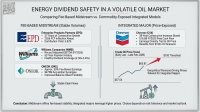
Energy Transfer
Energy Transfer (NYSE:ET | ET Price Prediction) trades at $19.04 with a market cap around $65.6 billion. The quarterly distribution rose to 33 cents per unit for the May payment, putting the annualized rate at $1.35 and the trailing yield near 7%. Units have returned more than 15% year to date on top of that payout.
The bull case is operational momentum. Q1 2026 adjusted EBITDA rose 20% year over year to $4.94 billion, distributable cash flow climbed to $2.70 billion versus $2.31 billion, and management raised FY2026 adjusted EBITDA guidance to $18.2 billion to $18.6 billion. NGL exports were up 19%, terminal volumes up 19%, and crude transport up 8%. Growth CapEx of $5.5 billion to $5.9 billion funds Mustang Draw I (June 2026 in-service), the Springerville Lateral for AI/data center demand and a Bayou Bridge expansion. The stock’s forward P/E sits at 12.
The caveat: ET is an MLP, so unitholders receive a K-1 tax form rather than a 1099. Interest expense also climbed to $947 million from $809 million a year earlier and Q1 EPS of $0.35 missed the $0.38 consensus.

ONEOK
ONEOK (NYSE:OKE) is the C-corp option in the group, which matters for IRAs and tax-sensitive accounts. Shares trade at $91.11, up nearly 23% year to date, with a yield near 5% on the $1.07 quarterly dividend (annualized $4.28) raised in January. The dividend has stepped up from 99 cents in 2024 to $1.03 in 2025 to $1.07 in 2026.
Roughly 90% of 2025 earnings were fee-based, insulating ONEOK from commodity swings. FY2025 adjusted EBITDA grew 18% to $8.02 billion, and 2026 guidance calls for adjusted EBITDA of $7.9 billion to $8.3 billion and diluted EPS of $5.04 to $5.87. CEO Pierce Norton flagged the company “delivered another year of double-digit earnings growth in 2025.” The Eiger Express Pipeline expansion to 3.7 Bcf/d is fully subscribed, and management has a $2 billion buyback authorization alongside $150 million of incremental EnLink/Medallion synergies expected this year.
The caveat: 2026 guidance assumes WTI in the $55 to $60 range, and management has flagged moderating producer activity. CapEx is also stepping up to $2.7 billion to $3.2 billion.

Enterprise Products Partners
Enterprise Products Partners (NYSE:EPD) is the pedigree pick. The quarterly distribution moved to 55 cents per unit in Q1 2026, the 27th consecutive year of distribution growth, putting the annualized payout at $2.20 and the yield near 6% at the current $37.87 price. Units are up nearly 17% over the past year.
Q1 2026 set 12 new operational records, including NGL fractionation up 16% year over year to 1.9 MMBPD and marine terminal volumes of 2.3 MMBPD. Adjusted EBITDA rose 10% to $2.69 billion, and DCF reached $2.7 billion (including a $600 million Bahia final payment from ExxonMobil). Enterprise has $5.3 billion of major growth projects under construction, just announced two new 300 MMcf/d Permian processing plants for 2027, and has used 31% of its $5.0 billion buyback program. Forward P/E is 13.
The caveat: Q1 revenue fell 7% year over year on weaker NGL prices (57 cents per gallon versus 67 cents), and EPD also issues a K-1.

What to watch next
The setup into the back half of 2026 favors operators that get paid on flow. EIA expects Brent to fade to $89 per barrel in Q4 2026 and $79 in 2027 as Middle East supply normalizes, which would pressure pure commodity names while leaving fee-based midstream cash flows largely intact. The catalysts to track are Mustang Draw I starting up at Energy Transfer, Eiger Express ramp at ONEOK, and the Permian plant build-out at Enterprise. The distributions keep arriving while those projects move from capex to cash flow.
Contact [email protected] for any questions or corrections.
Joel South covers large-cap stocks, dividend investing, and major market trends, with a focus on earnings analysis, valuation, and turning complex data into actionable insights for investors.
He brings more than 15 years of experience as an investor and financial journalist, including 12 years at The Motley Fool, where he served as an investment analyst, Bureau Chief, and later led the Fool.com investing news desk. He has also co-hosted an investing podcast and appeared across TV and radio discussing market trends.