Broadcom’s The Perfect Buy as Capex Fears Materialize
Every time hyperscalers signal tighter AI budgets, one chipmaker's order book quietly grows. The reason has everything to do with who actually benefits when the industry is forced to spend less.

I keep buying Broadcom because it is the one AI stock where the arithmetic of the boom lands directly on my brokerage statement without asking me to pray for a moonshot. Every time hyperscalers whisper about tightening capex, I add more. That sounds contrarian, but it is the whole point of the thesis.
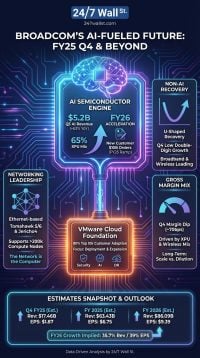
Here is what I keep coming back to. When Google, Meta, OpenAI, and Anthropic feel Wall Street pressure to justify AI spend, the response is cheaper compute per token. Custom ASICs give them significantly better energy efficiency and lower total cost of ownership than general-purpose GPUs, and Broadcom (NASDAQ:AVGO | AVGO Price Prediction) holds over 60% of the high-end custom AI silicon market. Capex fear is a tailwind for the ASIC supplier, not a headwind.
The Receipts Behind the Conviction
Q2 FY2026 revenue hit $22.187 billion, up 47.9% year over year. AI semiconductor revenue alone reached $10.80 billion, up 143%. Hock Tan then guided Q3 AI revenue to $16 billion, up over 200% year on year, on total revenue of $29.4 billion. That is the trajectory of a company racing to fill an order book. Q2 AI bookings were over $30 billion against the $10.8 billion we shipped.
The second thing that keeps me buying is the cash. Free cash flow in Q2 was $10.262 billion, or 46% of revenue, on capex of just $231 million. Adjusted EBITDA margin sits at 69%. Broadcom sells the picks and shovels without having to fund the gold rush.
The third piece is the income compound. The dividend of $0.65 per share quarterly reflects the 15th consecutive annual dividend increase since fiscal 2011, and management is running a $10 billion buyback authorized through December 31, 2026. EPS has climbed for 8 consecutive quarters, from $1.24 to $2.44.
Why Not NVIDIA or AMD
NVIDIA (NASDAQ:NVDA) is the obvious pick, and I own some. I keep sending new dollars to Broadcom instead because the dividend yield on NVIDIA is 0.02% on a per-share payout of $0.04. For a retirement-focused position, that is a rounding error. AMD (NASDAQ:AMD) is the other name investors reach for, and its trailing P/E is 175x with no dividend. Broadcom trades at a forward P/E of 20x with a PEG of 0.429 and a 1.462 beta. Cheaper forward multiple, real dividend growth, lower volatility. That is the trade I keep making.

The Risk I Will Not Wave Away
Customer concentration is real. A handful of hyperscalers, Google, Meta, OpenAI, Anthropic, drive the AI order book. If any one of them pulls a program, the growth curve bends. What keeps me buying anyway: contractual commitments include 1.3 gigawatts in 2027 as part of the larger 10-gigawatt by 2029 agreement with OpenAI, 5 gigawatts of next-generation TPU-based compute beginning in 2027 for Anthropic, and a Meta partnership to deploy 3 gigawatts through the end of 2028. Add the $200 billion Samsung manufacturing partnership through 2030, and diversification is arriving faster than the concentration risk is compounding.
Why the Buy Button Stays Active
Tan has told investors AI revenue will exceed $100 billion in 2027, and the current shipment pace makes that number look conservative rather than aspirational. Analyst consensus target sits at $525.44 against a current price of $381.92, with 44 Buy ratings and zero Sells. I own the supplier the entire AI cost-optimization argument runs through, and I plan to keep owning more of it every time the market gets nervous about capex.
Contact [email protected] for any questions or corrections.
Alex Sirois is a financial writer with experience spanning both retail and institutional investing. He has written for InvestorPlace and held roles at BNY Mellon and Bernstein, giving him a perspective that bridges Main Street portfolios and Wall Street analysis.
Alex holds an MBA from George Washington University and has built his career across multiple industries, including e-commerce, education, and translation — a breadth of experience that informs how he breaks down complex financial topics for everyday investors. His writing is conversational, actionable, and grounded in long-term, buy-and-hold investing principles.
At 247 Wall St., Alex focuses on delivering analysis that is both accessible and useful, with a clear emphasis on helping readers make more informed decisions with their money.