Microsoft Posts Record Revenue as Cloud Services Cross $100 Billion. Here’s Our New Price Target
Microsoft just delivered a record-breaking quarter with Azure crossing a massive milestone, yet shares are down nearly 19% this year. Here is what the numbers reveal about whether a bold 2027 price target is within reach.

This post may contain links from our sponsors and affiliates, and Flywheel Publishing may receive compensation for actions taken through them.
Microsoft (NASDAQ:MSFT | MSFT Price Prediction) just posted the kind of quarter that should have launched shares higher. Revenue of $90.01 billion grew 17.75%, Azure grew 43%, and full-year Azure revenue crossed $100 billion for the first time.
Yet MSFT is down 18.89% year to date. The disconnect is the story. So here is the question I want to answer: can Microsoft shares reach $625 in 2027?

Why Microsoft Shares Are Stuck Despite a Blowout Quarter
Shares are down 23.2% over the last year and essentially flat on the week at 0.05%. The one-month move of 5.96% hints at a bottoming process, but the year has been ugly.
The reason is the capex bill. Q4 capital expenditures hit $35.80 billion, up 109.63% year over year, and full-year capex reached $115.95 billion. Free cash flow fell 23.19% in the quarter. That is why the market pulled back even after five straight EPS beats. With a beta of 1.13, MSFT amplifies any macro doubt about AI spending returns.
Wall Street Sees Big Upside. I Think They Are Still Too Cautious
The consensus target sits at $557.25, with 13 strong buys, 41 buys, 3 holds, and zero sells. That is 95% bullish.
Citi raised the firm’s price target on Microsoft to $600 from $570 and keeps a buy rating on the shares while Piper Sandler raised the firm’s price target to $550 from $540 and keeps an Overweight rating. Our own model lands at a base case of $514.42, or 31.72% upside, with a bull case of $601.33 and confidence at 90%. Here is where I push back.
Analysts are backing into a target using a modest multiple and ignoring the operating leverage inside Azure. Earnings grew 23.4% year over year. When capex normalizes, that earnings power flows straight to the multiple.

The Path to $625 Per Share
Reaching $625 from today’s price of $390.54 would require a gain of 60%. With forward EPS of $20.16, a price of $625 implies a forward P/E of 31x. Our base case of $514.42 already implies 23x, meaning the bold target requires 8x of additional multiple expansion.
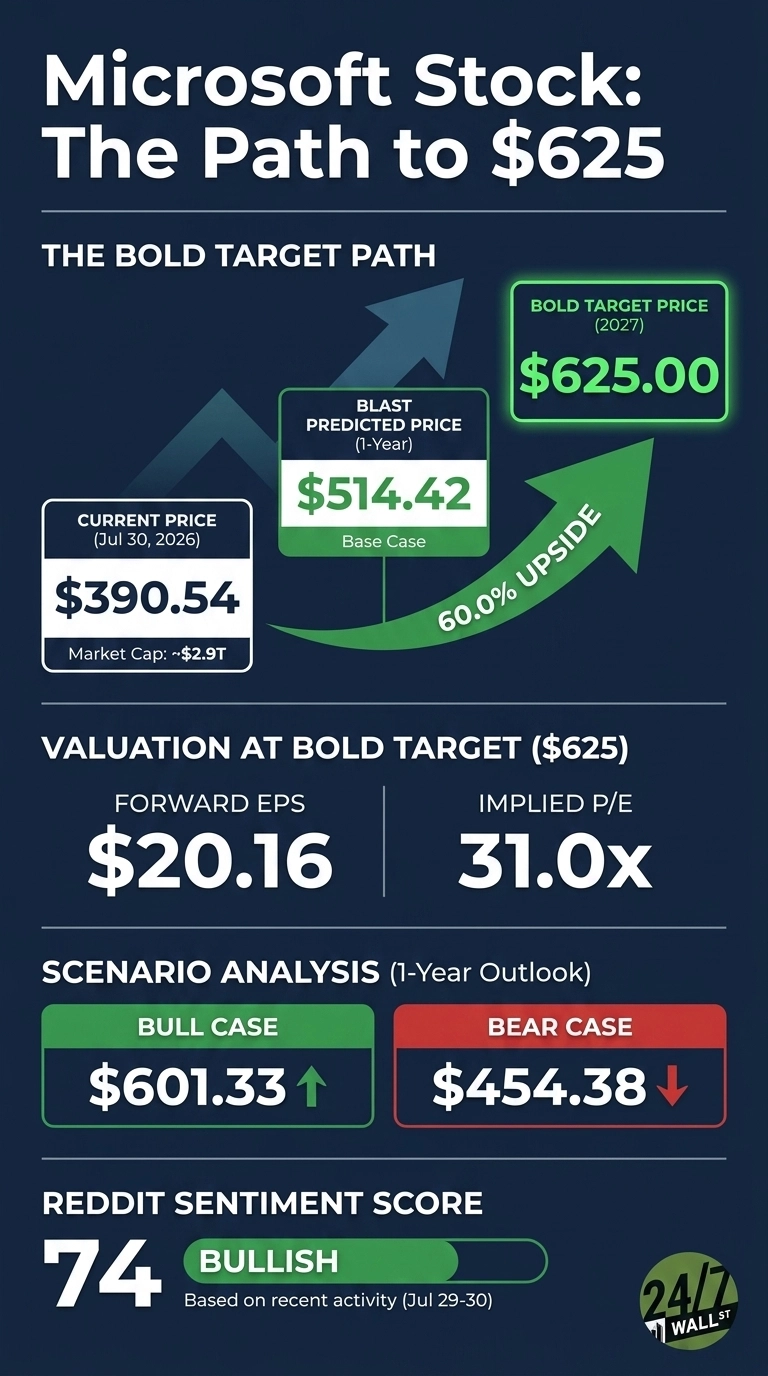
Is that achievable? I think so, if a few things line up. The 1.149 adjustment factor in our model is driven by a 1.15 tech sector multiplier and that 95% bullish analyst consensus.
Commercial RPO surged 84% to $678 billion, which is contracted revenue waiting to convert. Microsoft 365 Copilot crossed 30 million paid seats.
As CEO Satya Nadella put it, “This year, Azure revenue surpassed $100 billion for the first time, and Microsoft 365 Copilot reached over 30 million paid seats, reflecting the confidence customers are placing in us to power their AI transformation.”
If EPS grows another 20%+ into fiscal 2027, the multiple compresses naturally even as the price climbs. The primary risk is that capex keeps outpacing free cash flow and pressures margins.
Where Microsoft Trades Today vs Its Earnings Power
At $390.54 against forward EPS of $20.16, MSFT trades at roughly 19x forward earnings. That is cheap for a company growing revenue 17.75% with a 46.3% operating margin.
Shares sit between a 52-week low of $349.20 and a high of $551.05. The 10-year return of 679.33% is a reminder that this business compounds through drawdowns. The valuation case is straightforward: you are paying a mid-teens growth multiple for accelerating AI revenue.

Is $625 Realistic? My Verdict
Reaching $625 requires a 60% gain, and I will admit that is a stretch inside 12 to 18 months. It is not a long shot either.
For it to happen, Azure needs to hold growth north of 35%, capex needs to plateau so free cash flow reaccelerates, and Copilot seat additions need to keep compounding.
What derails it is a broader AI capex unwind if enterprises pause spending. Returns at this level shouldn’t be expected every year, but we’ve outlined the blueprint for how Microsoft could reach $625 in 2027.
Contact [email protected] for any questions or corrections.
Vandita Jadeja is a financial publisher with over a decade of experience writing about financial topics, including investment, savings, retirement, insurance and banking. Vandita is a Chartered Accountant who loves to debunk financial concepts for readers.
Her work has appeared on sites that include The Motley Fool, InvestorPlace, and Benzinga. She covers investing and focuses on stock picks and price prediction for 24/7 Wall St.
When not looking for the next stock investment opportunity, she can be found traveling, reading, chasing sunsets and enjoying her iced latte.