Analyst Says Palantir’s 149% Growth Is a Glimpse of What’s Next for Elon Musk’s SpaceX
Palantir just posted numbers that a top Liontrust strategist calls proof that AI value is migrating up the stack, and she believes one private aerospace giant is about to force investors to rethink how they price a very different kind…

This post may contain links from our sponsors and affiliates, and Flywheel Publishing may receive compensation for actions taken through them.

Palantir’s Q2 earnings report gave AI-stack strategists a concrete data point to rally around. Palantir (NASDAQ:PLTR | PLTR Price Prediction) reported U.S. commercial revenue of $764 million, up 149% year over year, with total revenue of $1.935 billion growing 92.8% and a Rule of 40 score of 155%. For Clare Pleydell-Bouverie, Co-Head of the Global Innovation Team at Liontrust Asset Management, that number is the clearest evidence yet that value in the AI stack is climbing upward from the model labs into the software and data-organization layers, and she argues Elon Musk’s SpaceX is next in line to demonstrate the same dynamic.
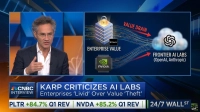
Speaking on CNBC on August 4, Pleydell-Bouverie framed Palantir as the archetype of the shift. “Enterprises are adopting Palantir as the full stack enterprise AI platform. We’re seeing a shift in value capture across the AI stack going upwards to that software application layer, to those very few companies that are actually converting tokens into revenue,” she said. CEO Alex Karp echoed the language on the earnings call, calling the quarter “otherworldly” and framing the results as validation of demand for “AI sovereignty.”

The Falling-Inference-Cost Thesis
Pleydell-Bouverie’s core argument rests on economics. As the cost of inference falls, the competitive moat of pure model providers narrows, and the surplus flows to whoever can package intelligence against proprietary data. “Open source models combined with Palantir’s data architecture and tools are now capable of frontier model performance. If you can ground your AI in your own proprietary data, that is significantly preferable to giving away your data to a third party model app,” she said.
Palantir’s Q2 disclosures support that framing. U.S. commercial TCV climbed 153% to $2.132 billion, remaining deal value reached $6.238 billion, and the company closed 220 deals of $1 million or more. Management then raised full-year 2026 revenue guidance to $8.150 billion to $8.158 billion, with U.S. commercial revenue guided in excess of $3.424 billion. The detail sits inside Palantir’s Q2 8-K press release filed with the SEC.
Software 2.0 and the 10% Cut
The Liontrust view is that legacy seat-based software vendors are structurally disadvantaged against AI-native platforms. “The chasm between legacy software companies, traditional seat based, versus software 2.0 companies, these AI first companies built on and for accelerated compute, is widening. Palantir is probably among the 10% of companies that are on the right side of this shift,” Pleydell-Bouverie said. Palantir’s 62% adjusted operating margin and $1.220 billion in free cash flow (up 130% year over year) illustrate what that right side looks like in P&L form.
The market has been more ambivalent about the multiple than the fundamentals. Shares trade at a $153.95 handle after jumping 22.52% on August 4, though the stock is still down 29.31% year to date. Prediction markets are leaning bullish into month-end: Polymarket assigns a 100% probability to PLTR touching $156 in August and 86.7% to touching $162.
Why SpaceX Is the Next Test Case
SpaceX (NASDAQ:SPCX) is where Pleydell-Bouverie extends the thesis. “With SpaceX, launch effectively lowers the cost of putting these satellites up in space. You’ve got AI that is turning compute into revenues, Cursor, which is now turning those compute revenues into high value software. It’s this interactivity that is going to be the investment case going forward,” she said. Anthropic and Google both ramped AI revenues with SpaceX in May and June, and the company’s early-2026 absorption of xAI folded Grok into a stack that now spans launch, Starlink connectivity, compute, and software.
Her contention: analysts underweight SpaceX because they price launch, connectivity, compute, and software as separate businesses instead of one flywheel. Prediction markets appear to share that ambivalence. Polymarket traders assign a 75% probability to SPCX hitting $125 in August and just 31.5% probability to a quarterly earnings beat, while shares sit at $118.33 after a 29.3% drawdown over the past month.
For Pleydell-Bouverie and Liontrust, the Palantir report is the tell. Interactivity across the stack, per her view, is what compounds. Whether SpaceX delivers a Palantir-scale U.S. commercial acceleration is the next question the stock will answer.
Contact [email protected] for any questions or corrections.
AJ spent 10 years writing about financial markets at The Motley Fool. His coverage centers on technology stocks and the broader macroeconomic trends, from interest rates to geopolitics, that shape where markets are headed next. AJ is drawn to the stories where big-picture economics and individual companies collide.