The 1 Number That Shows Why Palantir’s Critics Are Completely Wrong
Palantir has lost nearly 40% of its value as critics dismissed it as just another AI middleman, but one obscure software metric buried in its latest earnings report tells a strikingly different story about where this company actually stands.


The AI trade has become a proving ground rather than a promise. Over the past year, investors have stopped rewarding companies simply for talking about artificial intelligence and started demanding evidence that AI can generate lasting revenue, expanding margins, and real competitive advantages.
Few companies have felt that shift more than Palantir Technologies (NASDAQ:PLTR | PLTR Price Prediction). After climbing above $207 last year on expectations it would become one of the defining AI winners, the stock has fallen roughly 40% as critics increasingly dismissed it as little more than an “LLM wrapper.” Its second-quarter earnings released this morning, however, delivered a set of numbers that makes that criticism much harder to defend.
One Metric Changes the Entire Conversation
Let’s start with the number that matters most. Palantir generated a Rule of 40 score of 155%. In software, the Rule of 40 combines revenue growth with operating profit margin. Anything above 40% is considered the hallmark of a solid software business. Palantir didn’t merely clear that hurdle — it nearly quadrupled it.
Even more striking, the company’s progress has been remarkably consistent. Two years ago, Palantir posted a Rule of 40 score of 64%. Almost every quarter since then has seen the score rise. Last year it hit 94%, a figure CEO Alex Karp described at the time as “obliterating” the metric.
That climb is rare because software companies usually face a tradeoff. They can grow rapidly while sacrificing profitability, or they can maximize margins by slowing investment. Palantir is doing both simultaneously.
Karp says the company is on pace to deliver its first-ever $1 billion operating income quarter, only a year after producing its first $1 billion revenue quarter. Those milestones suggest operating leverage is accelerating rather than fading.
The Financial Results Back Up the Story
Critics have increasingly dismissed Palantir’s potential. Noted billionaire investor Michael Burry said recently that Palantir’s government business was its bread-and-butter, criticizing its enterprise business “low margin and small.”
If that were true, its financial performance would likely resemble many AI startups riding temporary demand. Instead, here’s what the latest numbers showed:
| Metric | Reported | Consensus |
| Revenue | $1.94 billion | $1.81 billion |
| EPS | $0.41 | $0.35 |
| U.S. Commercial Revenue | $764 million (+149%) | $716 million |
| U.S. Government Revenue | $809 million (+90%) | — |
| Remaining Deal Value | $6.2 billion (+124%) | — |
| Full-Year Revenue Guidance | $8.16 billion | $7.73 billion |
| Operating Income Guidance | $4.9 billion | $4.5 billion |
Yes, Palantir’s government business is still larger, but the commercial segment is growing so fast it may soon surpass it.
Surprisingly, the guidance increase may matter even more than the quarterly beat. Raising full-year revenue expectations to $8.16 billion and operating income guidance to $4.9 billion tells investors management expects today’s demand to continue instead of fading after one exceptional quarter.
These aren’t the numbers of customers experimenting with AI. They’re committing to larger deployments that extend well into the future.
Why Palantir’s Strategy Looks Different
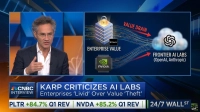
Karp has consistently argued that governments and enterprises need to own the model weights and infrastructure powering their AI applications instead of renting access to someone else’s closed platform. That philosophy separates Palantir from software companies that simply connect customers to third-party large language models.
If enterprises increasingly want AI systems that integrate proprietary data, security controls, and operational workflows, owning the underlying infrastructure becomes a competitive advantage rather than an unnecessary expense. The rapid expansion in Palantir’s commercial backlog suggests customers are buying into that vision.
Granted, the stock still trades at a premium valuation, leaving little room for execution mistakes. Investors should expect volatility whenever expectations become elevated.
Key Takeaway
In short, Palantir’s 155% Rule of 40 score may be the single strongest argument against the claim that it’s merely an AI wrapper. The company’s revenue growth is accelerating, margins continue expanding, commercial demand keeps building, and management felt confident enough to raise guidance across the board. Those are characteristics of a software platform deepening its competitive moat — not one riding a temporary AI wave.
Ultimately, smart investors should keep watching execution rather than headlines. If Palantir continues converting rapid growth into expanding profitability at anything close to its current pace, the recent pullback may prove to have been less a warning sign than an opportunity to buy a market leader while sentiment remains divided.
Contact [email protected] for any questions or corrections.
After two decades of patrolling the dark corners of suburbia as a police officer, Rich Duprey hung up his badge and gun to begin writing full time about stocks and investing. For the past 20 years, he’s been cruising the markets looking for companies to lock up as long-term holdings in a portfolio while writing extensively on the broad sectors of consumer goods, technology, and industrials. Because his experience isn’t from the typical financial analyst track, Rich is able to break down complex topics into understandable and useful action points for the average investor. His writings have appeared on The Motley Fool, InvestorPlace, Yahoo! Finance, Money Morning, and, of course, 24/7 Wall St. He has been featured in both U.S. and international publications, including MarketWatch, Financial Times, Forbes, Fast Company, and USA Today.